

























Automatic Welder: How Automation Is Transforming Modern Welding

Automatic Welder: How Automation Is Transforming Modern Welding
Welding has always been a craft — and in many shops, it still is. But across the manufacturing world, a quiet revolution is underway. An automatic welder takes the repetitive, precision-critical parts of welding and hands them to machines that never tire, never rush, and never have an off day. The result is not the replacement of skilled welders, but their liberation: operators move from performing every weld by hand to supervising, programming, and quality-checking work that is faster, more consistent, and more profitable. Heron is at the center of this shift, building automatic welding systems that factories rely on every day.
What an Automatic Welder Actually Does
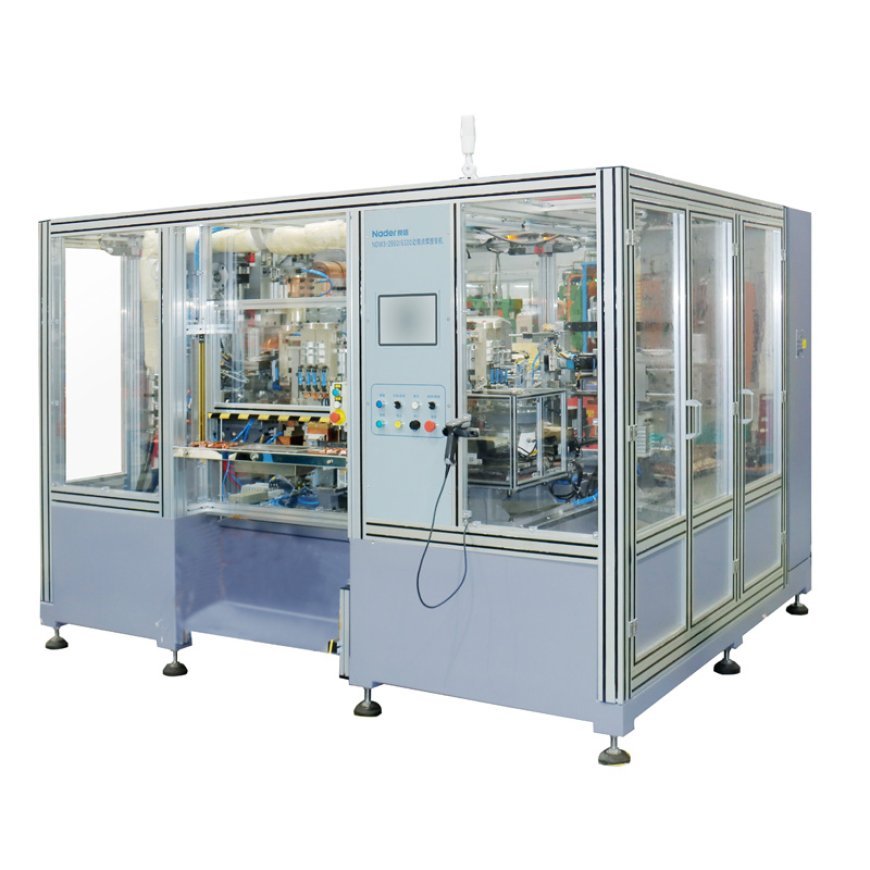
An automatic welder performs welding operations with minimal human intervention once it is set up. Depending on the system, that can mean a machine that moves the workpiece past a fixed welding head, a gantry that travels along a seam, a rotary table that presents parts to the gun, or a fully robotic arm that follows a programmed path. The operator's role shifts from holding the torch to loading parts, selecting programs, and monitoring quality.
The benefits begin with consistency. A human welder, no matter how skilled, varies slightly from weld to weld — travel speed, torch angle, and timing all drift across a long shift. An automatic welder repeats the same motion, the same speed, and the same parameters on every single part. That consistency shows up directly in quality data: fewer defects, less rework, and welds that meet specification the first time.
Speed is the second major gain. Automatic systems weld continuously, without the pauses for repositioning, rest, and setup that manual welding requires. On high-volume parts, an automatic welder can easily double or triple throughput compared to manual methods, while using the same floor space and often the same power supply.
Where Automatic Welding Pays Off Fastest
The fastest returns come from repetitive, high-volume work. If your shop welds the same joint hundreds or thousands of times a week, automation is almost certainly profitable. Automotive components, appliance panels, storage tanks, frames, and structural assemblies all fall into this category — parts where the weld pattern is fixed and the volume justifies the investment.
Automatic welding also shines on long, straight seams. A longitudinal seam welder or a seam-welding gantry produces a continuous, uniform weld along meters of joint without stopping — work that is exhausting and error-prone by hand. Heron's automatic systems include seam welders designed for exactly this application, delivering leak-tight, cosmetically clean seams on tanks, ducts, and vessels.
The Components That Make It Work
A complete automatic welding system is more than a welding power source. It combines a motion system that positions the gun or the part, a controller that coordinates motion with weld parameters, a fixture that holds parts accurately, and a welding head matched to the process — resistance, MIG, TIG, or seam welding.
The controller is the brain of the system. Modern Heron controllers store dozens of weld programs, each with its own current, time, force, and motion profile. Switching from one part to another is as simple as selecting a program, which slashes changeover time and eliminates setup errors. Quality monitoring is built in as well: the controller tracks every weld, flags deviations, and logs data that feeds directly into quality records.
Fixtures deserve special attention, because they decide whether automation actually delivers. A fixture that locates parts quickly and holds them firmly makes loading fast and welds consistent. A poorly designed fixture causes misalignment, wasted cycles, and operator frustration. Heron's engineers work with customers on fixture design as part of every automation project, because they know the fixture is where automation succeeds or fails.
What About Your Skilled Welders?
One of the most common worries about automation is that it will make skilled welders redundant. In practice, the opposite usually happens. Shops that automate find their welders becoming more valuable, not less: they become programmers, setup technicians, and quality specialists who manage several machines instead of one torch. Their knowledge of weld behavior, joint design, and defect causes becomes even more important when it is applied to programming and troubleshooting automated systems.
Planning Your Move to Automation
The smartest path to automation starts with one cell, not a whole factory. Pick a high-volume part with a stable design, automate that one process, and measure the results: throughput, defect rate, and cost per part. Heron's team helps customers run exactly this kind of pilot, with a system sized to the application and a clear business case before any major investment.
Conclusion
automatic welder technology is no longer a luxury reserved for giant factories — it is a practical, profitable tool for any shop with repetitive welding work. With consistency, speed, and quality that manual methods cannot match, automation pays for itself quickly and keeps paying for years. Heron builds the systems, the controllers, and the support that make the transition smooth.
#AutomaticWelder #HeronWelder #WeldingAutomation #Manufacturing #WeldingTechnology
What's Your Reaction?
 Like
0
Like
0
 Dislike
0
Dislike
0
 Love
0
Love
0
 Funny
0
Funny
0
 Angry
0
Angry
0
 Sad
0
Sad
0
 Wow
0
Wow
0