
























How to Prepare for MHT-CET Physics with a Smart Study Strategy

Preparing for the Maharashtra Common Entrance Test (MHT-CET) requires a clear understanding of Physics concepts, regular numerical practice, and effective time management. For students aiming to secure admission to engineering colleges, Physics is an important subject that can significantly influence their overall performance.
A well-organised preparation strategy helps students cover the syllabus, improve problem-solving speed, and develop confidence before the examination. Instead of relying only on memorisation, students should focus on understanding concepts and applying them accurately to different types of questions.
Understand the MHT-CET Physics Syllabus
The first step in preparation is understanding the Physics syllabus and identifying the important topics from Classes 11 and 12. Students should study the prescribed syllabus carefully and divide it into manageable sections.
Topics such as Mechanics, Thermodynamics, Electrostatics, Current Electricity, Magnetism, Optics, Modern Physics, and Oscillations require regular revision and practice. Creating a topic-wise checklist can help students track their progress and ensure that important chapters are not overlooked.
Focus on Conceptual Clarity
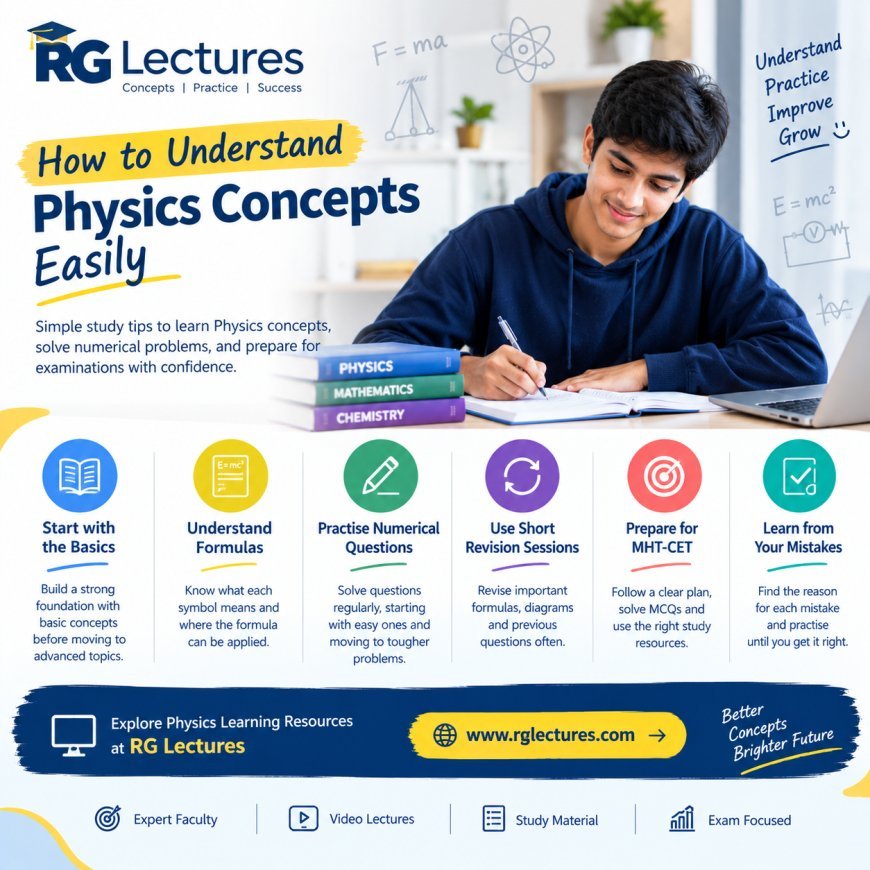
Physics becomes easier when students understand the principles behind formulas and numerical problems. Rather than memorising equations without context, learn what each formula represents and when it should be applied.
For example, understanding the relationship between force, mass, and acceleration makes it easier to solve different types of mechanics questions. Similarly, a strong foundation in electricity helps students approach circuit-based numerical problems more confidently.
Students can use structured lessons and study resources from RG Lectures to strengthen their understanding of Physics concepts and prepare systematically for entrance examinations.
Practise Numerical Problems Every Day
Numerical questions are an essential part of Physics preparation. Students should solve problems regularly, starting with basic examples and gradually progressing to questions that require multiple steps.
While practising, pay attention to units, signs, formula selection, and calculations. If a question is difficult, review the underlying concept before attempting it again. Maintaining a notebook of frequently used formulas and common mistakes can also make revision more effective.
Daily practice improves familiarity with different question patterns and helps students develop the speed needed for a timed examination.
Use Mock Tests to Measure Progress
Mock tests help students understand their preparation level and identify areas that need improvement. Attempting tests under timed conditions also builds familiarity with the pressure of the actual examination.
After each test, review incorrect answers and questions that took too long to solve. Determine whether the problem occurred because of a conceptual gap, calculation error, or poor time management.
Regular assessment allows students to adjust their study plans and focus on the topics where improvement is most needed.
Revise Formulas and Important Concepts
Revision should be a regular part of the preparation process. Create short notes containing important formulas, definitions, laws, and key results from every chapter.
Spend time revisiting difficult topics and solving questions that were previously answered incorrectly. Frequent revision helps improve recall and reduces the time required to identify suitable formulas during the examination.
Students should also practise mixed-topic questions to strengthen their ability to recognise which concept applies to a particular problem.
Improve Speed and Accuracy
Time management is particularly important in competitive entrance examinations. Students should learn to identify straightforward questions and solve them efficiently before spending additional time on challenging problems.
Practise with a timer and monitor both accuracy and completion time. Avoid rushing through calculations, as careless mistakes can reduce the overall score. With regular timed practice, students can develop a more effective question-solving strategy.
Choose the Right Learning Support
Good study materials, clear explanations, and regular practice can make preparation more manageable. Students should select resources that match their learning level and provide opportunities to resolve doubts.
RG Lectures offers educational support for students preparing for competitive examinations, including MHT-CET Physics. Aspirants can explore the available learning resources to find support for concept development, question practice, and exam preparation.
Conclusion
Success in MHT-CET Physics depends on consistent effort, conceptual understanding, regular numerical practice, and effective revision. Students who follow a realistic timetable and analyse their mistakes can steadily improve their preparation.
Begin with the fundamentals, practise questions every day, and use mock tests to evaluate progress. With a focused approach and the right learning resources, students can strengthen their Physics knowledge and prepare more confidently for the MHT-CET examination.
What's Your Reaction?
 Like
0
Like
0
 Dislike
0
Dislike
0
 Love
0
Love
0
 Funny
0
Funny
0
 Angry
0
Angry
0
 Sad
0
Sad
0
 Wow
0
Wow
0