
























Remote Patient Monitoring Apps in the UAE: Technologies and Opportunities for 2027
Explore remote patient monitoring app development in the UAE for 2027, including key technologies, essential features, costs, healthcare use cases, and compliance considerations.
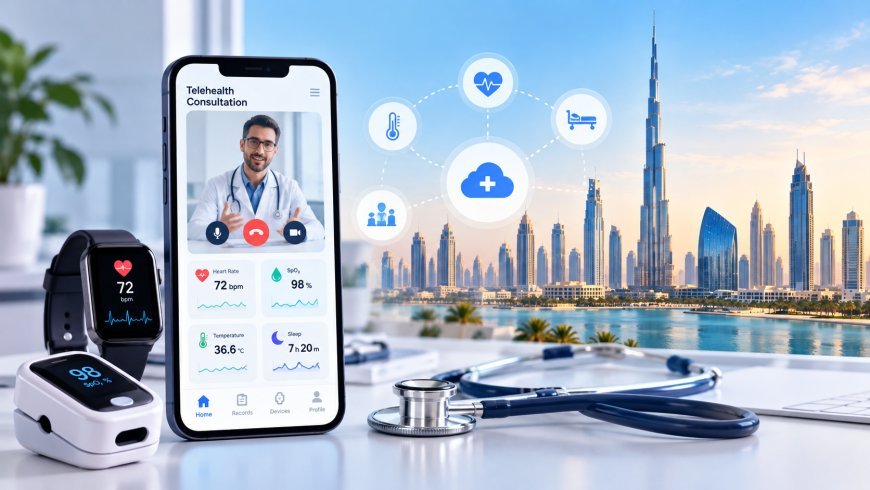
Healthcare is moving beyond hospital visits towards more connected and convenient care experiences. Remote patient monitoring (RPM) apps allow healthcare providers to collect selected patient health measurements remotely, review changes over time, and support follow-up care without requiring every interaction to take place in a clinic.
In the UAE, digital health initiatives and connected medical record systems are creating new opportunities for remote patient monitoring app development in the UAE. The Ministry of Health and Prevention (MoHAP) has previously introduced AI-based remote patient monitoring technology, while the UAE's Riayati platform supports the exchange of medical information across connected healthcare facilities.
As healthcare organisations plan for 2027, remote patient monitoring app development in Dubai can help hospitals, clinics, and healthcare providers explore more continuous, data-informed approaches to patient care. By investing in healthcare app development in the UAE, businesses can explore connected medical devices, real-time health data tracking, AI-assisted analytics, and secure digital healthcare solutions.
p development can help them explore more continuous, data-informed approaches to patient care.
This article covers the technologies, essential features, business opportunities, development considerations, and security requirements healthcare businesses should understand before investing in a remote patient monitoring app in the UAE.
What Is a Remote Patient Monitoring App?
A remote patient monitoring app is a digital healthcare solution that helps collect and transmit health-related information from patients outside traditional clinical settings.
Depending on the intended use, an app may connect with wearable devices, medical sensors, home monitoring equipment, and healthcare provider systems. Patients can view selected measurements, receive reminders, and share information with their care teams.
Healthcare professionals can use authorised dashboards to review incoming data, identify measurements that may require attention, and organise follow-up according to established clinical protocols.
Common measurements may include:
-
Blood pressure
-
Heart rate
-
Blood glucose levels
-
Blood oxygen saturation
-
Body weight
-
Temperature
-
Activity and sleep patterns
The measurements collected depend on the devices used, the patient's needs, and the intended clinical purpose of the application. An RPM app should support clinical care rather than replace professional medical assessment or emergency services.
Why Remote Patient Monitoring Is Relevant to the UAE in 2027
The UAE has been investing in digital health infrastructure, data integration, and technology-enabled healthcare services. Dubai's digital health strategy has highlighted patient-centred services, connected health information, analytics, and digital innovation as important areas for healthcare transformation.
For healthcare providers, remote patient monitoring may offer several opportunities.
More continuous follow-up: Selected health measurements can be collected between appointments, helping care teams review relevant changes over time.
Greater patient convenience: Patients may be able to complete agreed monitoring activities at home rather than travel to a facility for every routine measurement.
More structured chronic care: Monitoring workflows can support care plans for people who need regular observation, provided the approach is clinically appropriate.
Improved information availability: When integrations are properly designed, authorised clinicians may be able to review relevant monitoring data alongside other patient information.
More organised care coordination: Shared dashboards, review queues, and notifications can help teams manage monitoring tasks more consistently.
These benefits depend on suitable clinical workflows, patient participation, device accuracy, and the healthcare provider's capacity to review and act on incoming information. Technology alone does not guarantee better outcomes or lower costs.
7 Remote Patient Monitoring Technologies to Watch in 2027
1. Connected Wearables and Medical IoT Devices
Wearable technology and connected medical devices are central to many RPM solutions. They can capture measurements and transmit them to a mobile application or backend platform.
Depending on the use case, a system might connect to a blood pressure monitor, glucose monitoring device, pulse oximeter, or compatible wearable.
Developers should evaluate device accuracy, supported data formats, connectivity, battery life, and compatibility before selecting hardware.
For example, a hypertension monitoring programme could allow patients to submit blood pressure measurements from a supported home device. The app could organise readings by date and make them available for review by the authorised care team.
2. AI-Assisted Data Analysis
Artificial intelligence can help organise large volumes of monitoring data, identify patterns, and prioritise information for clinical review.
Potential applications include detecting unusual measurement patterns, identifying missing readings, and highlighting patients who may need follow-up under an approved care protocol.
For 2027, healthcare businesses should distinguish between administrative automation, decision-support tools, and systems intended to influence clinical decisions.
AI-generated insights require appropriate validation, monitoring, and human oversight. They should not be presented as definitive diagnoses or treatment recommendations without the necessary clinical and regulatory basis.
3. Predictive Analytics and Risk Stratification
Predictive analytics can help healthcare teams examine trends across repeated measurements and identify patients who may require closer attention.
For instance, a care team may review a sustained change in a patient's recorded measurements rather than relying on a single reading in isolation.
A well-designed platform can combine configurable thresholds, trend visualisations, and clinician-defined review rules. More advanced models may be considered when suitable data, clinical validation, and governance are available.
The aim is to support timely review, not to promise that an app can predict or prevent every medical complication.
4. Cloud Infrastructure and Scalable Data Processing
RPM platforms may process information from many devices and patients. Their backend infrastructure must support secure data ingestion, storage, processing, and authorised access.
Cloud-based architecture can help organisations scale capacity as their monitoring programmes grow. However, the hosting model should be selected according to applicable UAE requirements, the provider's security policies, integration needs, and operational constraints.
Important technical considerations include encryption, access management, backup and recovery, monitoring, and secure API design.
5. Healthcare System and Electronic Medical Record Integration
Remote monitoring data becomes more useful when it can be accessed through appropriate healthcare workflows rather than remaining isolated in a standalone app.
The UAE's Riayati platform supports connected healthcare systems and medical information exchange, including integration with health information exchange platforms such as NABIDH in Dubai and Malaffi in Abu Dhabi.
For an RPM project, the integration approach should be confirmed with the relevant healthcare provider and platform operators.
Developers may need to evaluate interoperability standards, patient identity matching, data mapping, consent, access permissions, and the approval process for connecting to existing systems.
6. Secure Patient Communication and Telehealth
Remote monitoring can be combined with secure messaging, virtual consultations, appointment scheduling, and follow-up reminders.
For example, a clinician reviewing a patient's submitted measurements may use an integrated workflow to arrange a consultation or request additional information.
These functions should have clear boundaries. Messaging does not replace emergency response, and notifications must not imply that a clinician is continuously watching a patient's measurements unless such a service is genuinely staffed and defined.
7. Arabic-English Interfaces and Accessible Design
An RPM app serving the UAE should consider the needs of Arabic-speaking and English-speaking patients, as well as users with different levels of digital confidence.
Important design considerations include:
-
Correct right-to-left (RTL) layouts for Arabic.
-
Clear labels and explanations for health measurements.
-
Accessible text sizes and readable charts.
-
Simple device pairing and onboarding.
-
Clear instructions for missing or invalid readings.
-
Language switching without losing user progress.
-
Easy-to-understand privacy and consent settings.
A simple, accessible interface can help patients complete monitoring tasks more consistently and reduce avoidable support requests.
Essential Features of a Remote Patient Monitoring App
Healthcare providers planning an RPM solution should prioritise features according to the clinical use case, rather than trying to include every possible capability in the first release.
| Feature | Purpose |
|---|---|
| Patient registration and consent | Supports appropriate onboarding and permission management |
| Device connectivity | Receives measurements from supported devices |
| Health measurement dashboard | Displays readings and trends over time |
| Clinician dashboard | Helps authorised staff review patient information |
| Configurable alerts | Flags readings or events that meet approved criteria |
| Reminders and notifications | Helps patients follow agreed monitoring schedules |
| Secure messaging | Supports appropriate communication between patients and care teams |
| Medical record integration | Connects relevant information with existing healthcare workflows |
| Reporting and analytics | Supports programme monitoring and operational review |
| Audit logs and access controls | Helps protect information and record relevant system activity |
Features involving clinical alerts, AI recommendations, or treatment decisions require additional clinical, technical, and regulatory assessment.
Healthcare Use Cases for Remote Patient Monitoring in the UAE
Chronic Disease Management
Patients with conditions requiring regular monitoring may benefit from structured digital workflows for recording measurements and sharing them with their healthcare team.
Depending on the clinical programme, an RPM app may support blood pressure tracking, glucose readings, weight measurements, or other relevant observations.
The care team must define which readings need review, how quickly they should be reviewed, and what action is appropriate when a threshold is reached.
Post-Surgery Recovery
After a procedure, selected patients may be asked to monitor specific measurements or report symptoms during recovery.
An RPM application can provide reminders, structured questionnaires, and a convenient way to share information with the care team. It may also help organise follow-up appointments.
The monitoring plan should be approved by the treating provider and include clear instructions for worsening symptoms or emergencies.
Elderly Care and Home-Based Monitoring
Remote monitoring may support selected older adults who need regular observation while living at home.
A suitable application could provide measurement reminders, caregiver access where authorised, and a dashboard for the relevant healthcare team.
The design should respect patient autonomy, avoid unnecessary surveillance, and provide straightforward instructions for patients and caregivers.
Maternal and Postnatal Care
For appropriately selected patients, digital monitoring may support specific follow-up activities during pregnancy or after childbirth.
Potential features include scheduled measurements, symptom questionnaires, appointment reminders, and secure communication with healthcare professionals.
These solutions require carefully defined clinical protocols and should not replace in-person assessment when it is needed.
Hospital-at-Home and Follow-Up Programmes
Healthcare providers exploring home-based care models may use RPM technology to collect selected measurements and coordinate follow-up outside hospital settings.
Such programmes require clear responsibility for reviewing readings, responding to alerts, managing device issues, and escalating urgent situations.
An app is one component of the service; clinical staffing and operating procedures are equally important.
How Much Does Remote Patient Monitoring App Development Cost in the UAE?
The cost of developing a remote patient monitoring app depends on the number of supported devices, clinical workflows, system integrations, security requirements, and the complexity of the patient and clinician interfaces.
The following figures are indicative planning estimates, not verified UAE market averages or fixed quotations.
| Development level | Indicative budget |
|---|---|
| Basic RPM app with essential tracking features | AED 10,000–20,000 |
| Standard RPM platform with device integration and clinician dashboard | AED 20,000–30,000 |
| Advanced RPM platform with complex integrations and AI-assisted analytics | AED 40,000+ |
A project may also require a separate budget for compatible medical devices, cloud hosting, third-party services, security testing, clinical validation, regulatory assessment, and ongoing maintenance.
Before development begins, healthcare providers should define the initial use case, identify the required devices, document clinical workflows, and confirm integration requirements. This helps establish a more realistic budget and delivery timeline.
Healthcare Data Security and Compliance Considerations in the UAE
Healthcare applications handle sensitive information, making privacy and security essential parts of the development process.
The UAE's Federal Law No. 2 of 2019 concerning the use of information and communication technology in health fields addresses the use of digital technology in healthcare and the protection of health data. Its executive regulation is also relevant to assessing applicable requirements.
Before launching an RPM app, businesses should assess the following areas.
Data protection: Establish what information is collected, why it is needed, how long it is retained, and who can access it.
Secure authentication: Use appropriate identity verification, access controls, and session management for patients, clinicians, and administrators.
Encryption: Protect health information during transmission and storage using suitable security controls.
Hosting and data transfers: Evaluate applicable UAE requirements and the proposed hosting architecture before selecting infrastructure.
Clinical alerts: Document who is responsible for reviewing alerts, how they are prioritised, and what happens when a patient cannot be contacted.
Healthcare integrations: Confirm the relevant permissions, technical standards, and approval procedures before connecting to healthcare information systems.
Regulatory review: Determine whether the app or its features require additional healthcare, medical-device, or service-provider approvals. Requirements depend on the intended use and operating model.
Compliance should be assessed with the relevant healthcare authority and qualified legal or regulatory advisers. A development team should not assume that a general-purpose mobile app automatically satisfies healthcare requirements.
How to Choose a Remote Patient Monitoring App Development Company in Dubai
Selecting a development partner involves more than comparing prices or reviewing app design portfolios. Healthcare providers should assess whether the team understands connected devices, sensitive data, clinical workflows, and integration challenges.
Consider these factors when evaluating a remote patient monitoring app development company in Dubai:
-
Healthcare technology experience: Ask about relevant healthcare applications, device integrations, and patient-facing products the team has developed.
-
Device compatibility: Confirm how the team will assess device accuracy, data formats, connectivity, and vendor dependencies.
-
Security architecture: Review its approach to encryption, authentication, access control, audit logs, and security testing.
-
Integration capability: Discuss electronic medical records, healthcare information exchange, APIs, and the approval requirements for connecting to existing systems.
-
Clinical workflow planning: Ensure the proposed app supports the care team's actual review and escalation procedures.
-
Scalability and maintenance: Understand how the platform will handle additional patients, devices, integrations, and future feature updates.
-
Transparent project scope: Request clear deliverables, milestones, assumptions, costs, and post-launch support arrangements.
A suitable partner should be able to explain the trade-offs between different technical approaches and identify risks before they become expensive development problems.
Why Choose Apptunix UAE for Healthcare App Development?
Apptunix UAE helps businesses explore custom mobile app development solutions tailored to their operational and customer requirements.
For healthcare organisations considering remote patient monitoring, the development process may involve patient and clinician interfaces, connected-device workflows, secure backend systems, healthcare integrations, and analytics features, depending on the agreed project scope.
A structured approach starts with understanding the intended use, patient needs, clinical workflows, integration requirements, and applicable compliance obligations before selecting the technology.
If you are planning a healthcare application for the UAE market, working with an experienced development team can help you evaluate the technical options and define a practical product roadmap.
Planning to build a remote patient monitoring app in the UAE?
Discuss your project requirements with Apptunix UAE and explore a tailored healthcare app development solution.
Book a FREE Consultation with Apptunix UAE
Frequently Asked Questions
1. What is remote patient monitoring app development?
Remote patient monitoring app development involves creating software that collects health-related measurements from supported devices, presents information to patients and authorised healthcare professionals, and supports agreed monitoring and follow-up workflows.
2. Is remote patient monitoring suitable for UAE healthcare providers?
It may be suitable for hospitals, clinics, and other healthcare providers that have an appropriate clinical use case, suitable devices, trained staff, and the necessary operational and regulatory arrangements.
3. Can an RPM app integrate with existing hospital systems?
Yes, integration may be possible through suitable APIs and supported healthcare interoperability standards. Access to platforms such as Riayati or other health information exchange systems depends on technical compatibility, eligibility, approvals, and applicable requirements.
4. Can AI be used in remote patient monitoring apps?
AI may help analyse measurement trends, organise alerts, and support clinical review. Its use in clinical decision-making requires appropriate validation, oversight, and assessment of applicable regulatory requirements.
5. What features should an RPM app include?
Core features may include patient onboarding, device connectivity, health dashboards, clinician access, configurable alerts, reminders, reporting, secure communication, and audit logs. The final feature set should reflect the intended clinical use.
What's Your Reaction?
 Like
0
Like
0
 Dislike
0
Dislike
0
 Love
0
Love
0
 Funny
0
Funny
0
 Angry
0
Angry
0
 Sad
0
Sad
0
 Wow
0
Wow
0