




















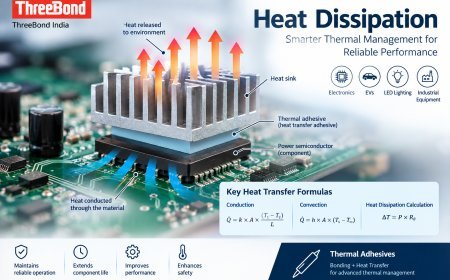







Heat Dissipation: Meaning, Formula, Calculation, and Role of Thermal Adhesives
Learn the meaning of heat dissipation, key formulas, calculation examples, and how thermally conductive adhesives help manage heat in electronics and EVs.

Heat dissipation is the process of transferring excess heat away from a component, surface, or system to prevent overheating and maintain reliable performance. It is an important part of thermal management in electronic devices, electric vehicles (EVs), power supplies, LED lighting, and industrial equipment. Whenever a component converts electrical energy into useful work, some energy may be released as heat. If this heat cannot escape efficiently, the component's temperature can rise, affecting its efficiency, service life, and safety.
For example, consider an electronic control unit inside an electric vehicle. It manages electrical signals and power during operation. As current flows through its components, heat is generated. If that heat remains trapped, the unit may operate at a higher temperature than recommended. A suitable heat sink, cooling arrangement, or thermally conductive adhesive can help transfer the heat away from sensitive components.
Understanding the science behind heat transfer helps engineers choose the right cooling method and materials. In this guide, we will explain the heat dissipation meaning, common heat transfer methods, the relevant formulas and equations, practical calculation examples, and the role of thermal adhesives in modern engineering.
What Is Heat Dissipation?
Heat dissipation refers to the movement of thermal energy from a hotter object or region to a cooler object or surrounding environment. This transfer continues until the temperature difference is reduced or a steady operating condition is reached.
Heat can move through solid materials, fluids, and electromagnetic radiation. The rate at which it moves depends on factors such as temperature difference, material properties, surface area, and the surrounding environment.
Think about a smartphone during a long gaming session. The processor performs millions of operations, consuming electrical power and generating heat. The phone's internal materials conduct this heat toward its body, while the outer surface releases some of it into the surrounding air.
If the device cannot release heat quickly enough, its temperature increases. The phone may reduce processor speed to protect itself. This is a simple example of why effective thermal management matters.
In industrial applications, the same principle applies to power semiconductors, electric motors, battery modules, lighting systems, and control circuits.
Why Is Heat Dissipation Important?
Effective thermal management offers several benefits:
-
Reliable operation: Helps electronic components remain within their recommended operating temperatures.
-
Longer component life: Reduces thermal stress that can accelerate material degradation.
-
Improved performance: Helps prevent unwanted temperature-related reductions in operating speed or output.
-
Better product safety: Supports temperature control when combined with appropriate electrical, mechanical, and thermal protection.
-
Consistent operation: Helps reduce excessive temperature differences and localised hot spots.
However, removing heat is not simply about making a component as cold as possible. The goal is to maintain its temperature within the limits specified by the manufacturer under actual operating conditions.
Understanding the Three Main Methods of Heat Transfer
To understand how heat leaves a component, it is useful to understand the three basic methods of heat transfer.
1. Conduction
Conduction occurs when thermal energy moves through a material because of a temperature difference. It is particularly important in solid materials such as copper, aluminium, ceramics, and thermal interface compounds.
For example, when a power semiconductor becomes hot, heat may travel through its mounting surface and into a metal heat sink. The heat sink then spreads the thermal energy over a larger area.
The efficiency of conduction depends on the material's thermal conductivity, the thickness of the material, its contact area, and the temperature difference across it.
Materials with higher thermal conductivity generally allow heat to move more easily through them, assuming other conditions remain comparable.
2. Convection
Convection transfers heat between a surface and a moving or surrounding fluid, such as air or liquid.
Imagine a metal heat sink fitted to an electronic power supply. Heat travels from the electronic component into the heat sink. Air moving across the fins carries some of this heat away.
A fan can improve forced convection by increasing airflow. In liquid-cooled systems, a coolant can carry heat away from a component and transfer it to a radiator or another cooling device.
The effectiveness of convection depends on factors such as airflow, fluid properties, surface geometry, and the temperature difference between the surface and the surrounding fluid.
3. Thermal Radiation
Thermal radiation transfers energy through electromagnetic waves. Unlike conduction and convection, it does not require direct contact between objects or a fluid medium.
For example, a hot industrial surface can release thermal energy into its surroundings through radiation.
Radiation becomes more significant at higher temperatures and depends on surface emissivity, surface area, and the temperatures of the object and its surroundings.
In many compact electronic assemblies, conduction and convection are the main heat-transfer mechanisms. However, radiation can also contribute to the overall thermal balance.
Heat Dissipation Formula: Understanding the Basic Equations
There is no single equation that describes every heat-transfer situation. The appropriate formula depends on whether heat is moving through a solid, leaving a surface, or changing the temperature of an object over time.
The following equations are useful starting points for engineers and technical professionals.
1. Heat Transfer Through Conduction
For steady, one-dimensional heat conduction through a flat layer, Fourier's law can be expressed as:
Q̇ = k × A × (T₁ − T₂) / L
Where:
-
Q̇ = heat-transfer rate in watts (W)
-
k = thermal conductivity of the material in W/(m·K)
-
A = area available for heat transfer in square metres (m²)
-
T₁ − T₂ = temperature difference across the material in kelvin (K) or degrees Celsius (°C)
-
L = thickness of the material in metres (m)
This equation assumes a uniform material, steady conditions, and a simplified one-dimensional heat-flow path.
It shows that a material with higher thermal conductivity, a larger transfer area, or a greater temperature difference can transfer more heat under otherwise identical conditions. Increasing the layer thickness reduces the heat-transfer rate in this simplified model.
Example: Suppose an electronic component transfers heat through a material with a thermal conductivity of 2 W/(m·K). The effective contact area is 0.001 m², the material thickness is 0.001 m, and the temperature difference across the layer is 10°C.
Using the equation:
Q̇ = 2 × 0.001 × 10 / 0.001
Q̇ = 20 W
The calculated conduction rate is 20 watts under the stated idealised conditions.
This is not necessarily the total heat removed from the electronic component. Actual performance also depends on contact resistance, other materials in the thermal path, and how efficiently the heat is released into the environment.
2. Heat Transfer Through Convection
Newton's law of cooling describes convective heat transfer:
Q̇ = h × A × (Tₛ − T∞)
Where:
-
Q̇ = convective heat-transfer rate in watts
-
h = convective heat-transfer coefficient in W/(m²·K)
-
A = exposed surface area in m²
-
Tₛ = surface temperature
-
T∞ = surrounding fluid temperature away from the surface
The coefficient h depends on the fluid, flow conditions, and surface geometry. It is not a fixed value for every application.
For example, if a heat sink has an effective surface area of 0.05 m², a convective heat-transfer coefficient of 20 W/(m²·K), and a surface temperature 30°C above the surrounding air, the estimated heat-transfer rate is:
Q̇ = 20 × 0.05 × 30
Q̇ = 30 W
This simplified calculation estimates 30 watts of convective heat transfer. It does not include radiation or conduction resistance between the heat source and the heat sink.
3. Heat Required to Change an Object's Temperature
When an object gains or loses heat and its temperature changes, the following equation can be used:
Q = m × c × ΔT
Where:
-
Q = thermal energy transferred in joules (J)
-
m = mass in kilograms (kg)
-
c = specific heat capacity in J/(kg·K)
-
ΔT = temperature change in kelvin (K) or degrees Celsius (°C)
For example, suppose a 0.5 kg metal part has an effective specific heat capacity of 500 J/(kg·K). If its temperature rises by 20°C, the energy absorbed is:
Q = 0.5 × 500 × 20
Q = 5,000 J
The part absorbs 5,000 joules of thermal energy under these assumptions.
This equation calculates energy, not the rate of heat removal. To determine an average heat-transfer rate, divide the energy transferred by the time taken, provided the relevant conditions are understood.
How to Perform a Heat Dissipation Calculation
A practical calculation starts by identifying the heat source, the amount of heat generated, and the available path for removing it.
Let's consider a simplified example involving an electronic power module.
Assume the module continuously generates 25 W of heat during normal operation. The design team wants to estimate the temperature rise associated with the thermal path between the module and its surroundings.
For a steady-state system, a useful simplified relationship is:
ΔT = P × Rθ
Where:
-
ΔT = temperature rise in °C or K
-
P = heat dissipation rate in watts
-
Rθ = overall thermal resistance in °C/W or K/W
Suppose the total thermal resistance from the heat-generating component to the surrounding environment is estimated to be 1.2°C/W.
The expected temperature rise is:
ΔT = 25 × 1.2
ΔT = 30°C
If the surrounding temperature is 30°C, the estimated component temperature would be:
Component temperature = 30°C + 30°C = 60°C
This is a simplified steady-state estimate. It assumes that the stated thermal resistance represents the entire relevant path and that the heat generation and environmental conditions remain constant.
In a real design, the thermal resistance must account for the complete path, including the component package, interface material, heat sink, and heat transfer to the environment. The engineer must also consider the manufacturer's maximum temperature limits and any required safety margin.
What Can Change the Result?
A calculation is only as useful as its assumptions and input data. The following factors can affect the actual temperature:
-
Ambient temperature: Higher surrounding temperatures leave less room for additional temperature rise.
-
Thermal resistance: A poorly designed interface or undersized heat sink can restrict heat flow.
-
Contact quality: Gaps, surface roughness, and trapped air can increase thermal resistance.
-
Material thickness: A thicker interface layer may increase resistance to heat conduction.
-
Airflow: Restricted ventilation can reduce convective cooling.
-
Operating load: Higher electrical power losses can generate more heat.
-
Installation conditions: Mounting pressure, orientation, and enclosure design can affect performance.
For reliable results, engineers should combine calculations with testing under representative operating conditions.
What Is a Heat Dissipation Equation Used For?
A heat dissipation equation helps engineers estimate whether a component can operate within its permitted temperature range. It can also help compare materials, evaluate cooling methods, and identify potential thermal bottlenecks.
For example, an engineer designing an LED lighting assembly may use thermal resistance to estimate the temperature rise of the LED junction. A designer working on an electric vehicle battery system may evaluate how heat moves from a cell or module toward a cooling structure.
The equations are also useful when selecting thermal interface materials. If the material layer contributes too much resistance, the component may run hotter than expected even when the heat sink itself is appropriately sized.
However, calculations should not be treated as a substitute for product-specific testing. Real assemblies may contain several materials and interfaces, and their combined thermal behaviour can be more complex than a single equation suggests.
What Is a Heat Transfer Adhesive?
A heat transfer adhesive, often called a thermally conductive adhesive, is a bonding material designed to provide both adhesion and a path for thermal energy to move between components.
Conventional adhesives are primarily selected for their bonding performance. A thermally conductive adhesive is formulated to support heat transfer as well, making it useful in applications where components must be secured while heat moves toward a heat sink, housing, or another thermal management structure.
These materials can be particularly useful in compact electronic assemblies where there is limited space for mechanical fasteners.
Depending on the formulation, a thermal adhesive may also offer electrical insulation, flexibility, environmental resistance, or the ability to fill small gaps between surfaces. These properties vary by product, so engineers should check the relevant technical data sheet before selecting a material.
How Does a Thermally Conductive Adhesive Work?
Consider a power semiconductor mounted near a metal heat sink.
If the two surfaces have small gaps, air can remain trapped between them. Air generally has low thermal conductivity compared with metals and many thermally conductive interface materials. These gaps can therefore restrict the movement of heat.
A suitable adhesive can fill the interface, bond the components, and create a more effective path for thermal conduction.
The process can be understood in three stages:
-
Application: The material is applied to the specified bonding or interface area.
-
Bonding and curing: The material establishes the required bond according to its curing mechanism and application instructions.
-
Thermal transfer: During operation, heat passes through the cured material toward the receiving component or cooling structure.
The actual performance depends on the adhesive's thermal conductivity, bond-line thickness, contact conditions, curing quality, and the thermal resistance of the rest of the assembly.
It is important to remember that thermal conductivity alone does not determine the final operating temperature. The complete thermal design matters.
Applications of Heat Dissipation Materials
Thermally conductive adhesives and related materials are used in several industries.
1. Electric Vehicles
Electric vehicles contain battery systems, power electronics, onboard chargers, and motor-control units. These systems generate heat during charging and operation.
Thermally conductive bonding materials can help transfer heat between selected components and thermal management structures. In battery assemblies, the chosen material must also meet the requirements for electrical isolation, mechanical strength, environmental exposure, and the relevant safety design.
For example, an EV battery designer may need to bond a component to a thermal plate while maintaining a reliable thermal path. The material must be selected for the actual battery architecture rather than on thermal conductivity alone.
2. Consumer and Industrial Electronics
Power supplies, processors, sensors, communication equipment, and industrial controllers may produce substantial heat within a compact space.
A suitable thermal interface can help move heat away from sensitive components while providing the required mechanical attachment or sealing.
3. LED Lighting
LEDs convert electrical energy into light, but a portion of the energy is released as heat. If this heat is not managed correctly, it can affect light output, colour stability, and service life.
Thermally conductive materials can help transfer heat from selected LED components to a heat sink or housing designed to release it.
4. Automotive Electronics
Modern vehicles rely on electronic control units, sensors, power modules, and lighting systems. These components must operate across changing temperatures and environmental conditions.
A suitable thermal adhesive may support heat transfer and component fixation while meeting the specific requirements of the vehicle application.
How ThreeBond India Supports Thermal Management
Choosing the right material is an important step in designing a reliable thermal management system. ThreeBond India offers specialised materials for applications involving electronic components and thermal transfer.
Its product range includes heat-dissipating materials such as ThreeBond 1225B and ThreeBond 2955.
ThreeBond 1225B is described by the company as a one-component, room-temperature-curing silicone adhesive sealant for electrical and electronic components. Its listed applications include thermal management and electrical insulation for switching power supplies, power ICs, computer CPUs, and lighting equipment.
ThreeBond 2955 is a moisture-curing material based on a silyl-containing polymer and thermally conductive filler. The company identifies it for heat transfer from various electronic components.
For EV applications, ThreeBond also describes 2045B and 2145B, two-component, room-temperature-curing epoxy resins intended for thermal management in battery systems. Their suitability depends on the requirements of the specific assembly.
You can explore the available solutions on the ThreeBond India Heat Dissipation Agents page and learn more about thermally conductive adhesives for EV components.
Before choosing a product, review its technical data sheet for thermal conductivity, curing conditions, electrical properties, operating-temperature
range, adhesion requirements, and compatibility with the substrates. Where needed, consult the technical team to identify a material that suits your design and manufacturing process.
How to Choose the Right Thermal Adhesive
Not every thermally conductive adhesive is suitable for every application. A product that works well in an LED assembly may not be the best option for an EV battery module or an industrial power supply.
Consider these factors before making a selection:
-
Thermal conductivity: Determine how readily the material conducts heat under the relevant test conditions.
-
Thermal resistance: Evaluate the complete interface, including the thickness of the cured layer and contact quality.
-
Electrical properties: Establish whether the application requires electrical insulation or electrical conductivity.
-
Bonding strength: Confirm that the adhesive can withstand the mechanical loads and vibration expected in service.
-
Curing requirements: Check whether the product requires moisture, heat, mixing, or a specific curing period.
-
Operating environment: Consider temperature cycling, humidity, chemicals, and other exposure conditions.
-
Manufacturing needs: Check viscosity, dispensing requirements, production speed, and assembly tolerances.
-
Reliability testing: Validate the material in the finished assembly under representative operating conditions.
A good selection process considers the complete application rather than choosing a product solely because it has a high thermal conductivity value.
Common Mistakes to Avoid
Even a high-performance thermal material may not deliver the expected results if it is used incorrectly.
Choosing a material based only on thermal conductivity: A high conductivity value does not automatically guarantee low total thermal resistance. Thickness and contact quality also matter.
Applying too much adhesive: An unnecessarily thick bond line can increase thermal resistance in many interface designs. Follow the manufacturer's recommended application guidelines.
Ignoring surface preparation: Contamination, oil, dust, and unsuitable surface conditions can affect adhesion and contact quality.
Overlooking curing conditions: Incomplete curing may affect mechanical and thermal performance. Follow the specified curing process.
Ignoring the cooling system: An effective interface cannot compensate for an undersized heat sink, restricted airflow, or an unsuitable overall thermal design.
Skipping validation: Confirm performance through appropriate testing, including temperature measurements under representative loads and environmental conditions.
Frequently Asked Questions
1. What is the heat dissipation meaning in simple words?
It means transferring excess heat away from a component or system so that its temperature remains within an acceptable operating range.
2. Which formula is used to calculate heat transfer?
The formula depends on the process. Fourier's law is commonly used for conduction, Newton's law of cooling for convection, and Q = mcΔT for calculating the energy required to change an object's temperature.
3. How do you calculate heat dissipation in watts?
Under steady-state conditions, the heat-transfer rate can be estimated from the relevant heat-transfer equation. For a simplified thermal-resistance model, the relationship is Q̇ = ΔT/Rθ, where ΔT is the temperature difference and Rθ is the thermal resistance.
4. What is the difference between thermal conductivity and thermal resistance?
Thermal conductivity describes how readily a material conducts heat. Thermal resistance describes how strongly a particular layer, interface, or complete thermal path opposes heat flow. A thin layer of a material with a given conductivity may have a different thermal resistance from a thick layer of the same material.
5. Can an adhesive improve heat dissipation?
Yes. A suitably formulated thermally conductive adhesive can bond components and provide a pathway for heat to move toward a heat sink or another thermal management structure. The improvement depends on the material, bond-line thickness, contact conditions, and overall system design.
6. Is a thermally conductive adhesive always electrically conductive?
No. Thermal conductivity and electrical conductivity are different properties. Many thermally conductive adhesives are electrically insulating, while specialised formulations may be electrically conductive. Always verify the product's technical specifications.
Conclusion
Effective thermal management is essential for the reliable operation of electronic devices, EV components, lighting systems, and industrial equipment. Understanding the basic principles of conduction, convection, and radiation helps engineers identify how heat moves and where a design may need improvement.
The appropriate heat dissipation formula can estimate heat-transfer rates, energy changes, or temperature rises. However, accurate design requires realistic material properties, a complete thermal path, and validation under actual operating conditions.
Thermally conductive adhesives provide an additional option by combining bonding with heat transfer. When selected and applied correctly, they can help engineers develop compact, reliable thermal management solutions.
ThreeBond India offers specialised heat-dissipating materials for various electronic and industrial applications. Reviewing the product specifications and matching them to the application's thermal, electrical, mechanical, and manufacturing requirements is the right starting point for selecting a suitable solution.
What's Your Reaction?
 Like
0
 Dislike
0
 Love
0
 Funny
0
 Angry
0
 Sad
0
 Wow
0