


















How AI-Powered POS Restaurant Software Is Cutting Labor Costs and Boosting Table Turns
AI integrated with the POS restaurant software is totally transforming restaurant operations. Besides automating the routine ones, they have also assisted with better manpower and reduced waiting time in between the customer service cycles and thereby restaurant owners have managed to control labour costs while serving a larger number of customers every day.


Picture a restaurant at its dinner rush. Orders are stacking up like dominoes, customers are queuing for tables, the kitchen staff is barely managing, chefs have been cooking for hours, and the servers are running back and forth from the counter and dining area non-stop. The restaurant, despite having enough customers, is losing precious time as routine operations are not well optimized.
Envision the same restaurant working with automated order processing, intelligent table management, AI predictions, and real-time staff coordination. The distinction is not necessarily a bigger workforce, but rather better technology.
AI integrated with the POS Restaurant Software is totally transforming restaurant operations. Besides automating the routine ones, they have also assisted with better manpower and reduced waiting time in between the customer service cycles and thereby restaurant owners have managed to control labour costs while serving a larger number of customers every day.
The Hidden Cost of Each Additional Minute in Restaurant Operations
Labor cost is among the biggest operational expenses for restaurants.
On the one hand, the issue is often the number of employees working on any given shift but on the other, even an extensively manned restaurant could lose money and time if processes are not efficient.
Let's look at the micro delays that keep happening even during a normal peak hour:
● Staff spends more time manually keying in orders and making confirmations on modifications.
● Cooking staff receives wrong or delayed order details.
● Managers fail to recognize the peak hours and plan the staff schedule accordingly.
● Billing and payment take longer, and customers are not only kept waiting for a longer period on these but also for a table.
● Staff spends their precious time coordinating tasks rather than attending to customers.
Each of these problems, though, could be handled. Only after they affect thousands or millions of orders do they start to really become significant, and that is when operational efficiency starts to take a hit.
AI-enabled restaurant solutions are able to handle those issues by bringing together various business areas with one all-knowing platform.
Manually Done Jobs to Smarter Workflows: AI Where It Counts
Normal POS systems were just for registering transactions and managing billing operations.
AI-driven solutions can not only help in managing daily business but also help the restaurant staff to take better decisions by identifying operational patterns and analyzing data.
Some of these are the areas where this revolution is taking place.
1. Handling more orders in less time with Smart Order Processing.
Taking orders, entering modifications, and conveying requests to kitchen employees can be very time-consuming tasks done by staff.
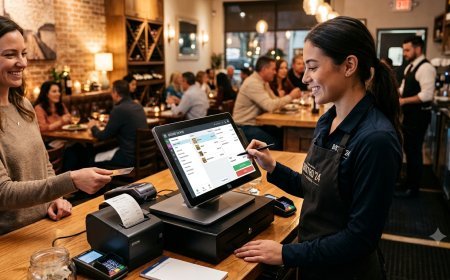
AI-powered POS systems reduce staff pressure by seamlessly integrating digital menu platforms, ordering platforms, kitchen displays, and billing operations.
Orders can directly be fed into the kitchen workflow, which significantly cuts down on redundant communication and manual entry.
This also benefits the restaurants by:
● Giving staff lesser chances to make errors and they also have less need for repeat confirmations.
● Saving employees' time on processing regular requests.
● Enabling the kitchen and front-of-house operations to function together more efficiently.
2. Predictive Scheduling Helps Control Labor Expenses
A restaurant manager's largest problem is figuring out how many employees to use per shift.
It is wasteful to have too many employees working during periods of low customer traffic, while having too few employees during high customer traffic times will impact service quality.
Artificial intelligence can analyze historical sales data, order volumes, seasonal trends, and peak times in order to predict how many employees a manager should have.
For example, the restaurant can recognize a pattern where Fridays tend to have higher demands than other days of the week and use the data to help the restaurant owner or manager arrange employee work schedules accordingly.
Restaurant owners can now decide how many employees are needed to run a restaurant without having to guess.
It is intended to guide managers and not to replace a manager's judgment, and a manager should consider things like employees' availability, local labour laws, and demand.
3. Automated Billing Frees Up Valuable Employee Time
Delaying billing is frustrating for customers but stressful for restaurant staff.
Customers want to pay their bills as quickly and easily as possible when paying for their meals, but all of the labour-intensive tasks involved in preparing bills, calculating payments and conducting transactions will slow down the process.
The billing process for restaurants can be streamlined with POS software, which includes features such as:
● Automated invoice generation.
● Integrated payment processing.
● Digital receipts.
● Split-bill functionality.
● Real-time transaction recording.
If people can do away with redundant billing jobs, they'll have more time to set up tables for customers who arrive and assist them.
Beyond Speed: How AI Uses Restaurant Data to Improve Decisions
AI restaurant technology is great for getting actionable insights for restaurant owners. While automation is a big benefit of this technology, having access to more information with this technology is great for restaurant owners to make better decisions for their restaurant.
Sales reports, order histories, and employee performance can all be tracked through AI restaurant technology to provide a better understanding of what is happening in the restaurant.
Some important applications include:
Restaurants can also use historical demand patterns to predict peak demand periods to plan for resources ahead of time.
Menu analysis is a process that helps restaurants determine which dishes are popular and which are not bringing in any money. Managers can use menu analysis to improve their menus and reduce excess inventory.
Bottleneck analysis: time to process an order and time to service customers can be analyzed. Bottlenecks can be identified.
Businesses can use sales data to determine inventory needs, because they can use it to make purchase decisions and to reduce waste.
The knowledge can help restaurant owners go from reactive to proactive.
Conclusion: Make Every Shift More Productive with Smarter Restaurant Technology
When you look at reducing labour costs and speeding up table turns, they end up becoming the same goal. Eliminating bottlenecks, better coordination, and the efficient use of existing resources all go a long way to support each goal.
POS systems in the AI age have a lot of flexibility, particularly with automation and giving restaurant operators a deeper insight into their customers and better scheduling.
There are many choices of digital service providers that can be of value, and FODUU has gained a lot of ground by differentiating itself in this area through a focus on innovation and technology and modern, elegant Web design. FODUU’s forward-thinking approach will serve FODUU and its customers well. With FODUU’s digital presence, its customers will be empowered to optimize their business operations.
Also Read: How to Choose the Right Restaurant POS Software in India: Features, Pricing & GST Compliance
What's Your Reaction?
 Like
0
 Dislike
0
 Love
0
 Funny
0
 Angry
0
 Sad
0
 Wow
0