





















How Can Constitutional Law Lawyers in India Protect Your Fundamental Rights?
The Indian Constitution ensures that citizens' fundamental rights, liberties and personal dignity are upheld. There will be cases where the State may act unfairly, discriminate, impose illegal deprivations or otherwise infringe an individual's rights under the Constitution. A Constitutional Law Lawyer in India can therefore assist private persons, companies or other bodies to obtain redress from the Courts.
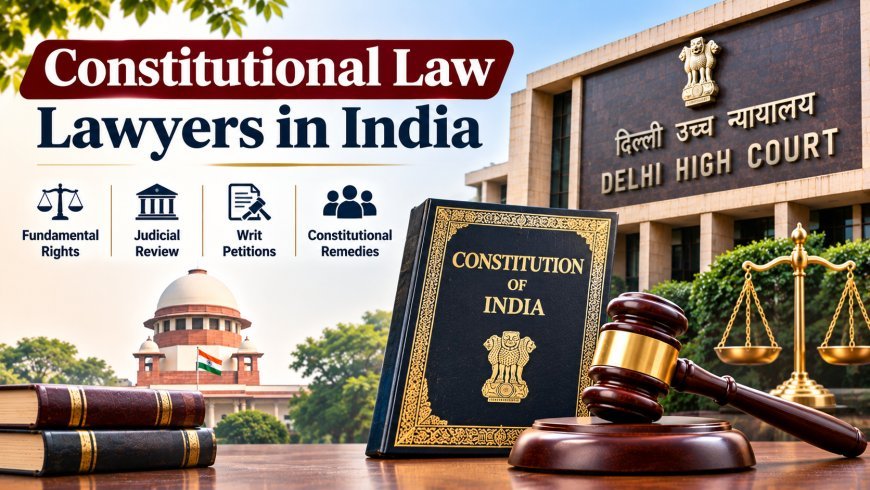
Many of these matters will raise key issues concerning the extent of State power, discrimination, freedom and right to approach the Court. Skilled lawyers will analyze any breach and litigate for suitable redress in accordance with the Indian Constitution.
Why Should You Consult Constitutional Law Lawyers in India?
Disputes arising under the Constitution can impinge on an individual's liberty, livelihood, assets, trade or occupation, and citizenship. If State action is found to exceed its competence, a person will often need the aid of a lawyer.
In India, a Constitutional Lawyer will look at the extent to which the State has acted (or failed to act) within the framework of the Constitution and other statutes. There may also be a role for a lawyer where issues such as discrimination, capricious state decision-making, wrongful imprisonment and curtailment of rights arise.
Prompt engagement with a lawyer can be critical if a contentious decision has direct bearing on the client. A number of factors will be considered including the strength of any claim, appropriate courses of action, competent forum(s) and timing.
Can Constitutional Lawyers Challenge Unfair Government Decisions?
A person can seek relief where a Government decision has been taken arbitrarily, unfairly, in breach of due process or contrary to the Constitution.
These could include an (alleged) unfair selection of candidates for public employment, a regulatory action imposed beyond the relevant power holder's legislative mandate, or any other form of Government encroachment upon an individual.
The Constitutional Law Advocate would consider the pertinent documentation, statute and case law and act to contest or seek relief from such a decision.
Of course, simply disapproving of a Government decision will rarely give rise to a justiciable constitutional issue, as there must be certain pre-requisites and evidentiary requirements.
Should You Approach the High Court or Supreme Court?
It will be necessary to select the correct Constitutional Court in which to proceed.
Article 226 empowers the High Courts to pass appropriate writs in aid of Fundamental Rights and for certain additional objects. They can therefore provide a valuable check on the exercise of State powers.
Depending upon the facts of each case, territory and any other relevant factors, one or more reliefs may be sought.
Alternatively, Article 32 entitles a person to move the Supreme Court to enforce his/her Fundamental Rights. In such instances, the Supreme Court may issue writs, directions or other orders as considered necessary.
As indicated above, these provisions relate to the Fundamental Rights set out in Part III of the Constitution.
A competent Writ Petition Lawyer at the High Court or Constitutional Lawyer at the Supreme Court will be able to advise as to the best course of action, subject matter and any competing forms of relief.
What Constitutional Remedies Can Lawyers Seek?
There are various forms of remedy available under the Constitution for any illegal action by a State authority.
These will be in the form of one or more of the Writs i.e. Habeas Corpus, Mandamus, Certiorari, Prohibition, Quo Warranto etc., depending on the facts of the case and subject to fulfillment of certain conditions.
In addition, a Constitutional Lawyer can pursue:
Review of an action taken by a Government authority;
Preventive relief from an illegality committed by a Government authority;
Stay of any impugned order(s);
Upholding of Fundamental Rights;
Any other appropriate relief from a Constitutional Court.
A Writ Petition Lawyer in India will first consider if the Court is competent to entertain the matter and what reliefs (if any) can be granted. It should be noted that merely filing a Writ Petition will not stay a Government Order nor ensure any protection.
Can Businesses and Institutions Seek Constitutional Protection?
The Constitution will be of concern to many private citizens as well as businesses, schools, clubs and other bodies.
In the business context, this could include: alleged discrimination by a decision-maker; arbitrary controls; a dispute over the issue or denial of a license; or any other matter impacting the conduct of a business.
Schools may seek guidance regarding the scope of regulation applicable to them, their rights, and any special constitutional status afforded to some types of school.
A Constitutional Rights Lawyer can assess if there has been an unjustified interference with your client's constitutional (and legislative) rights. Of course, they will also have regard to any justifiable control exercised by the State.
How Can Public Interest Litigation Address Community Concerns?
There will also be situations where a wider section of society has a standing to approach the Court. This could cover issues such as conservation, health, availability of basic amenities, and malfeasance by authorities.
Where there is a real and valid public right at stake, lawyers practicing as Public Interest Litigation Lawyers in India may be able to act on behalf of suitable parties. Such petitions have been very useful in raising important public issues with the Constitution Bench.
Naturally, the Court will scrutinize the basis upon which any given petition is filed. It will not countenance PILs as a vehicle for furthering commercial or routine personal grievances.
Clearly, there needs to be some substance to the cause, evidence to support it, and a suitable form of court relief available.
Why Does Experienced Legal Representation Matter?
Many issues under the Constitution will engage one or more of the basic rights, legislation, delegated legislation and case law.
The role of a suitably qualified Constitutional Lawyer in India will be to assess these factors, determine any applicable Constitutional provisions, and appraise the extent to which other avenues may afford sufficient redress.
In addition, they will be able to inform their client as to likely levels of cost involved in pursuing such action, and the scope and effects of the Constitutional Courts.
Both private persons and corporate bodies should therefore look at the appropriate prior litigation history, ability to clearly communicate legal points, knowledge of the relevant Courts and open commercial practice when instructing a lawyer.
Frequently Asked Questions
1. What do Constitutional Law Lawyers in India practise for?
They act for individuals and organisations where their fundamental rights have been infringed, there has been illegality by the State, discrimination or issues needing to be considered by a competent High Court or Supreme Court.
2. Will I be able to file a Writ Petition under the Constitution?
If the relevant Public Body has acted (or failed to act) illegally and in breach of justiciable rights, and provided that the Court has jurisdiction and no other adequate remedy exists, this will often be viable.
3. Why should I use Article 32 and not Article 226?
An individual can invoke Article 32 of the Constitution to seek enforcement of their Fundamental Rights from the Supreme Court. Alternatively, under Article 226, a High Court can entertain any "legal right".
4. Can I get assistance if I have been unsuccessful with a government job application?
Government job vacancies can give rise to significant Constitutional issues e.g. bias, unreasonable criteria and malpractice, though this will turn on the individual situation.
5. Can the Constitution prevent my land being taken by the Government?
Only to some extent. If the State has not followed the requisite statutory or other process, you may have a claim under Article 300A and any applicable statute(s). It will depend on the facts.
6. Can an order from the Government be stopped quickly?
You can apply for an expedited list or stay of proceedings, however simply instituting proceedings will not automatically prevent the operation of an impugned decision, nor ensure that you will succeed.
7. Can you bring Public Interest Litigation (PIL)?
There are many legitimate issues which affect large numbers of people and concern a 'public right'. However, PIL will be closely examined by the Courts as to locus standi, material put forward, whether truly a matter of public concern and whether a private grievance is being disguised.
8. Are there circumstances where my company can initiate proceedings against the Government?
Again, if the State has imposed unreasonable, illegal or biased measures upon your business, then a case may exist subject to the Court having the requisite jurisdiction.
9. What information will my lawyer need from me?
This may vary greatly, but typically will comprise the notification giving rise to your grievance, associated decisions, letters, proof of status and other documents. Your lawyer will advise of any further information required.
10. How much will this cost?
As above, there are many variables including the level of Court, time-sensitivity, amount of work involved and whether you wish your lawyer to appear in Court. You should seek a detailed breakdown of services and likely costs prior to instructing.
Conclusion
The Constitution of India provides important safeguards for citizens, businesses, and organisations against unlawful government actions. Whether a dispute involves discrimination, personal liberty, constitutional rights, or judicial proceedings, professional legal assistance can help clients seek appropriate remedies. For constitutional law consultation and legal representation, visit Legal Foster The matter may also be consulted with Advocate BK Singh.
What's Your Reaction?
 Like
0
 Dislike
0
 Love
0
 Funny
0
 Angry
0
 Sad
0
 Wow
0