


























How Electronic Health Record Systems for Mental Health Improve Clinical and Administrative Workflows
Discover how electronic health record systems for mental health improve clinical documentation, scheduling, billing, interoperability, workflow automation, and operational efficiency.

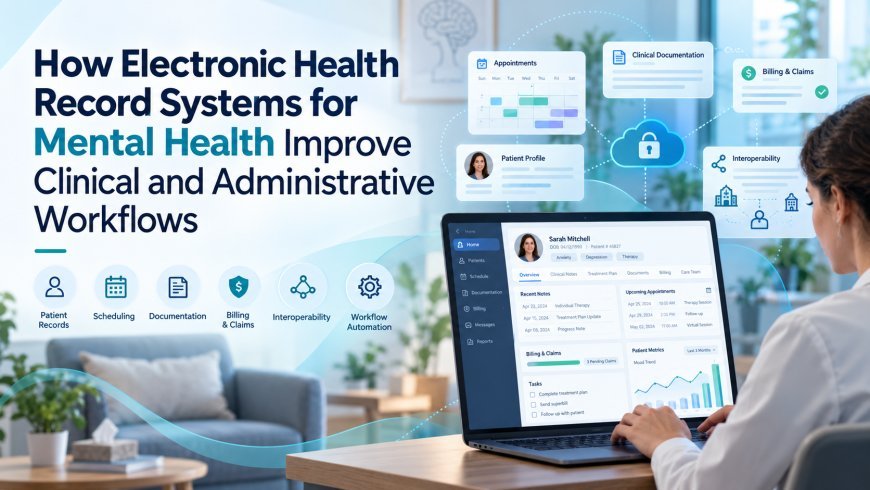
Electronic health record systems have become central to how mental health organizations manage clinical care, patient information, scheduling, documentation, billing, referrals, and communication. Yet the value of an EHR depends heavily on how well it supports the actual workflows of therapists, psychiatrists, counselors, care coordinators, administrators, and billing teams.
Behavioral health organizations have made significant progress in EHR adoption, but important technology gaps remain. In 2024, 68% of U.S. substance-use and mental-health treatment facilities reported using only an EHR to maintain patient records, while another 25% still combined EHRs with paper charts. More importantly, only 48% of EHR-only facilities reported electronically integrating outside information, highlighting that adoption does not automatically mean interoperability.
That distinction matters.
A mental health organization may already have an EHR but still rely on separate systems for intake, billing, eligibility verification, patient communication, assessments, referrals, telehealth, and reporting. When these systems are poorly connected, staff become responsible for moving information manually between workflows.
For established providers, the opportunity is therefore not simply to digitize records. It is to create an EHR environment that improves clinical productivity, reduces administrative work, connects departments, and supports future growth.
1. How Mental Health EHR Systems Improve Clinical Workflows
A strong mental health EHR should be designed around the patient journey and the daily work of clinicians. The objective is not simply to collect more information, but to make the right information available at the right stage of care while reducing unnecessary navigation and repetitive documentation.
1. Centralize Patient Information for Faster Clinical Review
Mental health clinicians frequently need to review previous progress notes, diagnoses, medications, assessment results, treatment goals, referrals, and recent patient communication before beginning a session. When this information is distributed across different screens or applications, preparation becomes slower and important context can be missed.
A well-designed EHR can organize relevant clinical information into a longitudinal patient view. Therapists can review recent changes without searching through dozens of separate records, while psychiatrists can access medication and treatment history in the same environment.
This creates better continuity while reducing the amount of administrative preparation required before each encounter.
2. Support Behavioral-Health-Specific Documentation
Generic medical documentation workflows do not always fit behavioral health.
Therapists and mental health providers may use SOAP notes, DAP notes, BIRP notes, psychiatric evaluations, treatment plans, group-session documentation, discharge summaries, and organization-specific forms.
Modern EHR systems can provide configurable templates based on service type, provider role, program, and clinical workflow.
This reduces the need for clinicians to force behavioral-health information into structures designed for other medical specialties. It also allows organizations to standardize documentation where consistency is important while preserving flexibility for meaningful clinical narrative.
3. Connect Assessments With Ongoing Treatment
Standardized behavioral health assessments are most valuable when clinicians can see how results change over time.
If PHQ-9, GAD-7, substance-use screenings, or organization-specific assessments are collected separately from the EHR, therapists may need to search for previous scores manually.
An integrated EHR can associate assessment results with treatment plans, encounters, and longitudinal patient history.
This allows clinicians to view changes across multiple sessions and use structured information to support care planning. Measurement becomes part of the clinical workflow rather than an administrative form that is completed and then rarely reviewed.
4. Turn Treatment Plans Into Active Clinical Tools
Treatment plans often become static documents that are updated mainly to meet review requirements.
Modern EHR systems can make treatment goals visible throughout the care process.
A therapist can reference active goals during documentation, associate interventions with specific objectives, review progress across sessions, and receive reminders when treatment plans require updating.
This creates a clearer relationship between assessment, treatment planning, clinical documentation, and outcomes.
The result is a more connected record in which the treatment plan reflects ongoing care rather than existing as an isolated document within the chart.
5. Improve Medication and Psychiatry Workflows
Organizations providing psychiatric services need additional functionality around medications, prescribing, medication reconciliation, lab information, and follow-up.
Behavioral-health EHR adoption data show that facilities using EHR-only environments report higher use of functions such as electronic prescribing, medication reconciliation, and lab access than organizations that still combine electronic and paper records.
Connecting these workflows allows psychiatrists and therapists to work from a more complete patient record.
For integrated behavioral health organizations, medication history should be visible alongside treatment notes, assessments, and care-plan information rather than maintained as a separate workflow.
6. Make Clinical Task Management More Reliable
A clinician's workload extends beyond scheduled appointments.
Therapists may need to complete documentation, respond to patient messages, review assessments, update treatment plans, coordinate referrals, sign records, and follow up after missed appointments.
A modern EHR can organize these responsibilities into structured work queues.
Tasks can be prioritized by due date, clinical workflow, patient status, or organizational rules.
This reduces dependence on memory, email, and manual tracking. It also gives supervisors better visibility into outstanding work without requiring them to repeatedly contact individual clinicians for status updates.
2. How EHR Systems Reduce Administrative Work Across Mental Health Organizations
Clinical efficiency is only one part of EHR value. Administrative teams manage intake, scheduling, eligibility, referrals, authorizations, billing, payments, communication, and reporting. When these functions operate independently, organizations create unnecessary manual work and increase the risk of inconsistent data.
1. Connect Digital Intake With the Patient Record
Intake is one of the first places where duplication occurs.
Patients may complete demographics, clinical history, insurance information, consent forms, referral details, and screening assessments online, only for administrative staff to transfer the same information manually into the EHR.
Integrated intake eliminates much of this repeated work.
Approved information can populate the appropriate patient record automatically, while incomplete items can be flagged before the first appointment.
Therapists enter the encounter with better context, and administrative teams spend less time copying information between systems.
2. Improve Scheduling Around Provider Availability and Service Type
Mental health scheduling can become complex as an organization adds providers, specialties, telehealth, locations, appointment types, and different service durations.
A modern EHR can connect scheduling with provider availability, credentials, location, specialty, appointment type, and patient preferences.
Instead of simply displaying open calendar slots, the system can help administrators match patients with appropriate clinicians.
Better scheduling also gives leadership visibility into utilization, wait times, cancellations, and capacity so staffing decisions can be based on actual operational demand.
3. Reduce Manual Insurance Eligibility Work
Eligibility verification often takes place outside the main clinical system.
Administrative teams may access payer portals, verify coverage, record benefit information, and then manually enter results into intake, scheduling, or billing systems.
A more integrated workflow can bring eligibility information closer to the EHR and revenue-cycle process.
This allows organizations to identify coverage issues before services are delivered, reduce repeated data entry, and give both administrative and billing teams access to consistent insurance information throughout the patient journey.
4. Connect Authorization Management With Care Delivery
Behavioral health services may depend on payer authorizations linked to specific dates, visit counts, levels of care, or treatment requirements.
When authorization information lives in spreadsheets or separate billing tools, clinicians and schedulers may not know how much authorized care remains.
Integrating authorization information with the EHR helps organizations monitor usage before appointments occur.
Scheduling, utilization review, treatment plans, and billing can then operate from the same authorization status, reducing the risk of delivering services that later become difficult to reimburse.
5. Improve Referral and Care Coordination Workflows
Mental health patients frequently move between therapists, psychiatrists, primary-care providers, hospitals, substance-use programs, community services, and specialists.
ASPE research has identified information exchange and interoperability as continuing challenges for behavioral-health providers, even as digital strategies increasingly support integrated physical and behavioral healthcare.
A modern EHR can track referral creation, required documentation, appointment status, and follow-up actions.
This helps teams understand whether the patient actually reached the next provider instead of losing visibility after the referral was sent.
6. Reduce Repetitive Administrative Communication
Mental health organizations send many predictable communications: appointment reminders, intake requests, assessment forms, consent documents, telehealth instructions, follow-up messages, and scheduling notifications.
These activities do not always require manual staff involvement.
When communication is connected to the EHR workflow, messages can be triggered by patient events.
A completed intake may trigger scheduling instructions, while an upcoming appointment may generate reminders automatically.
This reduces repetitive administrative workload while preserving direct human communication for situations requiring clinical context, judgment, or sensitive discussion.
3. How EHR Integration Improves Billing, RCM, and Organizational Visibility
Mental health organizations often treat clinical and financial workflows as separate systems, but reimbursement depends heavily on what happens inside the clinical record. EHR modernization creates the most value when documentation, billing, payer workflows, reporting, and administrative operations become part of a connected information environment.
1. Connect Documentation Completion With Billing Readiness
A clinical encounter may be complete from the therapist's perspective but still be unbillable because a signature, treatment-plan element, authorization detail, service code, or required field is missing.
An integrated EHR can check these requirements before the encounter moves downstream.
Instead of billing teams discovering the problem days later, the clinician can receive a targeted notification while the encounter is still recent.
This reduces repeated back-and-forth between departments and shortens the distance between care delivery and claim preparation.
2. Improve Claims Quality Before Submission
Claims problems often begin before the claim is created.
Incorrect payer information, incomplete documentation, inconsistent service details, missing authorization data, or patient coverage changes can all contribute to rejection or denial.
A modern EHR-RCM environment can validate these elements earlier.
Rules-based checks can identify missing information, while integrated eligibility and authorization data improve claim readiness.
The objective is not simply to submit claims faster. It is to reduce avoidable errors before they enter the payer workflow and create additional administrative work.
3. Give Billing Teams Better Clinical Context
Billing teams often need to investigate claims without seeing enough of the clinical workflow that produced them.
When EHR and RCM systems are connected, billing staff can understand encounter status, documentation completeness, authorization information, provider activity, and other relevant operational details without requesting information manually.
A well-designed Custom healthcare software Solution can connect established EHR, billing, payer, CRM, and reporting systems where replacing every application would create unnecessary disruption.
This creates continuity across clinical and financial teams while preserving existing systems that still provide value.
4. Make Denial Management More Preventive
Traditional denial management is reactive. A claim is denied, billing staff investigate the reason, correct it, and resubmit.
Modern EHR and RCM environments can use denial patterns to identify problems earlier.
If the same payer repeatedly rejects claims because of documentation, authorization, coding, or eligibility issues, the organization can address the upstream workflow.
This turns denial management from claim-by-claim correction into operational improvement.
The goal is to understand why denials happen and prevent recurring patterns rather than simply process them faster.
5. Connect Clinical and Financial Reporting
Clinical leaders and financial leaders often work from different reporting systems.
A modern EHR environment can connect operational information such as appointments, provider productivity, documentation completion, program utilization, and patient volume with financial information such as claims, payments, denials, and payer performance.
This gives leadership a more complete view of organizational performance.
Instead of asking why revenue changed after the fact, teams can see whether the underlying cause is appointment volume, provider capacity, incomplete documentation, authorization issues, or payer behavior.
6. Improve Multi-Location Operational Visibility
Multi-location mental health organizations need to compare performance across programs, facilities, providers, and service lines.
Separate local systems make this difficult because reporting definitions and workflows may vary between locations.
A centralized EHR environment can standardize core information while allowing location-specific operational rules.
Leadership can review patient access, appointment utilization, clinician workloads, documentation status, billing performance, and other indicators across the organization.
Better visibility makes it easier to identify which locations require workflow changes, additional staffing, or technology improvements.
4. How Modern EHR Architecture Prepares Mental Health Providers for Future Growth
An EHR can support current operations and still be poorly prepared for future growth. As organizations add locations, programs, clinicians, integrations, patient volume, and digital capabilities, architecture becomes increasingly important. Scalability, interoperability, security, cloud readiness, and extensibility determine whether the EHR continues supporting the business or eventually becomes a constraint.
1. Build for Interoperability, Not Just Internal Recordkeeping
Behavioral-health providers still face meaningful interoperability gaps.
ONC reported that only 19% of substance-use and mental-health treatment facilities participated in a health information exchange organization in 2024, while 48% of EHR-only facilities electronically integrated outside information.
These gaps matter because mental health care frequently intersects with primary care, hospitals, pharmacies, labs, and social services.
Modern EHR architecture should support secure external data exchange so clinicians can work with a more complete picture of the patient's healthcare journey.
2. Use FHIR and APIs to Reduce Integration Friction
Behavioral-health interoperability is receiving greater federal attention.
ASTP/ONC and SAMHSA are currently testing behavioral-health-specific FHIR profiles and the USCDI+ Behavioral Health dataset in real-world settings, with pilots designed to address interoperability, privacy, consent, and 42 C.F.R. Part 2 considerations.
For providers, the practical takeaway is clear: future-ready EHR environments need integration capabilities that can evolve with healthcare data standards.
APIs and FHIR-based services make it easier to connect external applications without repeatedly modifying the core EHR.
3. Modernize Legacy Components Without Replacing Everything
Established mental health organizations may have years of patient data, billing rules, custom forms, integrations, and clinical workflows inside existing platforms.
Replacing all of that at once can create significant operational risk.
A phased modernization approach can target the components causing the most friction.
Organizations may begin with reporting, integration services, document storage, outdated interfaces, databases, or performance issues.
Modernizing incrementally preserves valuable business logic while allowing the EHR environment to become more scalable and easier to enhance.
4. Use Cloud Architecture to Support Growth
Growth places additional pressure on infrastructure.
An EHR designed for a small clinic may experience slower performance as the organization adds hundreds of users, additional facilities, integrations, dashboards, and high-volume background processes.
Modern cloud architecture can improve elasticity, monitoring, resilience, deployment, and disaster recovery.
However, cloud migration should be treated as an architectural improvement rather than a simple hosting change.
Applications, databases, integration services, and security controls need to be designed so the environment can actually scale with demand.
5. Introduce AI Where It Reduces Administrative Friction
AI can support mental health EHR workflows when applied to specific tasks such as documentation drafting, clinical record summarization, workflow prioritization, administrative message routing, and operational analytics.
The most effective implementations keep clinicians responsible for clinical interpretation and final documentation approval.
AI should reduce navigation and repetitive administrative effort rather than make autonomous treatment decisions.
Organizations should also consider data quality, privacy, security, model monitoring, and human review before embedding AI deeply into clinical workflows.
6. Treat the EHR as an Evolving Business Platform
Mental health organizations change continuously.
New payer requirements emerge. New locations open. Clinical programs expand. AI capabilities improve. Interoperability standards evolve. Patient expectations change.
An EHR should therefore be managed as an evolving product rather than a one-time implementation.
Organizations should continually evaluate technical debt, clinician feedback, integration reliability, workflow bottlenecks, reporting needs, and emerging capabilities.
This approach reduces the risk of waiting until the platform becomes so outdated that every improvement becomes expensive, disruptive, and technically risky.
Conclusion
Electronic health record systems can significantly improve mental health workflows when they are designed as more than digital chart repositories.
The greatest value appears when clinical, administrative, financial, and operational workflows are connected.
For clinicians, that means faster access to patient context, flexible documentation, integrated assessments, active treatment plans, and better task management.
For administrative teams, it means connected intake, scheduling, eligibility, authorizations, referrals, and patient communication.
For billing teams, it means clearer documentation status, stronger claim readiness, better denial visibility, and more connected revenue-cycle workflows.
For leadership, it means consistent data across locations, providers, programs, and financial operations.
Behavioral health organizations have made substantial progress in adopting EHR systems, but interoperability remains an important gap. Federal research continues to show that health information exchange, integrated external data, and patient engagement capabilities lag behind basic electronic record adoption.
That is why the next stage of EHR transformation is not simply about digitization.
It is about connection, automation, modernization, and scalability.
Mental health providers that modernize their EHR environments around real workflows can reduce administrative friction, improve coordination, strengthen financial operations, and create a technology foundation capable of supporting future locations, programs, integrations, and digital services.
The strongest EHR system is ultimately the one that becomes less visible in daily work—because information moves where it should, repetitive tasks are reduced, clinicians can focus on care, and operational teams have the visibility they need to run the organization effectively.
What's Your Reaction?
 Like
0
 Dislike
0
 Love
0
 Funny
0
 Angry
0
 Sad
0
 Wow
0