

















IGCSE vs CBSE: Which Curriculum Fits Different Learning Needs?
Compare IGCSE vs CBSE to understand the differences in learning approaches, subject choices, assessment methods, and future education pathways. Discover the key factors parents should consider when selecting a school curriculum that suits their child's academic interests and learning needs.

IGCSE vs CBSE: Which Curriculum Fits Different Learning Needs?
Choosing the right school curriculum is an important decision for parents. With multiple educational boards available in India, understanding the differences between IGCSE and CBSE can help families select an approach that suits their child's learning preferences, academic interests, and future goals.
Both curricula offer structured education, but they differ in their learning approaches, assessment methods, and subject options. When comparing IGCSE vs CBSE, parents should consider how each curriculum supports their child's academic development.
Understanding the IGCSE Curriculum
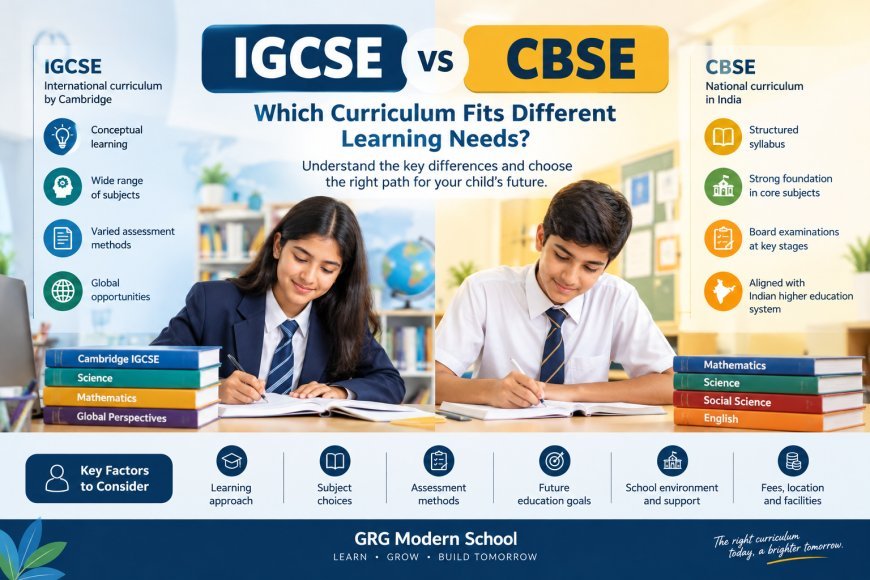
The International General Certificate of Secondary Education (IGCSE) is an international qualification offered by Cambridge International Education. It emphasises subject understanding, analytical thinking, problem-solving, and applying knowledge in different contexts.
Depending on the subject, assessment may include written examinations, coursework, practical assessments, or other evaluation methods. The specific assessment structure varies by qualification and subject.
Students following the IGCSE curriculum may benefit from opportunities to explore subjects in depth and develop independent learning skills.
Understanding the CBSE Curriculum
The Central Board of Secondary Education (CBSE) is a national education board in India. Its curriculum provides a structured academic framework across subjects, with prescribed syllabuses and board examinations at key stages.
CBSE education covers core subjects and offers pathways suited to students pursuing different academic interests. Its structure can be particularly familiar to families planning to continue their children's education within India's school and higher education systems.
IGCSE vs CBSE: Key Differences
1. Learning Approach
IGCSE places emphasis on conceptual understanding, inquiry, analysis, and applying knowledge. CBSE also incorporates competency-based learning and application-oriented questions, alongside structured syllabus coverage.
Parents should examine how individual schools deliver their respective curricula rather than assuming that every school follows the same teaching methods.
2. Subject Choices
IGCSE offers a range of subjects, with availability depending on the school and qualification stage. Students may be able to choose combinations that reflect their interests and academic goals.
CBSE provides a structured subject framework, with options and combinations varying by class and school.
3. Assessment Methods
Assessment under IGCSE varies by subject and may include examinations, coursework, or practical components where applicable. CBSE assessment methods also vary by class and subject, including school-based assessments and board examinations at designated stages.
Understanding assessment patterns can help parents identify which learning environment may suit their child's strengths.
4. Development of Academic Skills
Both curricula aim to build subject knowledge and prepare students for further education. IGCSE can provide opportunities for analytical thinking, research, and independent learning, while CBSE supports structured subject learning and competency development.
The quality of teaching, classroom activities, feedback, and academic support also influences how students develop these skills.
5. Future Education Plans
Students from both curricula can pursue higher education, subject to the eligibility requirements of their chosen institutions and courses.
Families considering universities in India or abroad should check subject prerequisites, qualification recognition, and admission requirements before selecting a curriculum.
How Can Parents Choose Between IGCSE and CBSE?
When comparing IGCSE vs CBSE, parents can consider the following factors:
-
Learning preferences: Does the child benefit from inquiry-based learning, structured lessons, or a combination of approaches?
-
Academic interests: Which subjects does the child enjoy, and what options are available?
-
Assessment preferences: How comfortable is the child with different forms of assessment?
-
Future plans: What qualifications and subjects may be required for future studies?
-
School environment: What teaching methods, facilities, and student support does the school provide?
-
Practical considerations: What are the fees, location, transport arrangements, and availability of the desired programme?
There is no single curriculum that is best for every student. The right choice depends on the child's needs, family priorities, and the quality of the school delivering the curriculum.
Exploring Curriculum Options at GRG Modern School
Parents researching international education in Coimbatore can explore GRG Modern School to learn about its curriculum, teaching approach, academic programmes, and student learning opportunities. Families should confirm the specific programmes and qualifications currently offered by the school before making an admission decision.
Comparing curricula alongside the school's learning environment can help parents make a more informed choice for their child's education.
Conclusion
The comparison of IGCSE vs CBSE involves more than choosing between an international and a national curriculum. Learning approaches, subject availability, assessment methods, future academic goals, and school-level support all deserve consideration.
By understanding these differences and evaluating their child's individual needs, parents can select an educational pathway that supports academic progress, skill development, and future opportunities.
What's Your Reaction?
 Like
0
Like
0
 Dislike
0
Dislike
0
 Love
0
Love
0
 Funny
0
Funny
0
 Angry
0
Angry
0
 Sad
0
Sad
0
 Wow
0
Wow
0