



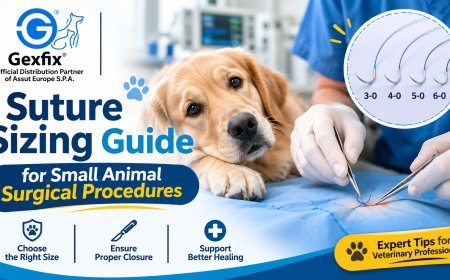














Suture Sizing Guide for Small Animal Surgical Procedures
This suture sizing guide helps small animal teams match USP sizes to tissue, patient weight and procedure, with ranges for dogs and cats and common mistakes.

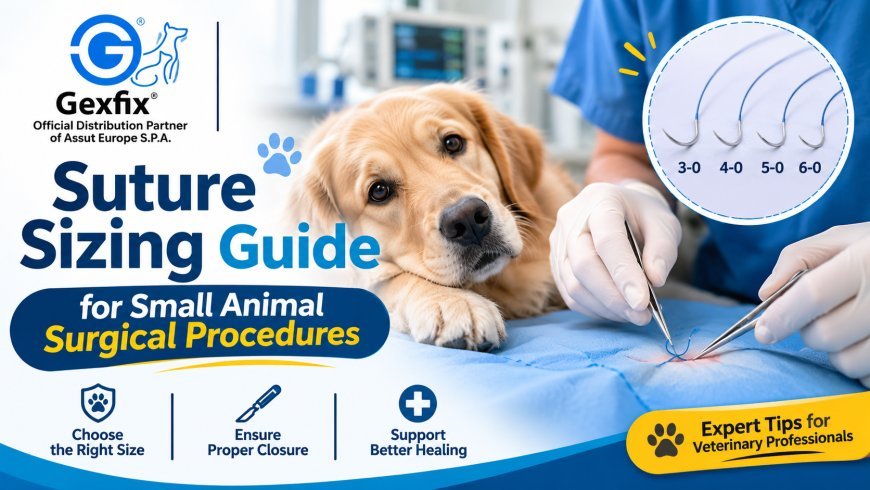
Every small animal surgery involves a decision about thread thickness, and that decision is easier when it is tied to the tissue being closed instead of memorized as a single number. A kitten under two kilograms and a retriever over thirty kilograms may need the same procedure yet require very different threads, because skin thickness, tissue volume and the load placed on a closure all change with body size. Suture sizing gives veterinary teams a shared language for these choices because the same labels appear on packages from every manufacturer. This guide explains how the labels work and why careful selection matters more in small patients. It then covers typical size ranges for common canine and feline procedures, the influence of material and needle choice, worked examples and the mistakes that cause most closure problems. It is general educational information and the attending veterinarian makes the final choice for each patient.
How Suture Size Is Labeled
Suture thickness follows the United States Pharmacopeia scale, usually written as USP. The scale looks backward at first because it counts downward through zeros. Plain numbers such as 1 and 2 describe heavy threads. Size 0 is finer than size 1, and after that each added zero means a finer thread, so 2/0 is finer than 0 and 4/0 is finer than 3/0. Packages may print the same size as 3 0 or 000 but every version means the same thing.
A metric number usually appears beside the USP size. It gives the diameter in tenths of a millimeter. USP 2/0 matches metric 3, USP 3/0 matches metric 2, USP 4/0 matches metric 1.5 and USP 5/0 matches metric 1. Comparing these numbers helps when products from different regions or manufacturers are being evaluated.
Diameter and strength rise together for a given material. A thicker thread holds more force before it breaks, but it also leaves a larger channel in the tissue and a bulkier knot. The guiding principle in surgical teaching is to use the finest thread that will reliably hold the tissue for as long as healing requires. A thread much stronger than the tissue can cut through the tissue before the thread ever fails, while a thread that is too weak will break under ordinary load and the closure will open.
Why Small Animals Need Careful Size Selection
Small animal patients cover an enormous range in a single clinic day. Skin in a toy breed or a kitten is thin and can tear under a heavy thread or a tight knot. Internal structures such as the bladder wall and the intestine are delicate and heal best when they are handled with fine material and small needles. At the other end of the range a large dog carries more tissue and generates more tension across a body wall closure, which calls for heavier threads in load bearing layers.
Thread size also affects tissue reaction. Every strand placed in a wound is foreign material, and more material usually means more inflammation. A heavier thread than the tissue needs adds that reaction without adding any benefit. In very small patients this extra bulk can also be felt under the skin or irritate the patient, which may lead to licking and chewing at the incision.
Four Factors That Guide Size Selection
Most surgeons run through a short mental routine before opening a package. The same four questions apply to almost every procedure.
Tissue Strength and Load
Skin and fascia hold stitches well, the abdominal wall carries the weight of the abdominal contents and the force of movement, and hollow organs are thin and must seal without leaking. Estimating how much load a tissue will carry during healing is the center of the decision, and heavier load calls for a heavier thread.
Healing Time
Some tissues regain strength within a few weeks, while others such as the body wall and tendons take much longer. A thread that loses strength too early leaves the repair unsupported, and a thread that lingers far beyond the need leaves material behind that the body must manage. Absorbable materials lose strength well before they disappear completely, so the strength curve matters more than the absorption date printed on the package.
Patient Size and Activity
The same layer in a cat and in a large dog calls for different sizes. Activity level matters too, because a restless patient places more stress on a closure than a calm one. A surgeon may add support through an extra layer or choose a slightly heavier size when heavy activity is expected during recovery.
Material and Needle
Size cannot be chosen alone because two threads of the same size from different materials behave differently. The needle also decides how the thread enters the tissue. Material, size and needle are best selected together.
Typical Size Ranges by Procedure
The ranges below are general reference points used in teaching and common small animal practice. Individual surgeons may choose differently based on the patient, the tissue and the conditions of the case.
Spay and Neuter Procedures
Ligation of the ovarian pedicles in a spay needs a secure knot because a slipped knot can cause serious bleeding. Cats and small dogs commonly receive 3/0, medium dogs often receive 2/0 and large dogs may need 0 or heavier depending on the thickness of the pedicle. The linea alba carries load and generally takes a heavier thread than the layers above it, while the subcutaneous layer usually needs only 3/0 or 4/0 in small patients. In a castration the spermatic cord is commonly ligated with 3/0 or 2/0 depending on the size of the dog, and skin or scrotal closure when it is performed uses fine thread.
Abdominal Wall Closure
The linea alba is the main load bearing layer in a midline closure. Cats and small dogs commonly receive 3/0 or 2/0 in this layer while medium to large dogs often receive 2/0 or 0. Giant breeds may need heavier sizes. A material that keeps useful strength for longer than the subcutaneous layer requires is usually chosen here, because the body wall needs weeks to regain its own strength.
Hollow Organs
Intestinal walls are thin and must seal without leaking, so sizes of 3/0 to 4/0 are common in small animals with the finer end used for cats and small dogs. A monofilament absorbable material with a taper needle is a frequent choice. The bladder wall heals quickly but must remain watertight, and sizes of 3/0 to 4/0 are common in cystotomy for the same reason. Stomach tissue is thicker than intestine and often takes 2/0 to 3/0 in dogs.
Subcutaneous Closure After Mass Removal
Closing dead space prevents fluid from collecting beneath the skin. Sizes of 3/0 to 4/0 are common in cats and small dogs while larger dogs may use 2/0 or 3/0. The goal is enough support to hold the tissue together and take tension off the skin without adding bulk that the body must absorb.
Skin Closure and Lacerations
Skin closure in cats and small dogs commonly uses 4/0 or 3/0 while medium to large dogs often use 3/0 or 2/0. Tension changes the choice. A wound over a joint or in an area where the skin is under strong tension may need a slightly heavier thread or a pattern that shares the load across wider tissue. Thin skinned breeds and older patients often tear more easily so a finer thread and gentle knot tension help protect the edge.
Orthopedic Soft Tissue Work
Joint capsule and fascia closures in dogs commonly use sizes from 2/0 to 0 depending on the size of the patient and the joint. Tendon repairs need materials that keep their strength for a long time and are usually planned with specialist guidance.
Rabbits, Ferrets and Other Small Pets
Very small patients generally need finer sizes than a cat. Rabbit skin in particular is thin and can tear easily, so surgeons often choose fine absorbable thread and buried patterns for skin closure. Species differ widely and the veterinarian chooses based on experience with the species and the specific tissue.
Matching Size to Patient Weight and Breed
Body weight is a practical guide because tissue thickness and load increase with size. Kittens and toy breeds sit at the finest end of nearly every range, cats and small dogs sit in the fine to middle range and medium dogs use the middle of the ranges. Large and giant breeds use the heavier end especially for body wall and orthopedic closures.
Breed adds another layer. Sighthounds and some other lean breeds have thin skin that tears easily around sutures. Bulldogs and other breeds with loose folded skin bring different problems because the skin shifts and edges are harder to line up. Obese patients may have thick fat layers that need careful closure under the skin to avoid dead space. Each of these factors can nudge the choice one size in either direction.
How Material Changes the Decision
Material affects how much strength a given size provides and for how long. Absorbable sutures break down in the body and suit internal layers where nothing should be left behind. Non absorbable sutures such as nylon keep their strength much longer and are common for skin closure that will be removed later.
Absorption time and strength time are not the same thing. A mid term monofilament such as PGCL may take roughly ninety to one hundred twenty days to be fully absorbed, but product data shows that most of its strength is gone within about two to three weeks. A long term monofilament such as PDS takes about one hundred eighty to two hundred ten days to absorb and keeps useful strength much longer. The instructions for use for each product list strength and absorption data, and the surgeon should compare that data with how long the tissue needs support.
Structure influences handling and risk. A monofilament passes smoothly through tissue and resists bacterial wicking, which makes it popular for contaminated or higher risk fields. A braided material handles easily and ties securely. Barbed threads grip tissue without knots and are used in specific closures. The best size depends on the material chosen, so these decisions are made together.
Pairing Size With the Needle
The needle should suit both the tissue and the thread. A very fine thread paired with a large needle leaves a hole larger than the thread needs, and a heavy thread on a very small needle drags through tissue and can fray. Packaged sutures generally pair standard needles with each size, so most of this matching is done in advance, but the surgeon should still confirm that the attached needle suits the tissue.
Taper needles spread tissue fibers and suit soft tissue and hollow organs. Cutting and reverse cutting needles slice through tough tissue and suit skin. Curvature and length matter as well. The client's Monofil 3/0 listings show how one thread can pair with different needles, with an HR 26 needle described as a 26 mm half circle taper for soft layers and a DS 24 needle described as a 24 mm three eighths circle cutting needle for skin.
Worked Examples
A Healthy Adult Cat Spay
A healthy adult cat needs ligation of the ovarian pedicles and closure of the abdomen. The pedicles need a secure knot so a size around 3/0 is common. The linea alba carries load and typically takes 3/0 or 2/0, while the subcutaneous layer needs little strength and may be closed with 4/0. The skin may be closed with a buried pattern using fine thread that avoids a removal visit.
A Large Dog With a Clean Flank Laceration
A large dog arrives with a clean straight laceration along the flank. The skin is thick and the wound is long, so deeper layers may be closed with 3/0 or 2/0 absorbable thread. The skin may be closed with 3/0 or 2/0 non absorbable monofilament or with staples depending on tension and surgeon preference. The heavier choice reflects the size of the dog and the thickness of the skin.
A Small Dog With a Bladder Stone
The bladder wall needs a watertight closure with minimal foreign material. A fine absorbable monofilament such as 4/0 is common with a small taper needle. A heavier thread would add bulk without adding strength the tissue needs, and material left in the bladder can attract mineral deposits in some patients.
When Other Closure Methods Fit
Some layers can be closed without thread at all, and knowing where these options fit helps explain why sizes are chosen for deeper layers. A skin stapler closes long straight skin incisions quickly with even spacing. It closes the skin layer only so deeper layers still need suture chosen by the principles above, and staples are removed after healing.
Tissue adhesive holds the edges of short shallow wounds that are under little tension. It sets within seconds and wears away as the skin heals, which avoids a removal visit. It does not support deeper layers or wounds that move a lot. Some teams apply a thin layer of surgical glue over a finished closure as a surface barrier in patients that tend to lick, which supports a properly closed wound but never replaces structural closure.
Many procedures combine methods. Deep layers may be closed with absorbable thread sized to the tissue, and the skin finished with staples or adhesive depending on incision length, tension and the behavior of the patient.
Handling, Instruments and Knots
A correctly chosen size still fails when it is handled poorly. Needle holders should grip the needle without crushing the thread, and a holder that is too large can bend a fine needle while one that is too small may let a large needle rotate. Forceps should hold tissue gently and scissors should cut cleanly. Well maintained veterinary surgical instruments support accurate suture placement and protect finer sizes from damage, and proper cleaning and sterilization lower infection risk.
Knot technique changes with size as well. Fine monofilament can slip when too few throws are used so surgeons often add an extra throw, while heavier threads make bulky knots that should be trimmed neatly and buried away from the wound line when possible. Tension matters at every size because a knot tied too tight squeezes tissue and reduces blood flow, while a knot tied too loose leaves a gap where fluid collects.
Label Checks and Storage
The package label should be read before every opening. It shows the material, the size, the needle type, the strand length, the sterility statement and the expiration date. Packs should stay in their original sterile packaging in a clean dry place, older stock should be used first and any pack that is damaged or wet should be discarded. Products labeled for veterinary use only are intended for animal patients.
Common Sizing Mistakes
Several errors appear again and again in small animal practice. Some surgeons choose a thread heavier than the tissue needs and cause extra trauma, while others choose a thread too fine for a load bearing layer so it breaks. Treating absorption time as if it were strength time is common and leaves layers unsupported when the thread weakens early. Using the same size for every patient regardless of body size causes problems at both ends of the weight range. Other mistakes include pairing a very fine thread with a needle that is too large, tying too few throws with fine monofilament, tying knots too tight and relying on adhesive to hold a wound under real tension. Running through the four questions before opening the package prevents most of these errors.
Summary
Good suture sizing in small animal surgery comes from a simple routine applied to each tissue. Consider how much load the tissue carries and how long it needs support, account for the size and activity of the patient and then pair the thread with a suitable material and needle. Typical ranges run from very fine sizes for delicate tissue and tiny patients to heavier sizes for the body wall and orthopedic closures in large dogs. Staples and adhesive can take over in certain layers but sutures remain the most adaptable way to match strength to tissue. Careful handling and attention to labels complete the process and help every closure heal cleanly.
Gexfix International Corp. supplies absorbable and non absorbable veterinary sutures in a range of USP sizes and needle types in partnership with Assut Europe S.P.A.
FAQs
Q: What suture size is common for skin closure in cats and small dogs?
A: Sizes 4/0 and 3/0 are commonly used for skin in cats and small dogs. The surgeon chooses based on skin thickness, wound location, tension and the activity level of the patient.
Q: Why does suture size matter more in small patients?
A: Small patients have thin skin and delicate internal tissue. A thread that is too heavy can tear tissue, leave large needle holes and add bulk that causes irritation. Finer sizes keep the closure in proportion to the tissue.
Q: Does a thicker suture always hold better?
A: A thicker thread holds more force but also causes more trauma and adds more foreign material. Surgeons generally choose the finest size that securely holds the tissue for as long as healing requires.
Q: Is absorption time the same as how long a suture stays strong?
A: No. An absorbable suture can take months to disappear while losing most of its strength much sooner. The instructions for use list both figures, and the surgeon matches strength time to how long the tissue needs support.
Q: Which size is typical for the abdominal wall in dogs and cats?
A: Cats and small dogs commonly receive 3/0 or 2/0 in the linea alba, while medium to large dogs often receive 2/0 or 0. Giant breeds may need heavier sizes depending on the surgeon's judgment.
What's Your Reaction?
 Like
0
 Dislike
0
 Love
0
 Funny
0
 Angry
0
 Sad
0
 Wow
0