

























Ultrasound Devices Market Size Report: Global Industry Overview, Value & Forecast 2026-2034
Global ultrasound devices market size reached USD 10.7 Billion in 2025. Looking forward, IMARC Group expects the market to reach USD 17.8 Billion by 2034, exhibiting a growth rate (CAGR) of 5.65% during 2026-2034

Market Overview:
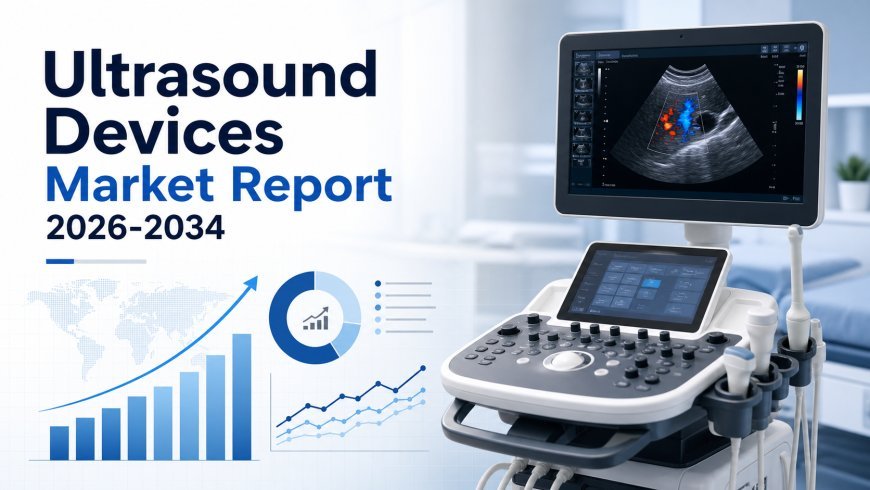
According to IMARC Group’s latest research publication, “Ultrasound Devices Market Report by Product Type, Device Display Type, Device Portability, Application, End Use, and Region”, the global ultrasound devices market size reached USD 10.7 Billion in 2025. Looking forward, IMARC Group expects the market to reach USD 17.8 Billion by 2034, exhibiting a growth rate (CAGR) of 5.65% during 2026-2034, as demand dynamics signal a robust growth trajectory for non-invasive imaging worldwide.
This detailed analysis primarily encompasses industry size, business trends, market share, key growth factors, and regional forecasts. The report offers a comprehensive overview and integrates research findings, market assessments, and data from different sources. It also includes pivotal market dynamics like drivers and challenges, while also highlighting growth opportunities, financial insights, technological improvements, emerging trends, and innovations. Besides this, the report provides regional market evaluation, along with a competitive landscape analysis.
How AI is Reshaping the Future of Ultrasound Devices Market
- AI is automating time-consuming tasks such as quantification and selecting the best image slice from a 3D dataset, which reduces operator dependence and makes ultrasound more intuitive for less experienced clinicians.
- Companies are backing AI with real capital. Philips is investing USD 150 Million to expand two US facilities that produce its AI-driven ultrasound systems and software, building on an existing annual US R&D investment of about USD 900 Million.
- GE HealthCare launched the Voluson Signature 20 and 18, which use AI for fetal anatomy recognition and automated pelvic floor and fibroid scans, along with voice control and ergonomic design.
- Handheld AI is reaching the point of care. Exo launched SweepAI, an FDA-cleared cardiac and lung scanning application for its Iris handheld system that gives real-time diagnostic feedback without needing an internet connection.
- Wipro GE Healthcare unveiled the Versana Premier R3, an AI-powered system with productivity tools designed to refine workflow, improve accuracy, and enhance patient outcomes.
Grab a sample copy of this report: https://www.imarcgroup.com/ultrasound-devices-market/requestsample
Key Trends in the Ultrasound Devices Market
- AI Integration Improves Diagnostic Accuracy: Sophisticated features such as 3D and 4D imaging, elastography, and Doppler technologies are being combined with AI-based algorithms that flag subtle abnormalities and standardize image quality. Samsung Medison unveiled its HERA Z20 premium OB/GYN system with AI-assisted diagnostics and eco-friendly design.
- Growing Demand for Portable Ultrasound Devices: Miniaturization and wireless connectivity are moving ultrasound into ambulances, community health centers, and home care. Butterfly Network debuted its third generation iQ3 digital ultrasound, offering real-time smartphone imaging and nearly double the processing power of the previous version.
- Wearable Ultrasound in Critical Care: Flosonics Medical’s FloPatch, the first wireless Doppler ultrasound device, was deployed in the surgical and transplant intensive care units of The Mount Sinai Hospital to support real-time fluid management.
- Advances in Non-Invasive Medical Imaging: Concern over ionizing radiation from CT scans and X-rays is steering doctors and patients toward radiation-free ultrasound. FUJIFILM India installed the ALOKA ARIETTA 850 endoscopic ultrasound system at Fortis Hospital, Bengaluru, improving cancer detection and non-invasive gastrointestinal care.
- Expansion Beyond Human Healthcare: Portable ultrasound is being adopted in veterinary clinics for companion animals and livestock, while industrial users apply it to material testing and quality control, opening additional revenue streams for manufacturers.
Growth Factors in the Ultrasound Devices Market
- Image-Guided Interventions and Minimally Invasive Surgery: Surgeons and interventional radiologists rely on ultrasound for precise needle placement, catheter insertion, biopsies, and tumor ablations. Radiation-free guidance is safer for both patients and clinicians and helps shorten recovery times.
- Emphasis on Preventive Healthcare: Governments, insurers, and providers are encouraging early detection. Ultrasound is used in preventive cardiology, liver disease screening, prenatal monitoring, and cancer detection programs because it is safe, repeatable, and cost-efficient.
- Point-of-Care Ultrasound and Emerging Markets: Emergency rooms, ICUs, and rural clinics use bedside systems to cut patient transfers and costs. Governments and NGOs support portable systems in maternal care initiatives and community health programs across Asia-Pacific, Latin America, and Africa.
- Affordability and Training: Manufacturers are building lower-cost models for small clinics and community hospitals, while expanded training courses are improving operator competence and broadening adoption.
- Continuous Product Launches: Esaote’s MyLab A50 and A70 battery-capable systems reached the US market, and Sonio introduced its Start, Plus, Premium, and Enterprise range for maternal health, showing sustained innovation across care settings.
Leading Companies Operating in the Global Ultrasound Devices Industry:
- Canon Medical Systems Corporation
- CHISON Medical Technologies Co. Ltd.
- Esaote SpA
- Fujifilm India Private Limited
- GE HealthCare
- Konica Minolta Inc.
- Koninklijke Philips N.V.
- Samsung Healthcare
- Shenzhen Mindray Bio-Medical Electronics Co., Ltd
- Siemens Healthineers
Ultrasound Devices Market Report Segmentation:
Breakup By Product Type:
- Diagnostic Ultrasound Systems
- 2D Imaging Systems
- 3D and 4D Imaging Systems
- Doppler Imaging
- Therapeutic Ultrasound Systems
- High-Intensity Focused Ultrasound (HIFU)
- Extracorporeal Shockwave Lithotripsy (ESWL)
Diagnostic ultrasound systems account for the majority of shares on account of rapid advances in handheld and portable devices such as the Philips Lumify.
Breakup By Device Display Type:
- Color Ultrasound Devices
- Black and White (B/W) Ultrasound Devices
Color ultrasound devices dominate the market due to detailed Doppler-based imaging and superior color flow visualization, as seen in Canon’s Aplio i-series.
Breakup By Device Portability:
- Trolley/Cart-Based Ultrasound Devices
- Compact/Handheld Ultrasound Devices
Trolley/cart-based devices lead the market because they combine enhanced imaging capability with mobility inside medical settings.
Breakup By Application:
- Radiology/General Imaging
- Obstetrics/Gynecology
- Cardiology
- Urology
- Vascular
- Others
Radiology/general imaging holds the largest share owing to the need for non-invasive organ and soft tissue assessment.
Breakup By End Use:
- Hospitals
- Imaging Centers
- Research Centers
Hospitals dominate the market as major users of ultrasound for diagnostic imaging and patient monitoring.
Breakup By Region:
- North America (United States, Canada)
- Asia-Pacific (China, Japan, India, South Korea, Australia, Indonesia, Others)
- Europe (Germany, France, United Kingdom, Italy, Spain, Russia, Others)
- Latin America (Brazil, Mexico, Others)
- Middle East and Africa
North America enjoys the leading position owing to advanced healthcare infrastructure, strong R&D activities, and the presence of key industry players.
Recent News and Developments in Ultrasound Devices Market
- August: Sonio introduced a new range of maternal health ultrasound equipment in the US, named Sonio Start, Sonio Plus, Sonio Premium, and Sonio Enterprise.
- August: Philips announced a USD 150 Million investment to expand two US facilities, including its Pennsylvania plant that manufactures ultrasound systems.
- August: Esaote made its MyLab A50 and A70 systems available in the United States, offering small, lightweight, battery-capable units for hospital, outpatient, and point-of-care settings.
- June: Flosonics Medical announced that The Mount Sinai Hospital deployed FloPatch in its surgical and transplant intensive care units, the company’s first East Coast deployment.
- March: Wipro GE Healthcare unveiled the Versana Premier R3, an AI-powered ultrasound system designed to improve clinical efficiency and precision.
- September: Samsung Medison unveiled the HERA Z20 at the ISUOG World Congress, and Exo launched SweepAI for its Iris handheld ultrasound system.
- February: FUJIFILM India launched the ALOKA ARIETTA 850 endoscopic ultrasound system, installed at Fortis Hospital, Bengaluru.
If you require specific details, data, or insights that are not currently included in the scope of this report, we are happy to accommodate your request. As part of our customization service, we will gather and provide the additional information you need, tailored to your specific requirements. Please let us know your exact needs, and we will ensure the report is updated accordingly to meet your expectations.
About Us:
IMARC Group is a global management consulting firm that helps the world’s most ambitious changemakers to create a lasting impact. The company provide a comprehensive suite of market entry and expansion services. IMARC offerings include thorough market assessment, feasibility studies, company incorporation assistance, factory setup support, regulatory approvals and licensing navigation, branding, marketing and sales strategies, competitive landscape and benchmarking analyses, pricing and cost research, and procurement research.
Contact Us:
IMARC Group
134 N 4th St. Brooklyn, NY 11249, USA
Email: sales@imarcgroup.com
Tel No:(D) +91 120 433 0800
United States: +1-201971-6302
What's Your Reaction?
 Like
0
 Dislike
0
 Love
0
 Funny
0
 Angry
0
 Sad
0
 Wow
0