























Why Does a Kids Car Struggle on Grass?
Discover why a ride-on vehicle struggles on grass, how different surfaces affect its performance, and what parents can do to improve its movement.

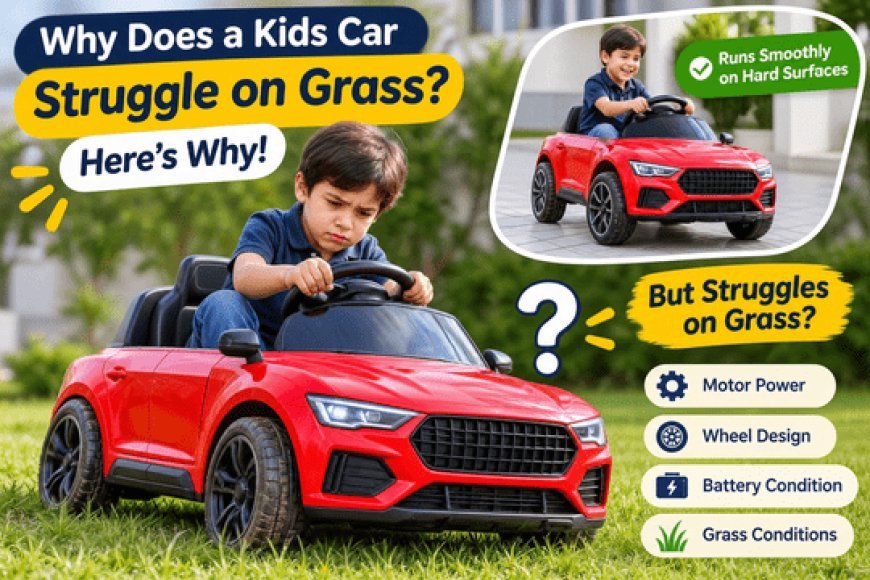
A kids car may move smoothly across indoor floors, tiles, and paved driveways but suddenly slow down when driven over grass. This difference can be confusing for parents, especially when the vehicle works perfectly well on other surfaces. The reason is usually related to traction, motor power, wheel design, and the resistance created by uneven ground. Grass may look like a simple surface, but it can make driving more difficult for small battery-powered vehicles. Understanding these factors can help parents identify why performance changes and choose suitable riding surfaces for their children's vehicles.
Why Is Grass More Difficult for Ride-On Vehicles?
Grass creates more resistance than smooth flooring. On tiles or concrete, the wheels can roll with relatively little effort. On grass, however, they must move through a surface that may be soft, uneven, or slippery.
Several conditions can make movement difficult:
-
Uneven ground: Small bumps, holes, and raised areas can interrupt wheel movement.
-
Soft soil: Wheels may sink slightly into loose ground, making it harder to move forward.
-
Wet grass: Moisture reduces traction and can cause the wheels to slip.
-
Thick grass: Longer grass can create additional resistance around the wheels.
These conditions require more effort from the motor, which is why a vehicle that performs well indoors may struggle outdoors.
5 Main Reasons a Ride-On Vehicle Struggles on Grass
1. Limited Motor Power
Motor power plays an important role in determining how easily a vehicle moves across different surfaces.
Many smaller ride-on models are designed primarily for smooth and relatively flat areas. Their motors may provide enough power for indoor floors and paved paths but struggle when additional resistance is introduced.
On grass, the motor needs to work harder to rotate the wheels and move the vehicle forward. If the available power is limited, parents may notice slower movement or difficulty climbing small slopes.
2. Wheel Design and Material
Not all wheels are suitable for outdoor surfaces.
Smooth plastic wheels can perform well on hard floors but may struggle to maintain traction on grass. They can spin without moving the vehicle forward, particularly when the ground is damp.
Some models feature wider wheels or rubber-like materials that provide better grip. However, wheel design alone does not guarantee good performance. The motor, vehicle weight, and surface conditions also matter.
3. Battery Condition
A battery-powered vehicle needs sufficient electrical power to operate its motors.
If the battery is partially discharged or has started losing capacity, the vehicle may already have reduced power. This becomes more noticeable on grass because the motor needs additional energy to overcome surface resistance.
For example, a vehicle might move normally across a smooth floor but slow down significantly when driven over a lawn.
Parents should check the battery charge, charging connections, and overall battery condition before assuming that the motor is faulty.
4. Excessive Vehicle Weight
Weight can also affect outdoor performance.
When a vehicle carries a child, the combined weight creates pressure on the wheels. On firm surfaces, this usually does not create much difficulty. However, on soft grass, the wheels may sink slightly into the ground.
This increases rolling resistance and makes movement more difficult.
Adding extra items or allowing the vehicle to carry more weight than its recommended limit can make the problem worse.
5. Wet or Uneven Grass
Sometimes, the vehicle itself is not the problem. The condition of the riding surface may be responsible.
Wet grass can become slippery, reducing the grip between the wheels and the ground. Similarly, uneven lawns can cause individual wheels to lose contact with the surface.
This can result in spinning wheels, sudden stops, and inconsistent movement.
For this reason, a dry and relatively flat grassy area is generally a better choice than wet or uneven ground.
How Does Wheel Size Affect Performance on Grass?
Wheel size can influence how easily a vehicle moves over soft outdoor surfaces.
Larger wheels may roll over small bumps and surface irregularities more easily than smaller wheels. They can also help reduce the chances of getting stuck in shallow dips.
Wider wheels may distribute the vehicle's weight across a larger contact area, which can help reduce sinking into softer ground.
However, bigger wheels are not automatically better. Their effectiveness depends on the overall vehicle design, motor capacity, available ground clearance, and tyre material.
When comparing a kids electric car, parents should consider wheel dimensions and construction alongside battery and motor specifications.
How Can Parents Improve Performance on Grass?
If a vehicle struggles outdoors, a few practical steps may help improve its movement.
1. Choose a Suitable Riding Area
Start with short rides on dry, closely cut grass. Avoid areas with deep holes, loose soil, thick vegetation, or steep slopes.
A relatively flat surface makes movement easier and reduces unnecessary pressure on the motor.
2. Check the Battery Before Outdoor Use
Make sure the battery is sufficiently charged before taking the vehicle outside.
If the vehicle continues to lose power even with a fully charged battery, consider having the battery and electrical system inspected.
3. Inspect the Wheels
Check for dirt, tangled grass, and small objects around the wheels. Remove any visible obstruction after switching off the vehicle.
Also, look for damaged wheels or loose connections that could affect movement.
4. Follow the Recommended Weight Limit
Every model has a maximum weight capacity. Exceeding it can increase resistance and put additional strain on the motor and battery.
Always check the manufacturer's specifications before use.
5. Avoid Forcing the Vehicle Forward
If the wheels keep spinning without moving the vehicle, do not continue pressing the accelerator.
Release the pedal and move the vehicle to a firmer surface. Repeatedly forcing it to move can place unnecessary stress on the motor and drivetrain.
Are All Ride-On Vehicles Suitable for Grass?
No. Different models are designed for different riding conditions.
Some are better suited to indoor floors, smooth driveways, and paved paths, while others are designed with features that support outdoor use.
Before choosing a model, parents should consider:
-
Motor power: Check whether the motor specifications are suitable for the intended surfaces.
-
Wheel construction: Look for suitable traction and durable wheel materials.
-
Ground clearance: More clearance can help when moving over minor surface irregularities.
-
Battery capacity: Consider the expected running time and charging requirements.
-
Weight capacity: Make sure the vehicle can safely support the intended rider.
Product descriptions and specifications available through online stores such as ToysUAE can help parents compare different models and understand their intended use before purchasing.
Final Thoughts
A ride-on vehicle that struggles on grass is not necessarily faulty. The difference in performance often comes from the additional resistance created by soft ground, uneven surfaces, and limited traction. Motor power, wheel design, battery condition, and vehicle weight also play important roles.
Parents can reduce these difficulties by choosing suitable riding areas, maintaining the wheels, checking battery condition, and following the manufacturer's recommendations. Understanding these factors also makes it easier to select a model that matches the surfaces where children will actually use it.
Frequently Asked Questions (FAQs)
1. Why does my ride-on vehicle move slowly on grass?
Grass creates more resistance than smooth flooring. Limited motor power, slippery wheels, low battery charge, and uneven ground can all contribute to slower movement.
2. Can plastic wheels work on grass?
Yes, but their performance depends on the wheel design and grass conditions. Smooth plastic wheels may struggle with traction, particularly on wet or uneven surfaces.
3. Does a higher motor power help with grass performance?
Generally, a more powerful motor can provide better support when additional resistance is involved. However, wheel design, battery capacity, vehicle weight, and ground clearance also affect performance.
4. Is it safe to drive on wet grass?
Wet grass can reduce traction and make the vehicle harder to control. It is better to avoid wet surfaces and follow the manufacturer's outdoor-use instructions.
5. Can grass damage the motor?
Driving occasionally on suitable grass does not automatically damage the motor. However, repeatedly forcing the vehicle through thick grass or difficult terrain can increase motor strain and potentially cause overheating.
6. Which wheels are better for outdoor surfaces?
Wider wheels with suitable tread or grip can provide better traction on some outdoor surfaces. The best option depends on the vehicle's overall design and intended use.
What's Your Reaction?
 Like
0
 Dislike
0
 Love
0
 Funny
0
 Angry
0
 Sad
0
 Wow
0