
























Why Short-Circuit and Grounding Studies Are Important in Substation Design

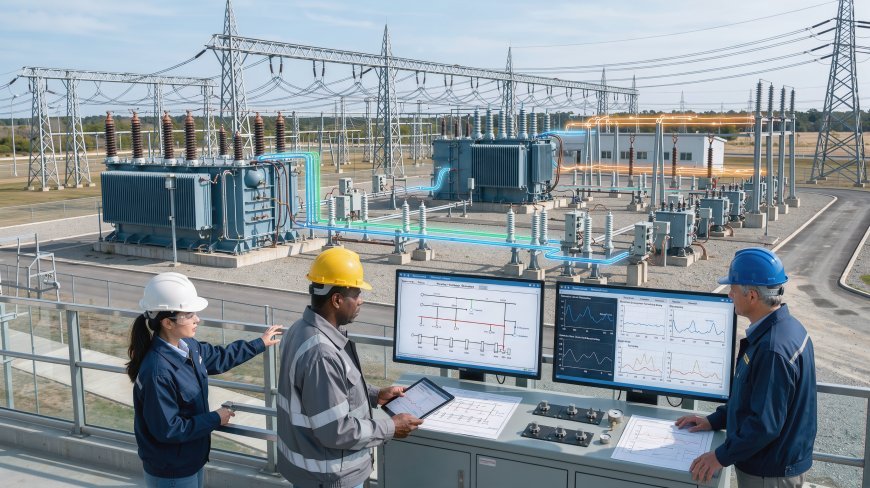
Modern electrical substations are essential components of power transmission and distribution networks. They connect generation facilities, transmission lines, transformers, and distribution systems while ensuring electricity is delivered safely and reliably. However, designing a substation involves more than selecting electrical equipment and arranging components. Engineers must understand how the electrical system will respond to faults and how fault-related currents will affect equipment, structures, and personnel.
Two important engineering activities that address these challenges are short-circuit studies and grounding studies. They help engineers identify potential electrical hazards, determine appropriate equipment ratings, and develop effective safety measures before a substation becomes operational.
Without these studies, a substation may face equipment failures, dangerous touch and step voltages, unexpected outages, and significant safety risks. Understanding their importance allows project developers and engineers to create safer, more reliable, and cost-effective electrical infrastructure.
1. Understanding the Importance of Short-Circuit Studies in Substation Design
A short circuit occurs when electrical current flows through an unintended low-impedance path. These faults can result from insulation failures, damaged equipment, lightning strikes, conductor contact, or environmental conditions. Depending on the location and type of fault, extremely high currents may flow through electrical equipment and connected network components.
Short-circuit studies evaluate the magnitude of these fault currents under different operating conditions. Engineers analyze possible fault scenarios, including three-phase faults, single-line-to-ground faults, line-to-line faults, and double-line-to-ground faults.
The primary objective is to determine the maximum and minimum fault current levels that electrical equipment may experience.
These calculations help engineers:
-
Select circuit breakers with suitable interrupting capacities.
-
Verify the short-circuit withstand ratings of transformers and switchgear.
-
Evaluate busbar thermal and mechanical withstand capabilities.
-
Determine appropriate protection relay settings.
-
Identify potential weaknesses in the electrical network.
Accurate short-circuit calculations also support equipment procurement and prevent situations where installed equipment cannot safely withstand the available fault current.
2. Fault Current Assessment and Its Role in Equipment Selection
One of the most important steps in electrical system planning is performing an accurate fault current assessment. It provides engineers with the information needed to understand how much current may flow during different fault conditions.
Fault current levels depend on several factors, including transformer impedance, generator contributions, transmission line characteristics, network configuration, and the operating status of connected equipment.
For example, a substation connected to multiple transmission sources may experience higher fault currents than a similar facility supplied by a single source. Similarly, adding new generation capacity or connecting large industrial loads can change the available short-circuit current throughout the network.
Engineers use specialized power system software to model these conditions and calculate fault levels at different electrical buses.
The results are particularly important when selecting circuit breakers, disconnect switches, current transformers, busbars, and other substation components.
If equipment ratings are lower than the calculated fault levels, a fault could cause severe equipment damage or create hazardous conditions. On the other hand, selecting equipment with unnecessarily high ratings may increase project costs.
A properly conducted assessment helps achieve the right balance between electrical safety, equipment performance, and overall project economics.
3. Why Grounding Analysis Is Essential for Personnel Safety
While short-circuit studies focus on fault current magnitude, grounding studies examine how fault currents flow through the earth and grounding system.
When an electrical fault occurs, current may enter the ground through substation equipment, grounding conductors, metallic structures, and buried electrodes. This current can create differences in electrical potential across the substation surface.
These voltage differences can expose workers and maintenance personnel to dangerous electrical shocks.
A comprehensive grounding analysis evaluates the grounding system's ability to safely conduct fault current into the earth while limiting hazardous voltage differences.
Two critical parameters are:
Step voltage: The voltage difference between two points on the ground surface separated by approximately one normal human step. It can create a dangerous current path through a person's legs.
Touch voltage: The voltage difference between a grounded metallic structure and the ground surface where a person may be standing while touching that structure.
Engineers evaluate these conditions to ensure that potential step and touch voltages remain within acceptable safety limits.
Grounding analysis also considers soil resistivity, grounding grid geometry, conductor size, electrode placement, fault duration, and surface layer characteristics.
The IEEE Std 80 grounding safety methodology is widely used as a technical reference for evaluating grounding system performance in AC substations.
4. How Substation Short-Circuit Studies Improve Protection Coordination
Electrical protection systems are designed to detect faults and isolate affected sections of the network before damage spreads.
However, protection devices must be properly selected and coordinated to operate reliably under different fault conditions.
Substation short-circuit studies provide the fault current information required to configure protection relays, circuit breakers, and other protective devices.
For instance, when a fault occurs on a feeder, the protection system should identify the affected circuit and disconnect it without unnecessarily interrupting the entire substation.
Engineers use calculated fault levels to establish suitable relay pickup settings, evaluate operating times, and verify circuit breaker interrupting capabilities.
Protection coordination studies also help prevent unwanted tripping, where an upstream protective device operates before the intended downstream device.
This coordination is particularly important in substations with multiple transformers, parallel feeders, interconnected transmission networks, and distributed generation.
Combining accurate fault calculations with protection coordination improves system selectivity, reduces outage risks, and supports reliable electrical operation.
5. Integrating Short-Circuit and Grounding Studies for Reliable Substation Engineering
Although short-circuit and grounding studies address different engineering requirements, they are closely connected.
Short-circuit calculations determine the fault current magnitude, while grounding studies use relevant fault conditions to evaluate the grounding system's electrical safety performance.
Both studies should therefore be considered together during substation design.
An effective engineering approach typically includes the following activities:
-
Network modeling: Develop an accurate representation of the electrical network, including transformers, generators, transmission lines, and other connected equipment.
-
Fault calculations: Evaluate different fault types and operating configurations to determine maximum and minimum fault current levels.
-
Grounding design: Assess soil resistivity, grounding grid dimensions, conductor sizing, and potential distribution across the substation.
-
Safety verification: Calculate step and touch voltages and compare the results against applicable safety criteria.
-
Design optimization: Adjust grounding conductors, electrode arrangements, and protective equipment specifications where necessary.
-
Technical verification: Review calculations, assumptions, equipment ratings, and design documentation before construction.
Engineering software such as ETAP, SKM PowerTools, and specialized grounding tools can support these activities when used with accurate network data and appropriate engineering assumptions.
Early integration of these studies can also reduce costly design changes during construction and commissioning.
6. Supporting Long-Term Substation Reliability Through Professional Engineering
Substation safety and reliability depend on sound engineering decisions made throughout the project lifecycle. Short-circuit and grounding studies help identify electrical risks before they become operational problems.
As power networks expand to accommodate renewable energy, battery energy storage systems, industrial facilities, and increasing electricity demand, fault levels and grounding requirements can change significantly.
Existing substations may therefore require updated engineering assessments when new equipment or generation sources are connected.
Working with experienced electrical engineering professionals helps project owners evaluate these changes and maintain compliance with applicable technical standards.
Keentel Engineering supports power infrastructure projects through specialized electrical engineering and power system study services. Comprehensive fault calculations, grounding evaluations, and protection assessments can help project developers make informed decisions about equipment selection, system safety, and substation performance.
Investing in these studies during the design stage is not simply a technical requirement. It is a practical way to protect personnel, safeguard expensive electrical assets, minimize operational disruptions, and improve the long-term reliability of the power network.
A well-designed substation begins with understanding how the electrical system behaves under both normal and abnormal conditions. Short-circuit and grounding studies provide the engineering foundation needed to achieve that goal.
What's Your Reaction?
 Like
0
 Dislike
0
 Love
0
 Funny
0
 Angry
0
 Sad
0
 Wow
0