
























What Factors Influence Zinc Stearate Performance in Rubber Production?
Rubber manufacturing involves several important processes, including compounding, mixing, shaping, moulding, and curing. Each stage requires suitable materials and additives to achieve consistent product quality. However, manufacturers often face challenges such as material sticking, poor dispersion, excessive friction, uneven surfaces, and processing delays. These problems can affect production efficiency and the quality of finished rubber products. Selecting appropriate industrial additives is essential for controlling these issues and maintaining reliable manufacturing results.
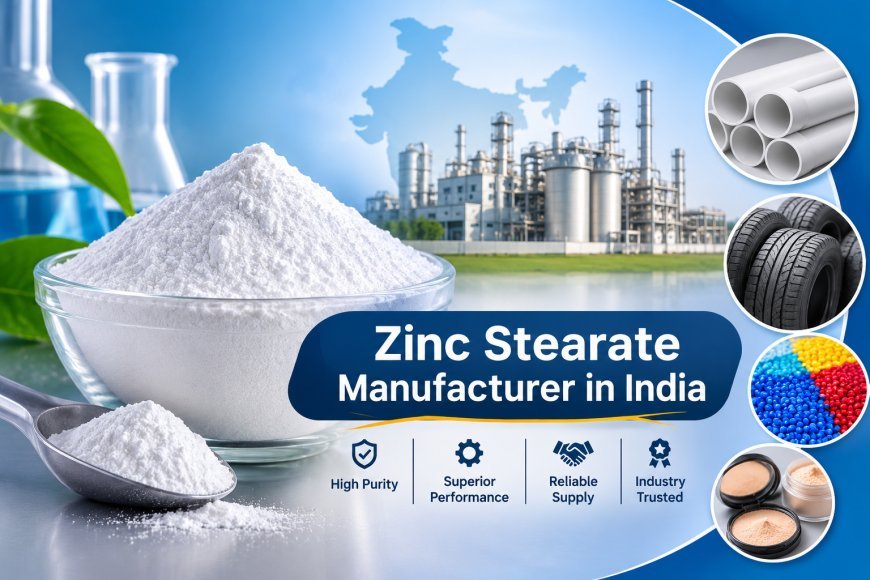
Choosing a reliable zinc stearate manufacturer in India is an important step for rubber manufacturers looking for consistent additive quality. Zinc stearate is commonly used as a lubricant, release agent, and processing aid in selected rubber applications. Its performance depends on factors such as purity, particle size, moisture content, formulation compatibility, and dosage. Understanding these factors helps manufacturers improve processing conditions and reduce avoidable production problems.
1. Purity and Chemical Composition
The purity of zinc stearate directly influences its performance in rubber manufacturing. Variations in chemical composition may affect lubrication, dispersion, and release properties during production.
Low-quality material with inconsistent composition can create formulation variations and unpredictable processing results. Manufacturers may experience sticking, uneven product surfaces, or differences between production batches.
To prevent these problems, businesses should check product specifications and select materials with consistent chemical properties. Working with a dependable supplier also helps maintain uniformity in industrial formulations.
2. Particle Size and Distribution
Particle size is another important factor affecting zinc stearate performance. It influences how easily the additive disperses throughout a rubber compound.
If particle distribution is inconsistent, the additive may not spread uniformly during mixing. This can lead to uneven lubrication and variations in the finished product.
Manufacturers should consider particle size specifications according to their production requirements. Proper mixing conditions and suitable material selection help improve dispersion and support consistent processing performance.
3. Moisture Content and Storage Conditions
Moisture can create difficulties during the handling, storage, and processing of industrial additives. Excessive moisture may affect powder flow and create challenges during material feeding and mixing.
Zinc stearate should be stored in suitable conditions to maintain its physical quality. Exposure to moisture, contamination, and improper packaging can affect material handling.
Manufacturers can reduce these risks by:
-
Storing material in a dry environment.
-
Keeping packaging properly sealed.
-
Avoiding direct contact with moisture.
-
Following recommended storage guidelines.
-
Checking material condition before production.
Proper storage helps maintain consistent additive quality and reduces unnecessary processing interruptions.
4. Correct Dosage in Rubber Formulation
Using the correct quantity of zinc stearate is essential for achieving the desired processing results. Too little additive may provide insufficient lubrication or release performance, while excessive quantities may affect the properties of the rubber compound.
Incorrect dosage can also create formulation inconsistencies and increase production costs.
Manufacturers should determine the appropriate quantity through formulation trials and technical evaluation. The required dosage may vary depending on the rubber type, manufacturing process, and intended application.
Maintaining accurate weighing and controlled mixing procedures helps achieve repeatable results across production batches.
5. Compatibility with Other Rubber Additives
Rubber formulations generally contain several ingredients, including polymers, fillers, accelerators, curing agents, lubricants, and processing aids. Zinc stearate must be compatible with the other components to perform effectively.
Poor compatibility or an unsuitable formulation balance may affect dispersion, curing behaviour, surface quality, and finished-product characteristics.
Manufacturers should evaluate the interaction between zinc stearate and other ingredients before finalizing a formulation. Conducting small-scale trials helps identify potential issues and determine suitable additive proportions.
6. Mixing Temperature and Processing Conditions
Temperature and mixing conditions can influence how zinc stearate performs during rubber production. Inadequate mixing may result in poor additive distribution, while unsuitable processing conditions can affect the overall compound.
Manufacturers should maintain appropriate mixing speeds, processing temperatures, and mixing durations according to the rubber formulation.
Regular monitoring of equipment also helps prevent inconsistent results. Maintaining controlled processing conditions supports better material distribution and reduces production variations.
7. Lubrication and Mould Release Requirements
Material sticking is a common challenge in rubber manufacturing, particularly during moulding and shaping operations. It can slow down production, increase cleaning requirements, and affect the surface finish of finished components.
Zinc stearate is used in selected applications for its lubricating and release properties. It can help reduce friction and support easier separation of rubber products from mould surfaces.
However, its effectiveness depends on the formulation, dosage, and moulding conditions. Manufacturers should test the additive under actual production conditions to determine its suitability.
8. Quality Control and Supplier Reliability
Consistent additive quality is essential for maintaining stable rubber production. Differences between material batches can affect processing behaviour and finished-product performance.
Before selecting a supplier, manufacturers should evaluate:
-
Product purity and technical specifications.
-
Particle size consistency.
-
Moisture content.
-
Packaging and storage practices.
-
Batch-to-batch quality.
-
Supply reliability and technical assistance.
Requesting samples and conducting production trials can help manufacturers assess whether the material meets their requirements.
How Ala Polystabs Supports Industrial Manufacturing
Ala Polystabs specializes in manufacturing PVC stabilizers and industrial additives for different manufacturing applications. Its product range includes zinc stearate, calcium stearate, lead stearate, PVC heat stabilizers, PVC One Pack Stabilizers, One Pack Pipe Stabilizers, and Tribasic Lead Sulphate.
The company focuses on product quality, reliable supply, and application-based solutions. By understanding customer requirements and manufacturing challenges, Ala Polystabs aims to support businesses with suitable industrial additives for consistent processing and dependable production results.
Conclusion
Zinc stearate performance in rubber production depends on several factors, including purity, particle size, moisture content, dosage, formulation compatibility, and processing conditions. Ignoring these aspects can lead to uneven dispersion, material sticking, and inconsistent product quality.
Manufacturers should evaluate additive specifications, maintain proper storage practices, and conduct formulation trials before large-scale production. Choosing a dependable supplier and using the correct zinc stearate grade can help improve processing efficiency, reduce manufacturing difficulties, and maintain consistent rubber product quality.
What's Your Reaction?
 Like
0
 Dislike
0
 Love
0
 Funny
0
 Angry
0
 Sad
0
 Wow
0