

























What Is Decision Intelligence? How Data Helps Businesses Make Better Decisions
In business, decision-making is crucial. Whether you should increase your price, what customers you should target, or which areas to invest in can be difficult to decide

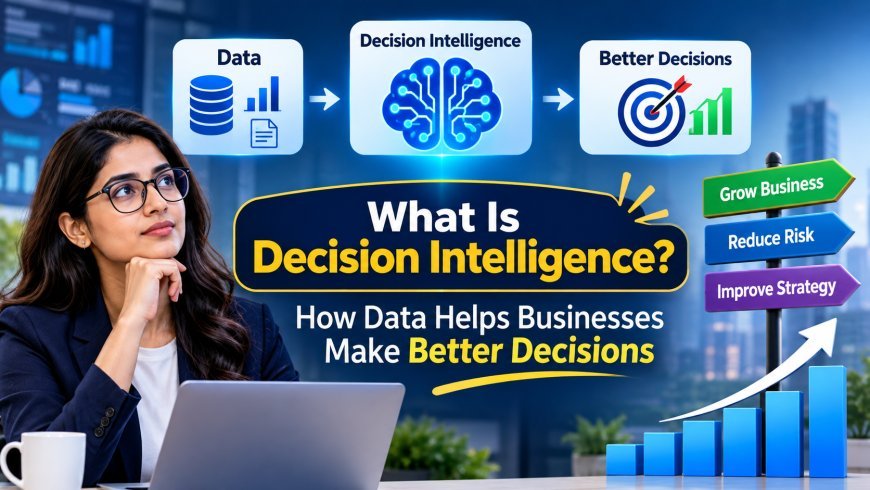
In business, decision-making is crucial. Whether you should increase your price, what customers you should target, or which areas to invest in can be difficult to decide. Decision intelligence is a technique that uses data and artificial intelligence along with human insight to make informed decisions. Many people are taking Data Analytics and Machine Learning Course to gain this expertise. Let’s gain an understanding of what decision intelligence is and why it is important.
What Is Decision Intelligence?
Decision intelligence uses data and AI to make better decisions. It brings together data, analysis, forecasting, and decision-making into one intuitive workflow.
It acts like an intelligent advisor to decision-makers in organisations. A decision intelligence solution will gather facts, analyse different options, forecast outcomes, and recommend the best course of action. People will still have the final say; however, they will be making their decision with more informed data.
How Is It Different from Business Intelligence?
BI can provide insights into what has happened. For example, what sales were made last month.
Decision Intelligence takes this further by providing explanations of why these things have happened, making predictions of possible future outcomes, and suggesting actions that can be taken. BI is retrospective; decision intelligence is predictive and prescriptive.
How Does Decision Intelligence Work?
The process usually follows a few simple steps:
-
Data collection: Data is collected from sales, customers, web, apps, and operations.
-
Data cleaning and structuring: Data is cleaned and structured to ensure trustworthy data.
-
Analytics: Patterns/trends in the data are discovered.
-
Prediction: Machine learning models make predictions.
-
Recommendations: Options are suggested with an indication of what the outcome may be.
-
Learning: Outcomes are monitored, and machine learning models improve.
Key Benefits for Businesses
Quick decision making
With data at your disposal, decisions can be made much quicker.
Minimise errors
As data-driven decisions are made, rather than decisions based on assumptions or previous practice, the chance of errors is minimised.
More informed planning
Planning for demand, costs and risk in a business can be done more effectively.
Improved consistency in decision making
Using the same data and analyses means that decision-making across different departments in a team can be more consistent.
Improved customer experience
Understanding what your customers need means that you can provide them with the right product at the right time.
Real-World Examples
-
Retail: Understand what products will be popular, and optimise stock levels and pricing.
-
Banks: Detect risk in lending situations and identify anomalies in a timely manner.
-
Healthcare: Optimise staffing, bed and equipment resources based on patient numbers.
-
Logistics: Create efficient delivery routes to reduce delays.
-
Marketing: Understand which marketing strategies are working and allocate budgets appropriately.
-
Cyber Security: Use data analysis and AI to identify threats and appropriate responses quickly.
Skills Needed to Work in This Field
Decision intelligence needs a mix of technical and business skills. Useful skills include:
-
Python programming and SQL
-
Statistics and data analysis
-
Machine learning basics
-
Data visualization using Power BI or Tableau
-
Understanding of business problems
-
Clear communication to explain insights to non-technical teams
Challenges to Keep in Mind
However, decision intelligence does not work perfectly. The models may give incorrect recommendations if the data they are using is of poor quality or biased. We must take care with security and privacy. Finally, people should be involved in making decisions from the recommendations, especially for very important decisions, to ensure correct choices have been made.
The Future of Decision Intelligence
Decision intelligence will become more common within organisations as AI becomes more common. The tools used will be easier to access, and many more teams will make decisions based on data. Professionals with knowledge in data, AI, and business will be very valuable in aiding this change. Awareness of data security is also very important in this role, as it is key that business data is protected.
Conclusion
With decision intelligence, you can make smarter decisions within your business. Using analytics, machine learning, and human insight, you can work more efficiently and reduce risk and increase outcomes. To get involved in this change, develop knowledge in analytics and security. By choosing which AI and Cybersecurity Certification you complete, you will learn to responsibly use data and AI, but also keep it secure. Start your journey in making smart decisions, driven by data, with Digicrome.
What's Your Reaction?
 Like
0
 Dislike
0
 Love
0
 Funny
0
 Angry
0
 Sad
0
 Wow
0