





















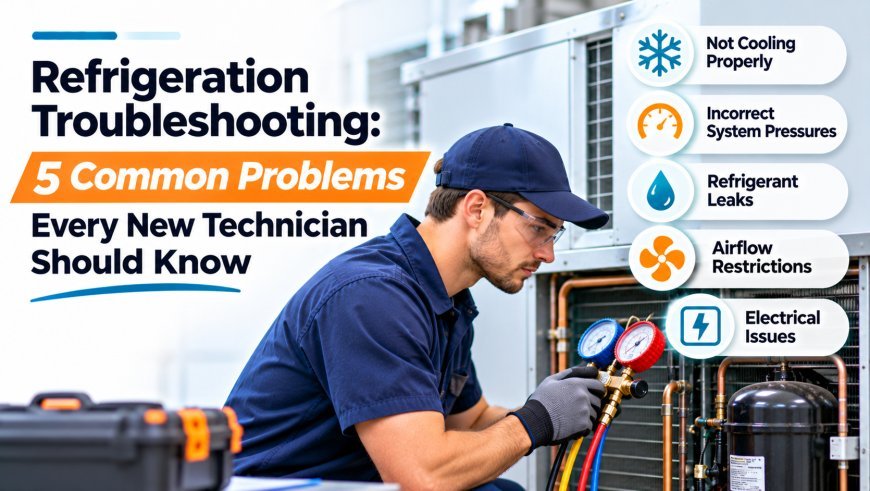
Refrigeration Troubleshooting: 5 Common Problems Every New Technician Should Know
A customer reports that their walk-in cooler isn't maintaining temperature. A new technician suspects low refrigerant, but the actual problem is a dirty condenser coil. The incorrect diagnosis wastes time, increases repair costs, and may result in another service visit.
This is why refrigeration technician training must go beyond understanding equipment components. Technicians need to recognize symptoms, investigate possible causes, and confirm their findings before recommending repairs.
For HVAC and refrigeration contractors, developing these skills early can reduce unnecessary repairs, improve service quality, and build customer confidence.
Why Refrigeration Troubleshooting Skills Matter
Many refrigeration problems produce similar symptoms. A cooler that isn't maintaining temperature could have restricted airflow, faulty controls, damaged door seals, or refrigerant-system issues.
Without a consistent diagnostic approach, technicians may replace working components while overlooking the actual problem.
Effective refrigeration technician training develops three essential abilities:
-
Technical understanding: Knowing how refrigeration components work together.
-
Diagnostic reasoning: Using measurements and observations to identify faults.
-
Repair verification: Confirming that corrective action resolves the original complaint.
These skills help technicians work more independently while reducing avoidable callbacks.
5 Common Refrigeration Problems and How to Diagnose Them
1. Refrigerator or Cooler Not Cooling Properly
Inadequate cooling is among the most common refrigerator problems technicians encounter.
Possible causes include dirty condenser coils, malfunctioning fans, damaged door gaskets, incorrect temperature settings, and refrigeration-system faults.
What technicians should check:
-
Actual compartment temperature versus the setpoint.
-
Condenser cleanliness and airflow.
-
Evaporator fan operation.
-
Door seals and control settings.
Start with accessible conditions before moving to advanced diagnostics.
For example, cleaning a blocked condenser may restore proper heat rejection without requiring refrigerant-circuit repairs.
2. Excessive Ice or Frost Buildup
Ice accumulation can restrict airflow and reduce cooling performance.
Potential causes include defrost failures, damaged door seals, excessive moisture infiltration, or evaporator airflow problems.
Technicians should examine the frost pattern, inspect relevant components, and verify defrost operation.
The objective is to identify why ice is forming rather than repeatedly removing it.
3. Compressor Not Starting
A compressor that fails to start may have electrical, control, starting-component, overload, or mechanical problems.
During refrigeration troubleshooting, technicians should learn to distinguish between a compressor receiving no start command and one attempting to start unsuccessfully.
Electrical testing must follow manufacturer instructions and applicable safety procedures. New technicians should perform such work only when appropriately trained and authorized.
4. Water Leaks and Drainage Problems
Water beneath refrigeration equipment may indicate a blocked condensate drain, drainage misalignment, or problems managing defrost water.
These faults provide useful introductory training exercises.
Technicians can practice locating the water source, inspecting the drainage system, correcting the problem, and confirming that drainage works properly.
5. Unusual Noises and Vibrations
Rattling, buzzing, grinding, and clicking can indicate loose panels, fan interference, worn components, or compressor-related issues.
Rather than replacing the loudest component immediately, technicians should identify where the sound originates and investigate the operating conditions.
Follow a Consistent Refrigeration Troubleshooting Process
Knowing refrigeration repair basics is only the beginning. Every technician should follow a repeatable diagnostic workflow.
-
Confirm the complaint: Ask when the problem started and whether it occurs continuously.
-
Inspect operating conditions: Check temperatures, airflow, controls, and visible equipment condition.
-
Check accessible causes: Look for dirty coils, damaged seals, and obstructions.
-
Measure and compare: Use appropriate instruments and manufacturer specifications.
-
Identify the root cause: Explain which findings support the diagnosis.
-
Verify the repair: Confirm proper operation and document the results.
This process encourages evidence-based decisions instead of unnecessary parts replacement.
Build Stronger Diagnostic Skills With Refrigeration Training
Effective refrigeration technician training combines system fundamentals, troubleshooting exercises, supervised practice, and safety awareness.
At Grandy & Associates, we understand that technicians need a strong technical foundation before handling increasingly complex service calls.
Our Refrigeration 101 online training provides a starting point for developing foundational refrigeration knowledge.
Train technicians to diagnose problems accurately, not simply recognize symptoms.
Explore our Refrigeration 101 course and give your service team a stronger foundation for real-world refrigeration troubleshooting.
What's Your Reaction?
 Like
0
 Dislike
0
 Love
0
 Funny
0
 Angry
0
 Sad
0
 Wow
0