




























The Evolution of Cricket in India: History and Modern Growth
Explore the evolution of cricket in India, from its early beginnings and international achievements to the rise of T20 cricket and modern technology.
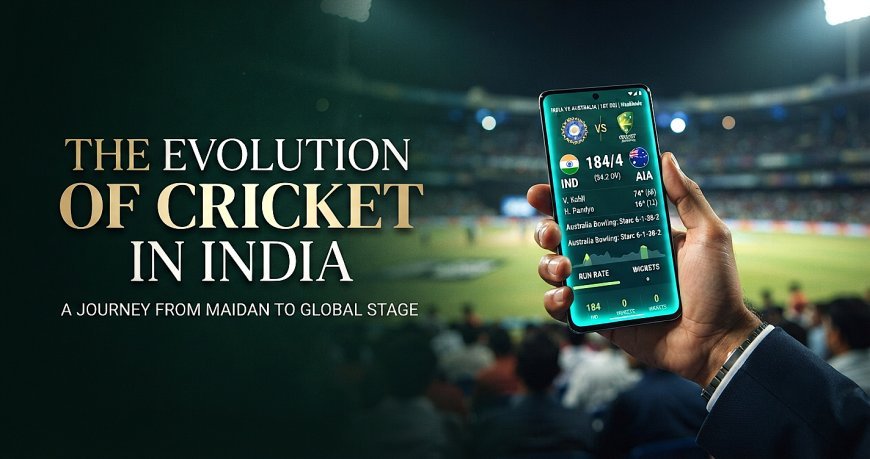
Cricket has become one of the most widely followed sports in India. From neighbourhood grounds and school competitions to international stadiums filled with passionate supporters, the game has developed into an important part of the country's sporting culture.
The evolution of cricket in India is a story of changing generations, memorable performances, international achievements, and technological progress. What began as a sport introduced during the British colonial period gradually developed into a major sporting institution with a dedicated following across different regions.
Today, Indian cricket includes several formats, including Test matches, One Day Internationals (ODIs), and Twenty20 (T20) cricket. Each format has contributed something different to the sport's popularity and development.
1. The Early Beginnings of Cricket in India
Cricket was introduced to India during British colonial rule. Historical records indicate that the game was being played by British communities in India during the eighteenth century.
Over time, local communities also became interested in the sport. The Parsi community played an important role in the early development of organised cricket in India, helping establish clubs and encouraging participation.
The formation of organised cricket teams and competitions gradually created opportunities for Indian players to develop their skills and compete at higher levels.
These early developments laid the foundation for the country's future cricketing journey.
2. The Development of Organised Indian Cricket
As interest in cricket increased, organised competitions and cricket associations began to emerge.
The Board of Control for Cricket in India (BCCI) was established in 1928. It became an important organisation for managing and developing cricket in the country.
India played its first official Test match against England at Lord's in June 1932. Although the team was still developing its international experience, the occasion represented an important milestone in Indian sporting history.
Participation in international cricket gave Indian players valuable experience and helped increase public interest in the sport.
3. India's First Major International Achievements
Indian cricket continued to develop through the following decades. Players from different parts of the country began establishing themselves internationally.
One of the most important milestones came in 1983 when India won the Cricket World Cup under the captaincy of Kapil Dev.
The victory against the West Indies at Lord's was a defining moment. It demonstrated that India could compete successfully against established international teams.
The achievement inspired many young players and contributed to the growing popularity of cricket throughout the country.
4. The Rise of Modern Indian Cricket
The 1990s brought significant changes to Indian cricket.
Players such as Sachin Tendulkar, Anil Kumble, Sourav Ganguly, Rahul Dravid, and VVS Laxman became important figures in international cricket.
Their performances helped establish India as a competitive cricketing nation.
Television coverage also expanded the sport's reach. Supporters could follow international matches from their homes, while newspapers and sports programmes provided regular updates.
Cricket gradually became a shared interest across different age groups and communities.
5. The Impact of One Day International Cricket
One Day International cricket played a major role in making the sport more accessible to a wider audience.
Unlike Test cricket, which can continue for five days, ODIs introduced a shorter format with a limited number of overs for each team.
The format created a different style of competition. Teams needed to balance batting aggression, bowling discipline, and fielding performance within a defined period.
India's 2011 Cricket World Cup victory under MS Dhoni became another historic moment.
The tournament brought together millions of supporters and demonstrated the emotional importance of cricket in Indian sporting culture.
6. The Growth of T20 Cricket
The introduction and expansion of Twenty20 cricket transformed the modern game.
T20 matches are generally completed in approximately three hours, making them more convenient for viewers who prefer shorter sporting events.
The format encourages aggressive batting, creative bowling strategies, athletic fielding, and quick decision-making.
The Indian Premier League (IPL), launched in 2008, became a major part of this development.
It brought together international and Indian players, created new opportunities for young cricketers, and introduced a franchise-based competition that attracted substantial public attention.
T20 cricket also encouraged teams to experiment with different playing combinations and tactical approaches.
7. Technology and Its Influence on Modern Cricket
Technology has changed how cricket is played, analysed, and followed.
Several technological developments have become important parts of modern cricket:
-
Decision Review System (DRS): Helps teams challenge certain umpiring decisions.
-
Hawk-Eye: Provides ball-tracking information to assist decision-making.
-
UltraEdge: Helps identify possible contact between the bat and ball.
-
Performance Analytics: Allows teams to study player statistics and match patterns.
-
Digital Broadcasting: Makes live matches, highlights, and analysis accessible through digital platforms.
These developments have improved the availability of match information and created new ways for supporters to understand the game.
8. The Importance of Domestic Cricket in India
Domestic cricket continues to play an important role in developing Indian talent.
Competitions such as the Ranji Trophy, Vijay Hazare Trophy, and Syed Mushtaq Ali Trophy provide opportunities for players to demonstrate their abilities.
These tournaments help identify talented cricketers and prepare them for higher levels of competition.
Domestic cricket also allows players to gain experience in different match situations, including long-format contests and limited-overs tournaments.
A strong domestic structure is essential for maintaining the quality and competitiveness of Indian cricket.
9. The Growing Popularity of Women's Cricket
Women's cricket has experienced considerable growth in India.
Players such as Mithali Raj, Jhulan Goswami, Harmanpreet Kaur, and Smriti Mandhana have contributed to the development and visibility of the women's game.
Greater media coverage, improved competition structures, and increased public interest have helped create more opportunities for women cricketers.
The Women's Premier League has also introduced another important platform for showcasing talent and encouraging participation.
Women's cricket is now an increasingly important part of India's overall sporting landscape.
10. The Future of Cricket in India
The future of Indian cricket will likely be shaped by continued investment in player development, coaching, infrastructure, and technology.
Young players are gaining opportunities through domestic competitions, age-group tournaments, academies, and professional leagues.
Digital platforms are also changing how audiences follow cricket. Match statistics, expert discussions, highlights, and live coverage are available through a growing range of media channels.
At the same time, maintaining a balance between different formats will remain important. Test cricket, ODIs, and T20 matches each contribute differently to the sport.
Conclusion
The journey of Indian cricket reflects decades of development, sporting achievements, and changing audience interests.
From its early beginnings during the colonial period to the international success of modern teams, cricket has continued to evolve with every generation.
The introduction of new formats, improvements in technology, growth in domestic competitions, and increasing opportunities for women have all contributed to the sport's development.
Understanding the evolution of cricket in India helps explain why cricket continues to hold such an important position in the country's sporting culture.
As new players emerge and the game continues to change, Indian cricket is likely to remain an important part of the global cricketing landscape.
Frequently Asked Questions
1. When was cricket introduced in India?
Cricket was introduced during British colonial rule. Historical records indicate that the sport was being played in India during the eighteenth century.
2. When did India play its first Test match?
India played its first official Test match against England at Lord's in June 1932.
3. When did India win its first Cricket World Cup?
India won its first Men's Cricket World Cup in 1983 under the captaincy of Kapil Dev.
4. When was the Indian Premier League launched?
The Indian Premier League began in 2008 and became an important part of modern T20 cricket.
5. How has technology changed cricket in India?
Technology has improved decision-making, performance analysis, broadcasting, and access to match information.
6. Why is domestic cricket important in India?
Domestic tournaments provide competitive opportunities for players, support talent development, and help prepare cricketers for international competition.
What's Your Reaction?
 Like
0
 Dislike
0
 Love
0
 Funny
0
 Angry
0
 Sad
0
 Wow
0