


























Understanding International Cricket Formats: Test, ODI and T20
Learn about the three major formats of international cricket: Test matches, One Day Internationals and T20 cricket, including their rules and differences.
Introduction
Cricket is a sport that offers different styles of competition, each with its own rules, pace, and challenges. Some matches test a team's patience and technical ability over several days, while others demand quick decisions and aggressive strategies within a few hours.
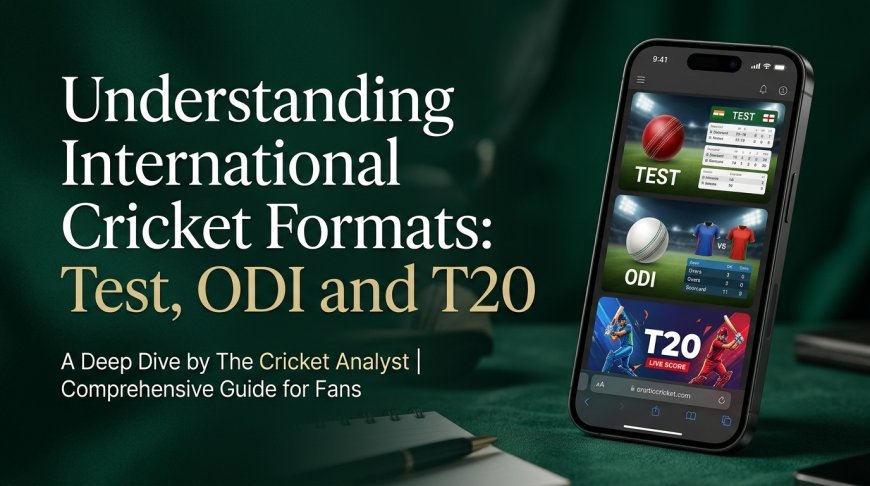
Understanding the different international cricket formats makes it easier for new followers to appreciate the game. The three main formats played at international level are Test cricket, One Day Internationals (ODIs), and Twenty20 Internationals (T20Is).
Although all three formats share the same basic principles, their playing conditions and strategies can be quite different. Let's explore how each format works and what makes it unique.
1. Test Cricket: The Traditional Format
Test cricket is the longest format of international cricket and is widely regarded as one of the most demanding forms of the game.
A Test match is scheduled for up to five days, with each team normally having two innings. Unlike limited-overs cricket, there is no fixed number of overs for an innings.
Important Features of Test Cricket
-
Matches are scheduled for up to five days.
-
Each team generally receives two innings.
-
Teams must balance attacking play with defensive techniques.
-
Weather and pitch conditions can influence the outcome.
-
Draws are possible if neither team achieves victory within the available time.
Test cricket requires concentration, patience, physical fitness, and strong technical skills. Players must adjust their approach according to changing conditions throughout a match.
Why Test Cricket Remains Important
Test matches provide a detailed examination of a player's abilities. Batters need to build long innings, bowlers must maintain discipline, and captains need to plan strategies over extended periods.
The format also preserves many of cricket's traditional qualities, making it an important part of international competition.
2. One Day International Cricket: A Balance of Strategy and Speed
One Day International cricket, commonly known as ODI cricket, introduced a shorter format while retaining many strategic elements of the traditional game.
An ODI match normally consists of 50 overs per team, with each side having one innings.
The format combines batting, bowling, and fielding strategies within a limited number of overs.
Important Features of ODI Cricket
-
Each team normally receives 50 overs.
-
Each side has one innings.
-
Teams have limited opportunities to build partnerships and score runs.
-
Fielding restrictions influence batting and bowling strategies.
-
Weather interruptions can affect the scheduled playing conditions.
How ODI Strategies Work
ODI cricket requires teams to manage their innings carefully.
The opening batters generally aim to establish a strong start. During the middle overs, teams try to maintain scoring momentum while protecting wickets. In the final overs, batters often increase their scoring rate.
Bowlers must also adjust their plans depending on the match situation, pitch conditions, and opposition batting strength.
The format rewards teams that can combine patience with well-timed aggression.
3. T20 International Cricket: The Fastest Main Format
Twenty20 International cricket, commonly called T20I cricket, is the shortest of the three major international formats.
Each team receives a maximum of 20 overs, making matches faster and generally more accessible to viewers with limited time.
T20 cricket has introduced new approaches to batting, bowling, and fielding.
Important Features of T20 Cricket
-
Each team receives a maximum of 20 overs.
-
Each side has one innings.
-
Batters often aim for a higher scoring rate.
-
Bowlers use variations to limit scoring opportunities.
-
Fielding and quick decision-making are especially important.
What Makes T20 Cricket Different?
T20 cricket places significant emphasis on adaptability.
Batters may use innovative shots to score boundaries, while bowlers use slower deliveries, yorkers, and other variations to challenge aggressive batting.
Captains must make decisions quickly because the match situation can change within a few overs.
The format has also helped introduce cricket to new audiences through shorter match durations and competitive franchise tournaments.
4. Key Differences Between Test, ODI and T20 Cricket
Although the three formats share the same basic rules, their playing conditions create different challenges.
|
Feature |
Test Cricket |
ODI Cricket |
T20 Cricket |
|
Scheduled duration |
Up to 5 days |
Usually one day |
Usually a few hours |
|
Overs per innings |
No fixed limit |
50 |
20 |
|
Innings per team |
Usually 2 |
1 |
1 |
|
Playing approach |
Long-term strategy |
Balanced approach |
Fast-paced strategy |
|
Draw possible |
Yes |
No |
No |
|
Main challenge |
Consistency |
Adaptability |
Quick decision-making |
Understanding these differences helps viewers recognise why players sometimes approach the same situation differently across formats.
5. How Batting Strategies Change Across Formats
Batting is one of the clearest examples of how cricket changes between formats.
In Test cricket, batters often focus on defending their wickets and building partnerships. Scoring quickly can be useful, but remaining at the crease is frequently the priority.
In ODIs, batters need to manage the innings across different phases. A steady beginning followed by controlled acceleration can create a competitive total.
In T20 matches, scoring opportunities are limited by the shorter innings. Batters therefore use a wider range of shots and often take calculated risks.
The ability to adapt between these approaches is an important quality for modern international cricketers.
6. How Bowling Strategies Differ
Bowling strategies also change depending on the format.
Test bowlers often focus on maintaining consistent line and length while creating pressure over extended periods. They may use swing, seam movement, and changes in pace to challenge batters.
ODI bowlers need to manage different stages of an innings. Early swing, middle-over control, and effective death bowling can all influence the final result.
T20 bowlers face a different challenge. They must limit scoring while dealing with aggressive batting approaches. Variations, accurate yorkers, and changes of pace are frequently used.
7. The Role of Fielding in Different Formats
Fielding is important in every form of cricket, but its tactical importance can vary.
In Test cricket, close catching positions and slip fielders can create opportunities when batters are under pressure.
In ODIs, teams balance boundary protection with attacking field placements. Captains must consider the innings stage and the number of overs remaining.
In T20 cricket, quick movement, accurate throwing, and boundary-saving efforts can make a significant difference because scoring opportunities are frequent.
A single fielding mistake can change the momentum of a short match.
8. Major International Competitions
Each format has its own major international competitions.
Test Cricket
The ICC World Test Championship provides a competitive structure for leading Test-playing nations. It encourages teams to compete consistently across a series of bilateral matches.
One Day International Cricket
The ICC Men's Cricket World Cup is one of the most recognised competitions in ODI cricket. Teams compete to become world champions through a tournament structure.
T20 International Cricket
The ICC Men's T20 World Cup brings together international teams in a shorter and faster competition. It showcases the tactical and entertaining nature of the T20 format.
Women's international competitions also feature these formats and provide opportunities for teams to compete at the highest level.
9. Can Players Excel in All Three Formats?
Some cricketers have demonstrated the ability to perform successfully across Test, ODI, and T20 cricket.
However, success in one format does not automatically guarantee success in another.
A player may have excellent defensive technique but need time to develop aggressive T20 batting skills. Similarly, a strong T20 bowler may need to improve consistency and stamina for longer matches.
Modern players increasingly work on different technical and tactical approaches to meet the demands of each format.
10. Which Cricket Format Is Best for New Viewers?
There is no single correct answer because each format offers a different experience.
-
Test cricket: Suitable for viewers who enjoy tactical depth, traditional competition, and long-form sporting contests.
-
ODI cricket: A balanced option for people who want a combination of strategy and a defined match duration.
-
T20 cricket: Suitable for viewers who prefer shorter matches and fast-changing situations.
New viewers can explore all three formats to understand the different aspects of cricket.
Conclusion
Test, ODI, and T20 cricket each contribute something unique to the international game.
Test cricket highlights patience, technique, and endurance. ODIs combine strategic planning with limited-overs competition, while T20 cricket encourages fast decisions and innovative approaches.
Understanding the international cricket formats helps viewers appreciate the skills required at different levels of competition.
As cricket continues to develop, all three formats remain important to its international identity and future.
Frequently Asked Questions
1. What are the three main formats of international cricket?
The three main formats are Test cricket, One Day Internationals (ODIs), and Twenty20 Internationals (T20Is).
2. How many overs are played in an ODI match?
An ODI match normally consists of 50 overs per team.
3. How many overs are played in T20 International cricket?
Each team receives a maximum of 20 overs in a standard T20 International match.
4. How long does a Test match last?
A Test match is scheduled for up to five days.
5. Which cricket format is the shortest?
T20 International cricket is the shortest of the three main international formats.
6. Can a Test match end in a draw?
Yes. A Test match can end in a draw when neither team achieves victory before the scheduled playing time ends.
7. Are batting strategies different in each format?
Yes. Test cricket often rewards patience, ODI cricket requires balanced scoring, and T20 cricket places greater emphasis on quick scoring and adaptability.
What's Your Reaction?
 Like
0
 Dislike
0
 Love
0
 Funny
0
 Angry
0
 Sad
0
 Wow
0