





















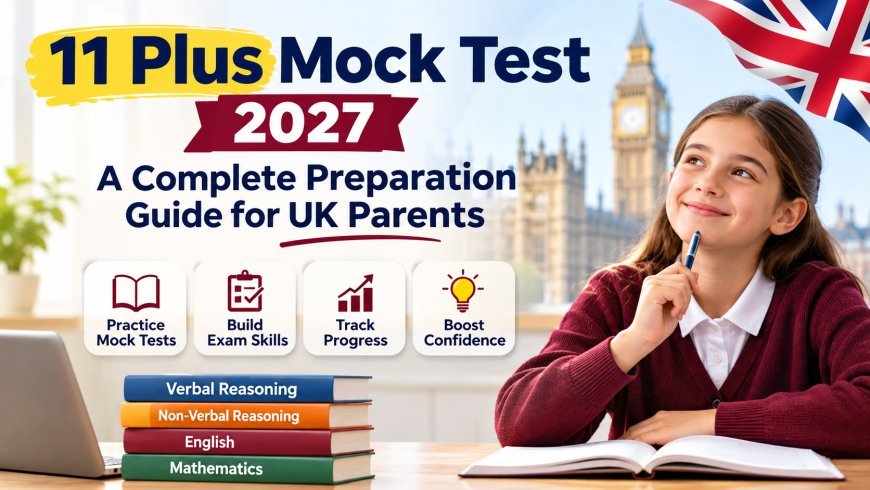
11 Plus Mock Test 2027: A Complete Preparation Guide for UK Parents

Preparing for grammar school entrance exams can feel overwhelming for both children and parents, especially when there are different subjects, exam formats, and admission requirements to consider.
An 11 Plus Mock Test helps children understand the examination structure, practise time management, identify weaker areas, and build confidence before the actual assessment.
For families planning for the 2027 grammar school entry process, starting preparation early and following a structured approach can make a meaningful difference. This guide explains how mock tests work, when to begin practising, and how parents can support their child's progress without creating unnecessary pressure.
What Is an 11 Plus Mock Test?
An 11 Plus mock test is a practice examination designed to reflect the style, difficulty, and timing of a grammar school entrance assessment. It allows children to experience examination conditions before sitting the official test.
Depending on the school or examination provider, assessments may cover English, mathematics, verbal reasoning, and non-verbal reasoning. However, requirements vary across grammar schools, making it essential to check the relevant admission arrangements.
Mock examinations help children become familiar with question formats while allowing parents to understand their child's current abilities. Rather than focusing exclusively on scores, families should use the results to identify learning gaps and develop realistic improvement plans.
Why Are Mock Tests Important for 2027 Grammar School Entry?
Mock examinations provide valuable preparation beyond ordinary classroom learning. They help children understand what to expect and reduce uncertainty surrounding unfamiliar assessment conditions.
Key benefits include:
-
Improved time management: Children learn to allocate sufficient time to different questions.
-
Greater examination confidence: Familiarity with timed assessments can reduce nervousness.
-
Identification of learning gaps: Results highlight topics requiring additional practice.
-
Better question-solving strategies: Regular practice encourages accuracy and efficient thinking.
-
Progress monitoring: Parents can evaluate improvement through repeated assessments.
Importantly, mock test results are indicators of current performance, not guarantees of grammar school admission. A balanced approach combines assessment practice with consistent learning and encouragement.
When Should Children Start Taking 11 Plus Mock Tests?
For children preparing for September 2027 entry, many grammar school entrance assessments are expected to take place during 2026, although individual school schedules vary.
Parents should therefore confirm registration deadlines, examination dates, eligibility requirements, and admission policies directly with their preferred schools or local authorities.
Children can begin with shorter practice exercises before progressing to full-length timed assessments. This gradual approach helps them develop examination skills without becoming overwhelmed.
During the early stages, parents should prioritise understanding and accuracy. As examination dates approach, realistic mock assessments can become a more regular part of the preparation routine.
Essential Subjects to Focus On
A successful preparation strategy should reflect the subjects included in the child's target examination.
English Comprehension and Writing Skills
English preparation may involve reading comprehension, vocabulary, spelling, punctuation, and grammar. Some examinations also assess writing, although this is not universal.
Encouraging regular reading helps children develop vocabulary, understand complex passages, and strengthen their interpretation skills.
Mathematics and Problem-Solving
Mathematics preparation should develop numerical confidence, reasoning, and the ability to solve unfamiliar problems.
Important areas may include arithmetic, fractions, percentages, measurement, geometry, and word problems. Children benefit from understanding mathematical methods rather than simply memorising answers.
Verbal and Non-Verbal Reasoning
Verbal reasoning examines language-based problem-solving abilities, while non-verbal reasoning commonly involves shapes, patterns, and visual relationships.
Regular exposure to different question types can improve familiarity and encourage logical thinking.
How to Create an Effective Mock Test Preparation Schedule
Consistency is more valuable than excessively long study sessions. Parents should establish a manageable timetable that accommodates schoolwork, extracurricular activities, and relaxation.
A practical weekly schedule might include English practice, mathematics revision, reasoning exercises, and a short assessment followed by feedback.
After each test, review incorrect answers together and identify whether mistakes resulted from misunderstanding, rushing, or unfamiliarity with the question format.
Set achievable weekly goals and celebrate improvements in accuracy, confidence, and understanding. Adjust the schedule according to the child's progress rather than following an unnecessarily rigid routine.
Common Mistakes Parents Should Avoid
Parents naturally want their children to succeed, but certain preparation habits can unintentionally increase examination pressure.
One common mistake is concentrating entirely on high scores while overlooking conceptual understanding. Another is scheduling frequent mock tests without allowing sufficient time to review mistakes.
Comparing children with classmates can also reduce motivation and confidence. Every learner develops at a different pace and may require different levels of support.
Instead, encourage steady progress, provide constructive feedback, and maintain a positive learning environment.
Choosing the Right Online Mock Test Platform
A suitable online assessment platform should offer relevant questions, clear instructions, accessible results, and useful performance feedback.
Parents should look for assessments aligned with their target school's examination format rather than assuming every mock test follows identical requirements.
Detailed feedback is particularly valuable because it explains which topics need improvement and helps families plan their next steps.
Online assessments can provide convenient practice opportunities at home, but they work best alongside reading, revision, and appropriate educational guidance.
How Learn2Write Supports Children's Learning
Learn2Write provides educational support focused on developing children's English, writing, comprehension, and examination-related skills. Its learning resources and assessment-focused approach can help families identify areas for improvement and encourage structured practice.
Parents exploring Learn2Write services can visit www.learn2write.co.uk to learn more about available educational support and assessment opportunities.
Final Thoughts
Preparing for grammar school entrance assessments requires patience, consistency, and an understanding of each child's individual learning needs. Mock tests are most effective when parents use them to recognise strengths, address difficulties, and build confidence rather than create pressure. By combining regular practice, thoughtful feedback, and suitable learning resources, families can develop a balanced approach to 11+ exam preparation and help children approach their assessments with greater confidence.
What's Your Reaction?
 Like
0
 Dislike
0
 Love
0
 Funny
0
 Angry
0
 Sad
0
 Wow
0