



















How White Label Link Building Services Help Agencies Expand Their SEO Operations
White label link building services help agencies expand their SEO operations by outsourcing backlink tasks, managing more client campaigns, saving time, and delivering link building solutions under their own brand.
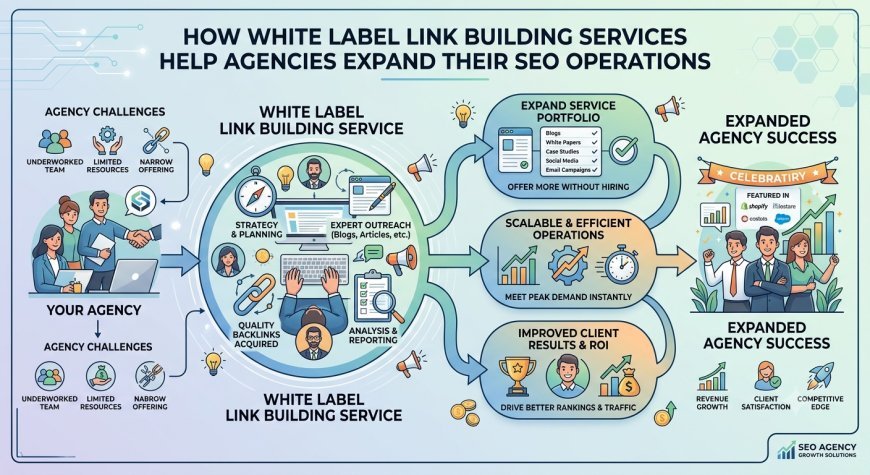
Digital marketing agencies often manage several client campaigns at the same time. Each campaign may require keyword research, technical improvements, content development, backlink analysis, and regular reporting. As the number of clients grows, completing every task internally can become difficult. White label solutions allow agencies to work with external providers while presenting the completed services under their own brand.
Professional White Label Link Building Services can help agencies manage backlink research, outreach, and placement activities without building every part of the process from scratch. When supported by clear quality standards and effective communication, this approach can help agencies organize their workloads and focus on client strategy.
Understanding White Label Link Building
White label link building involves an external provider completing link building tasks on behalf of an agency. The agency then incorporates the work into its own service offering and communicates with the client under its brand, according to the agreed arrangement.
Depending on the provider, the work may include prospect research, website evaluation, content coordination, outreach management, placement tracking, and campaign reporting. The exact responsibilities should be agreed upon before a campaign begins.
This arrangement can be useful for agencies that have the client relationships and SEO expertise but need additional operational support. It can also help smaller teams manage fluctuating workloads without immediately hiring additional full-time staff.
Why Agencies Consider External Link Building Support
Link building requires time and consistent attention. Teams must identify relevant websites, evaluate publishing opportunities, prepare suitable content, communicate with website owners, and check the final placements. Managing these tasks for multiple clients can place pressure on internal resources.
An external provider may help distribute the workload and establish a repeatable process. Agencies can use the additional capacity to focus on campaign planning, client communication, technical SEO, and performance analysis.
However, outsourcing does not remove the agency's responsibility to review the work. Agencies should maintain control over campaign objectives, approve suitable opportunities, and verify that completed activities meet their quality expectations.
Selecting Relevant Websites
Website relevance should be a major consideration in every link building campaign. A suitable publishing website should have a clear connection to the client's industry, audience, or subject matter. This helps ensure that the content and its references make sense to readers.
Agencies should evaluate the website's published articles, editorial standards, audience relevance, and overall content quality. Organic visibility and third-party SEO metrics may provide additional context, but they should not be the only selection criteria.
It is also important to look for warning signs, such as large amounts of unrelated content, excessive promotional links, or pages created primarily to sell backlinks. Choosing websites carefully can help agencies avoid low-quality placements that provide little practical value.
Establishing a Reliable Workflow
A clear workflow makes outsourced link building easier to manage. The process can begin with understanding the client's website, target audience, important landing pages, and campaign objectives. The agency and provider can then agree on suitable website categories, content requirements, timelines, and reporting standards.
Each opportunity should be reviewed before work proceeds. Once a placement is approved, the provider can coordinate content creation and publishing while keeping the agency informed about progress.
After publication, the agency should verify the live URL, target page, anchor text, link attributes, and content quality. Maintaining these checks helps identify mistakes and keeps campaign records accurate.
Maintaining Content Quality
Backlinks should appear within content that provides useful information. Articles should address a relevant subject, follow the publisher's guidelines, and offer value beyond the placement itself.
Writers should use clear language, accurate facts, and logical headings. Content should not be filled with repeated keywords or unnecessary promotional statements. Anchor text should also fit naturally into the sentence and describe the destination page accurately.
Agencies should establish written quality requirements for their providers. These can cover originality, proofreading, website relevance, approval procedures, and how paid or sponsored links are handled.
Combining Link Building With Content Production
Link building campaigns often require articles, resource pages, or other informative materials. Coordinating writing and outreach can help reduce delays and ensure that each placement supports a clear topic.
For example, an agency working with a business software company might plan articles about workflow management, data organization, and business productivity. Each article should be prepared for its intended audience and published only where the subject is appropriate.
Agencies that need additional support with article preparation may also consider White Label Content Writing as part of their service delivery process. Content and link building teams should work together to maintain consistent standards and meet agreed deadlines.
Following Search Engine Guidelines
Agencies should understand the risks associated with manipulative link building. Search engine guidelines discourage link schemes designed primarily to influence rankings, including paid links that pass ranking credit and large-scale placements created without genuine editorial value.
Sponsored placements should be transparent and use appropriate link attributes when required. Agencies should also avoid guaranteeing specific rankings or promising that every backlink will improve a client's performance.
A responsible campaign focuses on relevant websites, useful content, and clear documentation. This approach supports better decision-making and helps agencies explain their methods to clients.
Reporting and Client Communication
Consistent reporting helps agencies demonstrate completed work and identify areas that require attention. A campaign report may include the publishing website, live URL, target page, anchor text, publication date, link attribute, and verification status.
Where appropriate, agencies can also monitor referral visits, organic visibility, and changes in the performance of important pages. These indicators should be interpreted carefully because search performance depends on multiple factors.
Clear reporting helps clients understand what has been completed, what remains in progress, and how the activity fits into the wider SEO plan.
Building a Scalable Agency Service
White label link building can help agencies increase operational capacity when the provider, workflow, and quality standards are carefully selected. Agencies should compare communication practices, service scope, turnaround times, reporting detail, and quality control before committing to a long-term arrangement.
Regular reviews can reveal which processes work well and where changes are needed. Agencies should remain involved in strategy and final quality checks rather than relying entirely on an external provider.
Ultimately, a sustainable white label approach combines reliable execution with agency oversight. By prioritizing relevant websites, original content, transparent practices, and consistent reporting, agencies can manage link building more effectively while maintaining responsibility for the services delivered to their clients.
```
What's Your Reaction?
 Like
0
Like
0
 Dislike
0
Dislike
0
 Love
0
Love
0
 Funny
0
Funny
0
 Angry
0
Angry
0
 Sad
0
Sad
0
 Wow
0
Wow
0