




























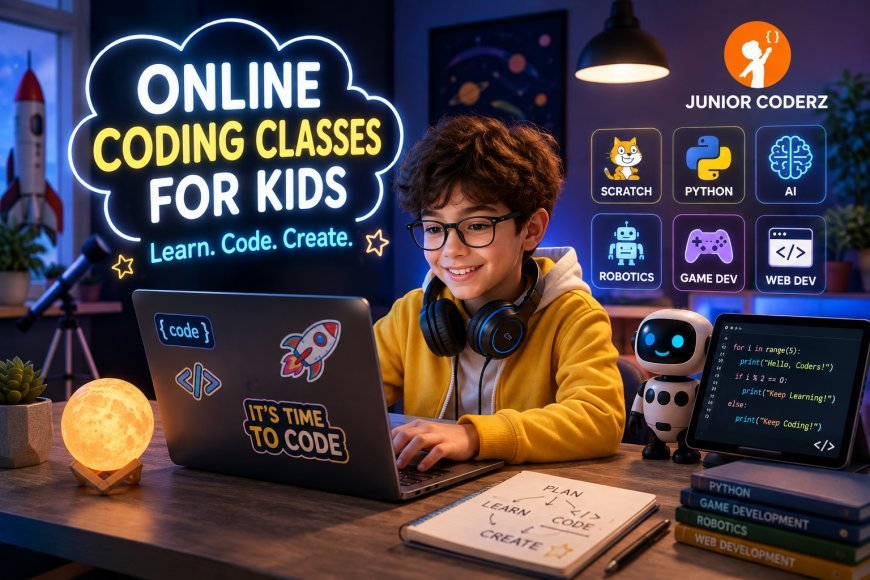
Online Coding Classes for Kids: Helping Children Learn, Create, and Innovate
Explore online coding classes for kids at Junior Coderz, covering beginner coding, Python, game development, robotics, AI, web development, and more.

Technology plays an important role in children's everyday lives. From educational applications and digital games to websites and smart devices, children interact with technology from an early age. Learning how these tools work can help them move beyond simply using technology and begin creating their own digital projects.
Online coding classes for kids offer a structured way for young learners to explore programming, develop logical thinking, and experiment with creative ideas. With age-appropriate lessons and practical activities, children can gradually understand how instructions, algorithms, and code work together to produce results.
Junior Coderz provides online coding programs for children and teenagers aged 6–18. Its curriculum includes beginner coding, Python, artificial intelligence, robotics, game development, web development, app development, electronics, and 3D modeling. The programs are designed to help learners explore technology through guided lessons and practical projects.
Why Should Children Learn Coding?
Coding is not only about learning a programming language. It also encourages children to think systematically, explore different solutions, and understand how individual instructions combine to complete a task.
When children create a game, animation, website, or simple application, they can see how their ideas become working projects.
1. Developing Problem-Solving Skills
Programming often involves breaking a large challenge into smaller steps. A child creating a game, for example, may need to decide how a character moves, what happens when it reaches an obstacle, and how the player earns points.
These tasks encourage children to analyze problems and test possible solutions. If something does not work as expected, they can review their instructions and make changes.
2. Encouraging Logical Thinking
Coding introduces concepts such as sequences, loops, variables, conditions, and algorithms. Children learn that computers follow instructions and that the order of those instructions matters.
Understanding these ideas can help learners approach challenges more methodically, both during coding activities and in other learning situations.
3. Supporting Creativity
Programming gives children a way to turn imagination into something interactive. They can design characters, build games, animate stories, develop websites, and experiment with digital designs.
Rather than following instructions alone, students can gradually begin making their own decisions about what to build and how their projects should work.
4. Building Persistence
A program may not work correctly on the first attempt. Finding and correcting mistakes is a normal part of programming.
Through debugging, children learn to review their work, investigate errors, and try alternative approaches. This makes coding a useful environment for practicing patience and persistence.
What Happens in Online Coding Classes?
A well-structured online coding course usually combines instruction, practice, and project work. Children learn a concept, see how it works, and then apply it through guided activities.
Junior Coderz promotes live online learning, expert-led instruction, hands-on projects, and personalized guidance. These elements help students work through new concepts with support instead of relying entirely on independent study.
A typical learning experience may include:
- An introduction to a new programming concept.
- A demonstration showing how the concept works.
- A guided coding exercise.
- Time to experiment with the instructions.
- A small project that applies the lesson.
- Feedback and opportunities to improve the result.
The exact activities depend on the child's age, experience, and selected course. Younger learners may begin with visual coding blocks, while older students can explore text-based programming and more complex projects.
Choosing Coding Classes According to Age
Children have different learning needs at different stages. A suitable course should match a learner's existing knowledge, interests, and ability to understand new concepts.
Junior Coderz offers several age-based and skill-based programs, providing options for beginners and students ready to explore more advanced topics.
Ages 6–7: Tiny Techies
Young beginners can benefit from visual, interactive activities that introduce programming without requiring them to learn complicated syntax immediately.
Tiny Techies is a beginner-level program listed for children aged 6–7. Its curriculum includes basic coding, computer skills, logical thinking, typing, and beginner game development through block-based coding.
Students can begin understanding sequences, commands, and simple game mechanics while developing familiarity with computers.
For example, a child might arrange coding blocks to move a character across a screen or create a basic interactive story. These activities make programming concepts easier to explore through experimentation.
Ages 8–10: Junior Inventors
As children become more comfortable with coding, they can explore a broader range of technology subjects.
Junior Inventors is an intermediate program for ages 8–10. According to the course listing, it combines Python, virtual robotics, artificial intelligence, 3D modeling, game development, electronics, and web and app development.
This variety gives learners opportunities to discover which technology topics interest them most.
A student who enjoys games may become interested in programming characters and game rules. Another may prefer digital design, robotics, or creating simple applications.
Ages 11–14: Code Champions
Students in this age group may be ready to combine foundational programming knowledge with more involved projects.
Code Champions covers areas such as Python, AI, virtual robotics, game development, electronics, 3D modeling, web development, and app development.
The course also emphasizes coding logic, debugging, and problem-solving. These concepts help learners understand how to identify errors and improve their programs.
Ages 11–14: Python-Focused Learning
Some students may prefer concentrating on text-based programming rather than exploring many different technology areas at once.
Junior Coderz offers Python Hybrid and Python Pioneers programs for ages 11–14. Python Hybrid combines advanced Python with areas such as AI, robotics, game development, electronics, 3D modeling, and application development. Python Pioneers focuses more specifically on Python fundamentals, advanced concepts, graphics, debugging, and object-oriented programming.
These options allow families to consider whether a broad technology curriculum or a more concentrated programming pathway better suits the student's interests.
Ages 14 and Above: Algorithm Avengers
Older learners may be ready to explore more advanced programming and digital creation.
Algorithm Avengers is listed as an expert-level program for students aged 14 and above. Its curriculum includes advanced Python, HTML, CSS, JavaScript, Blender, SolidWorks, game development, and advanced AI.
This combination introduces learners to several areas of software development and digital design while giving them opportunities to build on earlier knowledge.
Learning Python Through Practical Projects
Python is a popular programming language used in many areas of software development. Its readable syntax can make it a useful next step for students who are ready to move from visual programming to writing code.
In a structured Python course, children may explore:
- Variables and data types.
- Loops and conditional statements.
- Functions and reusable instructions.
- Lists and other data structures.
- Debugging techniques.
- Object-oriented programming.
- Simple interactive applications.
The value of learning these concepts becomes clearer when students use them in projects.
For example, a learner could create a calculator, build a text-based quiz, program a simple game, or develop a chatbot with appropriate guidance. Each project provides a practical context for understanding how code works.
Junior Coderz includes Python in several programs and provides a dedicated Python learning pathway for students interested in developing their programming skills.
Game Development: Turning Ideas Into Interactive Experiences
Games can be an engaging introduction to programming because they combine rules, movement, interaction, and visual feedback.
Children learning game development can explore how code controls different elements of a game, including:
- Character movement.
- Player input.
- Scoring systems.
- Levels and challenges.
- Collision detection.
- Game events.
- Winning conditions.
A beginner might create a maze game in which a character must reach a destination. A more experienced learner could add obstacles, a scoring system, and multiple levels.
These projects encourage students to think about both the technical structure and the experience of the person playing the game.
Junior Coderz includes game development in multiple programs, allowing learners to explore it alongside programming, design, and other technology subjects.
Exploring Web and App Development
Websites and applications are part of everyday digital life. Learning how they are created can help children understand the relationship between design, programming, and user interaction.
Web Development
Web development introduces students to the technologies used to build websites.
HTML helps organize webpage content, CSS controls its visual presentation, and JavaScript adds interactive behavior.
A learner might begin by creating a personal-interest webpage and gradually add navigation, styling, buttons, and interactive features.
App Development
Application development allows students to think about how software can help users accomplish particular tasks.
They may explore how an application is organized, how its interface works, and how different elements respond to user actions.
Junior Coderz includes web and app development in several of its learning pathways, allowing students to connect programming concepts with familiar digital products.
Robotics, Electronics, and 3D Modeling
Coding can also connect with subjects beyond traditional software development.
Robotics
Virtual robotics introduces learners to the relationship between programming instructions and machine behavior. Students can explore how a sequence of commands controls movement or completes a task.
Electronics
Electronics can help students understand how circuits and physical components work together. When combined with programming, these activities introduce the idea that software can interact with the physical world.
3D Modeling
Three-dimensional modeling allows children to create digital objects and explore shape, space, structure, and design.
Students interested in games, animation, engineering, or digital creativity may enjoy learning how to design and modify 3D objects.
Junior Coderz includes robotics, electronics, and 3D modeling in selected programs, giving students opportunities to explore these connected technology fields.
Introducing Children to Artificial Intelligence
Artificial intelligence is increasingly relevant to modern technology, and age-appropriate education can help students understand its basic ideas.
Depending on the course and learning level, children may explore machine learning fundamentals, generative AI, prompt engineering, and simple AI-powered applications.
It is also important for young learners to understand that AI systems can make mistakes. They should practice checking results, asking questions about accuracy, and using AI tools responsibly.
Junior Coderz includes AI-related topics in several programs and offers an AI Hybrid course for ages 8–16. Its listed curriculum includes generative AI, prompt engineering, machine learning fundamentals, Python, automation, and app and web development.
Why Hands-On Projects Matter
Reading about programming can introduce a concept, but building something gives children a chance to apply it.
Practical projects help learners connect abstract ideas with visible outcomes.
Consider a few examples:
- Loops: Repeat an action several times in a game.
- Conditions: Make a character respond differently to certain events.
- Python: Create a quiz or calculator.
- HTML and CSS: Design a webpage.
- JavaScript: Add interactive webpage features.
- Robotics: Program a system to follow a sequence of commands.
- AI: Explore a guided project that demonstrates how an AI model responds to input.
Projects also give students something concrete to review and improve. They can experiment with different approaches, explain their decisions, and gradually make their work more sophisticated.
Parents can encourage this process by asking children what they built, what they found interesting, and what they would like to change next.
What Should Parents Look for in an Online Coding Course?
Not every course is suitable for every child. Parents can compare a few important factors before choosing a program.
Age and Learning Level
The material should match the child's age, current skills, and learning pace. A beginner should not need advanced programming knowledge to participate.
Teaching Approach
Look for clear explanations, opportunities to ask questions, and activities that let students practice rather than only watch demonstrations.
Practical Activities
Projects can make lessons more engaging and help students apply what they learn.
Instructor Support
Guidance can be particularly helpful when a student encounters an unfamiliar concept or struggles to identify an error.
Curriculum Variety
Some children prefer game development, while others are more interested in Python, AI, robotics, websites, or digital design. A course that matches their interests may help sustain their curiosity.
Opportunities to Progress
A structured learning pathway can help children move from basic concepts toward more challenging projects as their knowledge develops.
Parents can review the available Junior Coderz programs and consider a free trial class to understand whether the teaching approach and course level suit their child.
How Children Can Make Progress Outside Class
Regular practice can reinforce concepts introduced during lessons. Children do not need to work on large projects every time they practice; short, manageable activities can also be useful.
Here are a few ways to support continued learning:
- Review a concept from the latest lesson.
- Repeat a coding activity independently.
- Make one small improvement to an existing project.
- Experiment with a different solution to the same problem.
- Keep a record of completed projects and new concepts.
- Ask for help when an error is difficult to understand.
Parents can support this process by providing an appropriate learning environment, encouraging questions, and recognizing effort rather than expecting every project to be perfect.
A child's interests may also change over time. Exploring different subjects can help them discover whether they prefer programming, game design, AI, robotics, or another technology field.
How Online Coding Education Can Support Future Learning
Technology continues to evolve, and no single programming language or tool can prepare students for every future development.
However, the process of learning to code can provide useful practice in logical reasoning, creativity, structured problem-solving, and adapting when a solution does not work.
Students also learn to approach larger tasks step by step. They can identify a goal, plan a solution, test their work, review the results, and make improvements.
These habits are useful beyond programming. They can support school projects, creative activities, and other situations that require planning and careful thinking.
The most valuable outcome is not simply memorizing code. It is learning how to understand a challenge and use available tools to create a thoughtful solution.
Begin Exploring Online Coding Classes for Kids
The right learning experience can help children approach technology with curiosity and confidence. Beginner-friendly activities can introduce programming concepts, while more advanced projects can give older students opportunities to explore Python, AI, web development, robotics, and other subjects.
Junior Coderz offers a range of online programs for children and teenagers, from Tiny Techies for ages 6–7 to advanced learning pathways for older students. Its curriculum combines programming with creative technology areas, allowing students to explore different interests as they progress.
For parents comparing online coding classes for kids, a useful starting point is to consider the child's age, interests, current experience, and preferred way of learning. Reviewing course details and trying an introductory class can help families make a more informed decision.
With suitable guidance and regular opportunities to experiment, children can gradually move from understanding basic instructions to creating games, websites, applications, and other digital projects of their own.
Frequently Asked Questions
What are online coding classes for kids?
Online coding classes for kids are structured lessons that teach programming and technology concepts through digital instruction, guided exercises, and practical projects.
At what age can children start learning coding?
Children can begin with age-appropriate coding activities when they are young. Junior Coderz offers its Tiny Techies beginner program for children aged 6–7.
Which programming language is suitable for children?
Visual, block-based programming can be a helpful starting point for beginners. As students gain experience, they may explore Python, HTML, CSS, JavaScript, and other technologies depending on their age and interests.
Can children learn game development online?
Yes. Online coding programs can introduce game mechanics, character movement, scoring, and interactive features through guided projects. Junior Coderz includes game development in several of its programs.
Do online coding classes help children develop problem-solving skills?
Coding provides opportunities to break challenges into smaller steps, test possible solutions, identify errors, and improve projects. These activities give children practical experience with structured problem-solving.
What should parents consider before enrolling a child?
Parents should consider age suitability, the child's interests, teaching methods, instructor support, practical projects, and the progression available within the curriculum.
What's Your Reaction?
 Like
0
Like
0
 Dislike
0
Dislike
0
 Love
0
Love
0
 Funny
0
Funny
0
 Angry
0
Angry
0
 Sad
0
Sad
0
 Wow
0
Wow
0