



























Why Is UPSC Sociology Optional a Popular Choice Among UPSC Aspirants?
Explore why UPSC Sociology optional is a popular choice among aspirants. Discover its manageable syllabus, General Studies overlap, current affairs relevance, answer-writing benefits, and preparation strategies to make an informed optional subject choice with guidance from L2A IAS.
The Union Public Service Commission (UPSC) Civil Services Examination is one of the most challenging competitive examinations in India. Every year, thousands of aspirants prepare for the examination with the dream of becoming IAS, IPS, and other civil servants. While General Studies and other compulsory papers require extensive preparation, choosing the right optional subject can significantly influence an aspirant’s overall performance. Among the available subjects, UPSC Sociology optional has emerged as a popular choice because of its manageable syllabus, conceptual clarity, relevance to current affairs, and usefulness in essay writing and General Studies.
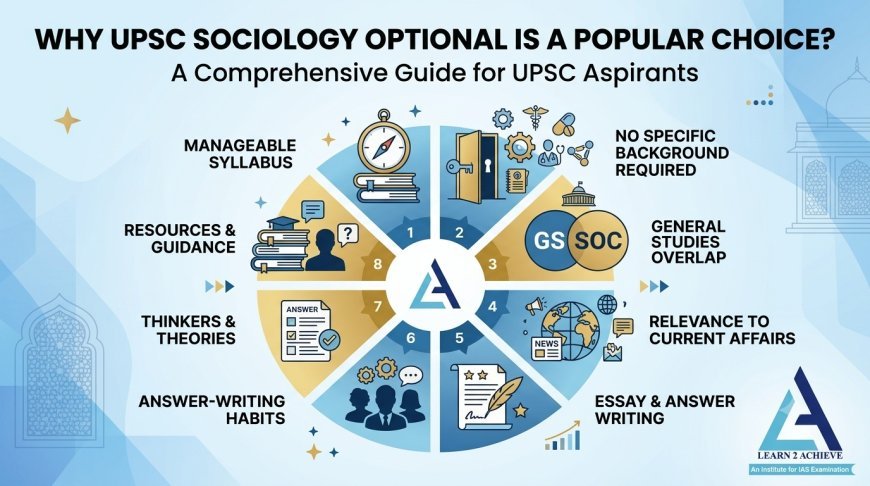
A Relatively Manageable and Structured Syllabus
One of the primary reasons aspirants prefer Sociology is its comparatively compact and structured syllabus. Compared with some optional subjects that demand extensive factual learning or specialised technical knowledge, Sociology offers a systematic framework for understanding society, social institutions, and human behaviour.
The syllabus covers fundamental sociological concepts, thinkers, research methods, social stratification, and Indian society. These topics provide a clear direction for preparation and help students organise their study schedules effectively.
Although the subject requires consistent revision and analytical understanding, its well-defined structure makes it easier for aspirants to identify important areas and develop a focused preparation strategy.
No Specific Academic Background Required
Another important advantage is that Sociology does not require a particular educational background. Graduates from engineering, medicine, commerce, humanities, science, and other disciplines can begin learning the subject from the basics.
The introductory concepts are generally accessible to beginners, provided they approach the syllabus systematically. Students gradually become familiar with sociological terminology, theories, and the perspectives of influential thinkers.
For candidates exploring UPSC Sociology optional, this accessibility can reduce the initial difficulty of entering an unfamiliar subject. Instead of relying entirely on previous academic knowledge, aspirants can build their understanding through standard books, classroom instruction, notes, and regular answer-writing practice.
Strong Overlap with General Studies
Sociology is particularly attractive because several of its themes overlap with the General Studies papers of the Civil Services Examination.
Topics such as poverty, urbanisation, women’s empowerment, population, communalism, secularism, social justice, globalisation, and social inequality are relevant to different parts of the UPSC syllabus.
This overlap allows aspirants to connect concepts learned for their optional subject with broader questions about Indian society and governance. Sociological perspectives can also help candidates understand the underlying causes of social problems rather than merely memorising facts.
However, this advantage should not be mistaken for complete syllabus duplication. Candidates must still prepare General Studies independently and understand the specific demands of each paper.
Relevance to Current Affairs
Sociology examines how societies change over time and how social institutions influence people's lives. Consequently, many contemporary developments can be analysed using sociological concepts.
Issues such as digital inequality, changing family structures, migration, unemployment, caste discrimination, gender relations, and the impact of technology on society offer opportunities to connect theoretical knowledge with real-world examples.
Aspirants preparing UPSC Sociology optional can strengthen their answers by combining relevant concepts with current examples, credible data, and balanced analysis. This approach demonstrates conceptual understanding and helps make answers more meaningful.
Regular newspaper reading and selective reference to government reports can further improve an aspirant's ability to apply sociological ideas to contemporary Indian society.
Useful for Essay Writing and General Studies Answers
Essay writing is an essential component of the Civil Services Examination, and Sociology can provide valuable perspectives for developing well-rounded arguments.
Concepts related to social change, equality, education, development, family, and institutions can help candidates examine essay topics from multiple angles. Sociological insights can also improve answers in General Studies papers that address governance, society, and social justice.
For example, a question about women's empowerment can be approached through education, economic participation, social norms, institutional barriers, and policy interventions. This multidimensional approach can make an answer more analytical and balanced.
Nevertheless, aspirants should avoid inserting sociological terminology unnecessarily. Every concept must directly support the question being answered.
Interesting Theories and Influential Thinkers
Sociology introduces students to influential thinkers such as Auguste Comte, Karl Marx, Émile Durkheim, Max Weber, and several Indian sociologists.
Their ideas explain different aspects of social organisation, inequality, authority, religion, social change, and modernisation. Understanding these perspectives enables aspirants to develop stronger arguments rather than relying solely on descriptive information.
Although learning thinkers and theories requires effort, their ideas become easier to retain when students understand their central arguments and practise applying them to relevant topics.
Successful preparation involves more than memorising names and definitions. Candidates should learn how to use theories accurately, compare different perspectives, and present relevant examples in examination answers.
Scope for Improving Answer-Writing Skills
Sociology rewards clarity, logical organisation, conceptual accuracy, and the appropriate use of examples. These requirements encourage aspirants to develop disciplined answer-writing habits.
A well-structured answer generally begins with a relevant introduction, explains the central argument, incorporates suitable sociological concepts, and concludes with a balanced observation. Diagrams, simple flowcharts, and relevant examples may also improve presentation when used appropriately.
Candidates choosing UPSC Sociology optional should practise writing answers within the prescribed time limits. Regular evaluation can help identify weaknesses in conceptual understanding, structure, relevance, and presentation.
Consistent practice is especially important because knowing a concept and explaining it effectively under examination conditions are two different skills.
Effective Preparation Resources and Guidance
Aspirants can prepare Sociology through standard reference books, syllabus-based notes, previous years' question papers, mock tests, and answer-writing exercises. The key is to use resources selectively instead of collecting excessive study material.
Previous years' questions help candidates understand recurring themes, the depth of analysis expected, and the importance of connecting theories with practical examples.
Mentorship and structured guidance can also support preparation by providing direction, regular feedback, and opportunities to clarify difficult concepts. However, coaching alone cannot guarantee success. Individual effort, revision, consistency, and independent analytical thinking remain essential.
Before selecting the subject, candidates should review the complete syllabus, examine previous years' papers, and assess their genuine interest in understanding social issues.
Conclusion
Sociology has become a preferred optional subject among many Civil Services aspirants because it combines conceptual accessibility with practical relevance. Its structured syllabus, connections with General Studies, usefulness in essay writing, and ability to explain contemporary social issues make it an attractive option for candidates from diverse academic backgrounds.
However, choosing an optional subject should depend on personal interest, learning preferences, syllabus familiarity, and the willingness to practise answer writing consistently. Aspirants seeking structured preparation, conceptual clarity, and expert academic support can explore the learning resources and guidance offered by L2A IAS to develop a focused study strategy, strengthen their understanding of Sociology, and prepare more confidently for the UPSC Civil Services Examination.
What's Your Reaction?
 Like
0
Like
0
 Dislike
0
Dislike
0
 Love
0
Love
0
 Funny
0
Funny
0
 Angry
0
Angry
0
 Sad
0
Sad
0
 Wow
0
Wow
0