






















Structural Simulation Services: A Guide to Performance Analysis
Understand how Structural Simulation Services help engineers analyse loads, detect weaknesses, optimise components, and improve product reliability before production.

Designing a reliable structure requires more than choosing strong materials and creating a suitable shape. Engineers must understand how a component responds to forces, how much it may deform, and whether repeated use could affect its long-term performance. Problems discovered after manufacturing can cause expensive redesigns, delays, and safety concerns. Structural Simulation Services help engineers evaluate these risks by predicting structural behaviour through computer-based analysis before a design reaches production.
These services allow engineering teams to investigate different loading conditions using digital models rather than relying exclusively on physical prototypes. The analysis can reveal areas of high stress, excessive movement, possible instability, or vibration concerns. Engineers can then compare design alternatives and make changes based on calculated evidence. When the model reflects real operating conditions and the results are appropriately verified, structural simulation becomes a valuable tool for improving design quality and controlling development risks.
What Do Structural Simulation Services Involve?
Structural simulation uses numerical methods to estimate how a physical structure responds to applied forces and other operating conditions. It can be used to analyse a single component, a connected assembly, or a larger structural system.
One common approach is the finite element method (FEM). Engineers divide a digital model into smaller elements connected at nodes. Simulation software solves equations describing the response of these elements and combines the results to estimate the behaviour of the complete structure.
The analysis may focus on strength, stiffness, stability, vibration, or fatigue. For example, a manufacturer may need to determine whether a machine base can carry its equipment without excessive deflection. A vehicle component designer may instead need to investigate how repeated loading affects durability.
The purpose of Structural Simulation Services is to answer specific engineering questions and provide information that supports practical design decisions.
Major Types of Structural Analysis
Static Structural Analysis
Static analysis evaluates structural behaviour under loads that remain constant or change slowly enough for dynamic effects to be ignored. It is commonly used for brackets, support frames, equipment platforms, and mounting assemblies.
Engineers examine stress, displacement, strain, and reaction forces to determine whether the design meets its requirements.
For instance, a support bracket may carry the required weight but bend enough to disturb the alignment of connected equipment. Static analysis helps engineers assess whether the bracket needs a thicker section, a stronger material, or a revised shape.
Nonlinear Structural Analysis
Linear analysis relies on assumptions that may not apply when a structure experiences large deformation, material yielding, or changing contact conditions.
Nonlinear analysis accounts for these effects when they are important to the engineering problem. It can help assess components exposed to heavy loads, flexible materials, or complex interactions between contacting surfaces.
This method often requires more detailed material information and careful numerical setup. Engineers must also check whether the calculated response is sensitive to the assumptions used.
Dynamic and Modal Analysis
Some structures experience forces that change rapidly or repeatedly. Examples include machinery operating at varying speeds, vehicle components exposed to road impacts, and industrial systems subjected to vibration.
Modal analysis identifies natural frequencies and mode shapes. These results help engineers investigate whether operating forces may cause resonance, which can increase vibration and structural response.
Dynamic analysis evaluates the effect of time-varying loads. It is useful when a structure's response depends on how quickly a force is applied or how it changes during an event.
Fatigue and Buckling Assessment
Fatigue analysis examines the potential effects of repeated loading. Even when each load cycle remains below the material's static strength limit, repeated stress can gradually initiate and grow cracks.
Buckling analysis focuses on structural instability under compression. Thin panels, slender columns, and lightweight supports may lose stability before the material reaches its usual yield strength.
These analyses help engineers determine whether geometry, reinforcement, material selection, or operating limits need to be reconsidered.
The Structural Simulation Workflow
1. Establish the Engineering Requirements
The project begins with a clear definition of the problem. Engineers identify the intended function, expected loads, installation conditions, material requirements, and applicable design criteria.
The objective might be to limit deflection, confirm load capacity, reduce component weight, or investigate an unexpected failure. A well-defined goal helps determine which analysis method and results are necessary.
2. Prepare the Digital Geometry
A computer-aided design (CAD) model provides the geometry for simulation. Engineers may simplify small features that do not significantly influence structural behaviour, reducing computational demands.
However, features that affect load transfer must be represented appropriately. These can include holes, joints, fasteners, welds, and changes in cross-section.
3. Define Materials, Loads, and Supports
Material properties depend on the type of analysis. Common inputs include elastic modulus, Poisson's ratio, density, yield strength, and fatigue data.
Engineers apply relevant forces, pressure, gravity, acceleration, or other loads. Supports and connections must represent the actual installation closely enough to produce meaningful predictions. Incorrect boundary conditions can make the results unreliable even when the model geometry is accurate.
4. Create the Mesh and Run the Simulation
The digital model is divided into finite elements to create a mesh. Element type and size depend on the geometry, loading conditions, and expected stress variations.
Areas around holes, corners, and connections may require a finer mesh. Engineers can perform mesh-convergence studies to check whether important results change significantly as the mesh is refined.
The solver then calculates the predicted structural response for the specified conditions.
5. Interpret and Verify the Findings
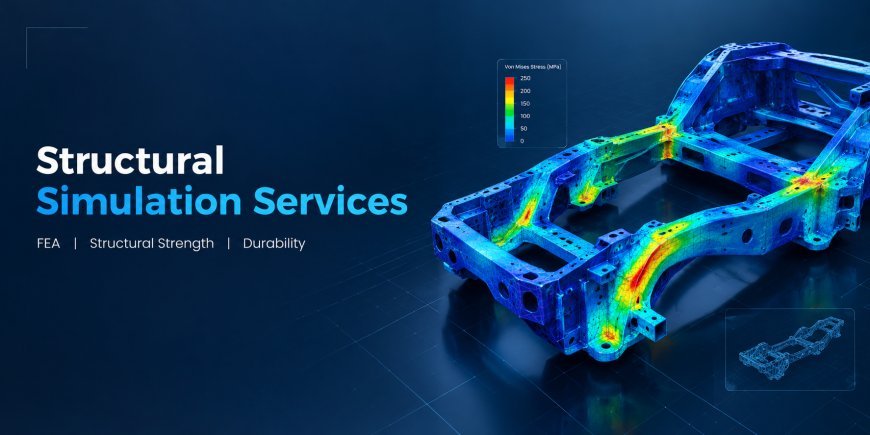
Simulation outputs may include stress contours, displacement plots, reaction forces, natural frequencies, and fatigue estimates. Engineers compare these results with design limits and investigate unexpected patterns.
Verification can involve hand calculations, established analytical solutions, numerical checks, and mesh-convergence studies. Physical testing may also be needed to confirm the model's predictions.
A useful engineering report explains the results, assumptions, limitations, and recommended design changes in clear language.
Practical Benefits of Structural Simulation Services
When used appropriately, structural simulation can improve the way engineering teams develop and evaluate designs.
-
Early problem detection: Potentially weak connections, excessive movement, and stability concerns can be identified before production.
-
Efficient design comparison: Engineers can assess alternative shapes, thicknesses, materials, and support arrangements digitally.
-
Better material efficiency: Analysis can help reduce unnecessary weight while maintaining the required structural performance.
-
Improved durability planning: Fatigue and vibration studies can reveal conditions that may shorten component life.
-
Fewer avoidable revisions: Identifying design problems earlier can reduce disruption during manufacturing and installation.
-
Stronger technical decisions: Documented results provide evidence for design reviews and engineering discussions.
Consider a company developing a frame for industrial equipment. Simulation may reveal that a cross-member bends excessively under its expected operating load. Engineers can compare a deeper section, an additional brace, or a different connection arrangement before selecting an option for further testing. This allows development effort to focus on changes that address the actual engineering problem.
Common Challenges and Considerations
Input Data Quality
The quality of a simulation depends on reliable material properties, loading information, geometry, and support conditions. Incorrect assumptions can lead to inaccurate predictions. Engineers should document uncertain inputs and evaluate whether those uncertainties could affect the design decision.
Mesh Quality and Numerical Limitations
A coarse mesh may fail to capture important stress variations, while poor element shapes can reduce numerical accuracy. Increasing mesh density alone does not guarantee a reliable answer.
Sharp idealised corners and point loads may also produce mathematical stress singularities. These results require careful interpretation and may call for a more realistic representation of the geometry or loading.
Project Cost and Technical Expertise
Complex nonlinear, dynamic, and fatigue studies can require additional time, computing resources, and specialist knowledge. The analysis should match the physical problem rather than being made unnecessarily complicated.
Validation and Safety Requirements
Simulation is not an automatic guarantee that a design is safe. Engineers must consider relevant design standards, safety factors, actual service conditions, and supporting test evidence. Safety-critical applications may require independent review and formal verification.
Frequently Asked Questions
1. Which industries use Structural Simulation Services?
Common applications include manufacturing, automotive engineering, aerospace, construction, energy, industrial machinery, and product development. These services are useful wherever structural strength, stability, or durability must be assessed.
2. Can structural simulation replace physical testing?
Not in every situation. Simulation can reduce unnecessary prototype iterations, but physical tests may still be needed to validate predictions, confirm material behaviour, or meet regulatory requirements.
3. What information is needed to start a simulation project?
Useful information includes CAD files, material specifications, expected loads, support conditions, operating requirements, and applicable standards. Existing test data can also improve the analysis.
4. How long does a structural simulation take?
The timeframe depends on model complexity, analysis type, input quality, computing resources, and the number of revisions. A basic static assessment may take less time than an advanced nonlinear or fatigue study.
5. What should a professional simulation report include?
A useful report should explain the objective, model assumptions, material properties, loads, boundary conditions, mesh approach, results, validation checks, and recommendations. It should also identify limitations that could affect how the findings are used.
Conclusion
Structural Simulation Services help engineers understand how structures may behave under realistic operating conditions before manufacturing or installation. By evaluating strength, deformation, vibration, fatigue, and stability, teams can identify potential problems and compare design improvements using numerical evidence.
Successful analysis requires accurate inputs, suitable modelling methods, careful interpretation, and appropriate validation. When these elements are combined, structural simulation supports more efficient development, informed material choices, and dependable engineering designs.
What's Your Reaction?
 Like
0
 Dislike
0
 Love
0
 Funny
0
 Angry
0
 Sad
0
 Wow
0