

























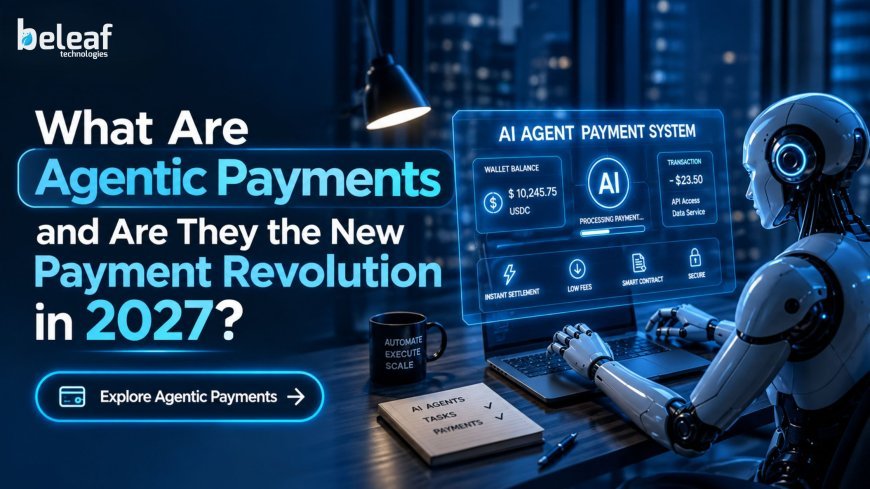
What Are Agentic Payments and Are They the New Payment Revolution in 2027?
As businesses explore AI-powered commerce, agentic payments could become an important development in 2027. Let's understand how this technology works and why it is attracting attention.

Digital payments have changed significantly over the years. People can now purchase products, pay bills, and transfer money using mobile applications, digital wallets, and online banking platforms. But what if payments could happen with less manual effort? What if an AI assistant could compare products, select the right option, and complete a purchase on your behalf?
Powered by artificial intelligence, agentic payments are introducing a new way to interact with digital payment systems. Instead of simply following fixed instructions, AI agents can understand user requirements, make decisions, and initiate transactions within authorised limits. As businesses explore AI-powered commerce, agentic payments could become an important development in 2027. Let's understand how this technology works and why it is attracting attention.
1. What Are Agentic Payments?
Agentic payments are payment transactions initiated or managed by AI agents on behalf of individuals or businesses. An AI agent is a software system that can understand instructions, analyse information, perform multiple tasks, and make decisions to achieve a specific goal. In a traditional payment process, a customer searches for a product, compares prices, selects a payment method, and completes the checkout manually.
With agentic payments, an AI agent can handle several of these activities. For example, a user might ask an AI agent to find a suitable hotel within a $200 budget and book it for a particular date. The agent can compare available options, check the requirements, and initiate the payment using an authorised payment method. The user does not need to manage every step individually.
2. How Do Agentic Payments Work?
Agentic payments combine AI technology, payment infrastructure, and security mechanisms to complete transactions.
Step 1: Understanding User Instructions
The AI agent receives a request, such as purchasing office supplies within an approved budget.
Step 2: Researching Available Options
It searches relevant platforms, compares prices, and identifies suitable products or services.
Step 3: Checking Payment Permissions
Before making a payment, the agent checks its authorised spending limits, payment credentials, and applicable approval requirements.
Step 4: Initiating the Transaction
Once the required conditions are satisfied, the agent initiates the payment through an approved payment system.
Step 5: Confirming the Purchase
The system receives transaction information and provides the user with a purchase confirmation or status update.
3. Seven Important Benefits of Agentic Payments
1. Faster Purchasing: AI agents can search and compare available options without requiring users to perform every action manually.
2. Personalised Decisions: Agents can consider user preferences, budgets, and previous instructions when identifying suitable purchases.
3. Reduced Manual Work: Repetitive purchasing and payment-related tasks can be handled through automated workflows.
4. Improved Business Efficiency: Companies can use agents to manage approved procurement activities and recurring purchases.
5. Continuous Operations: AI agents can perform authorised tasks outside normal business hours.
4. Real-World Applications of Agentic Payments
E-commerce: AI agents can compare products, identify suitable deals, and complete authorised purchases.
Travel and Hospitality: Agents can search for flights, hotels, and other travel services based on user preferences and budgets.
Business Procurement: Companies can use AI agents to reorder approved supplies, compare suppliers, and manage recurring purchases.
Subscription Management: Agents may monitor subscription requirements and handle authorised renewals or cancellations.
Digital Services: Software agents can pay for approved API requests, computing resources, and other online services.
5. Technologies Powering Agentic Payments
-
Artificial Intelligence: Helps agents understand instructions, analyse information, and make decisions.
-
Payment APIs: Allow applications to communicate with payment gateways and financial services.
-
Tokenization: Helps protect sensitive payment credentials by using secure payment tokens.
-
Authentication Systems: Verify users, agents, and authorised payment activities.
-
Payment Protocols: Define how agents communicate with merchants and payment infrastructure.
-
Transaction Monitoring: Helps identify unusual activity and enforce payment controls.
Emerging initiatives such as Google's Agent Payments Protocol (AP2), OpenAI and Stripe's Agentic Commerce Protocol (ACP), and payment-network programmes are helping develop the infrastructure needed for agent-driven commerce.
6. Security Challenges Businesses Must Consider
Although agentic payments offer new possibilities, allowing software to initiate financial transactions creates important security challenges. An AI agent may misunderstand instructions, select an unsuitable product, or make an incorrect decision. Without proper controls, these mistakes could result in unwanted payments.
-
Spending Limits: Set clear transaction and daily budget restrictions.
-
User Authorisation: Require approval for high-value or sensitive payments.
-
Agent Authentication: Verify that payment requests come from authorised agents.
-
Audit Records: Maintain records of instructions, approvals, and completed payments.
-
Permission Management: Allow users to modify or revoke an agent's payment authority.
7. Are Agentic Payments the Next Payment Revolution in 2027?
Agentic payments could become an important development in the future of digital commerce, but they are not expected to replace traditional payment methods overnight. Their growth will depend on consumer trust, merchant adoption, payment infrastructure, security standards, and regulatory clarity. In 2027, businesses may increasingly explore AI-powered purchasing assistants, automated procurement systems, and agent-to-agent transactions. The biggest change is the shift from people manually completing every payment step to AI agents managing selected purchasing activities under delegated authority. This could reshape how consumers and businesses interact with payment services over time.
Final Thoughts
Agentic payments represent an emerging connection between artificial intelligence and digital payment infrastructure. By allowing AI agents to research, make purchasing decisions, and initiate authorised transactions, this technology could make several payment processes more convenient and automated. However, its success will depend on secure authorisation, reliable technology, transparent operations, and user control. For businesses interested in entering this growing technology space,can be considered as a development partner to explore AI-powered payment platforms, API integrations, and customised software solutions.
What's Your Reaction?
 Like
0
 Dislike
0
 Love
0
 Funny
0
 Angry
0
 Sad
0
 Wow
0