
























How to Learn German Online in Hyderabad: A Complete Guide from A1 to B2
The next step is to identify the required German level, compare available batch schedules, and check the course syllabus and examination support before choosing an online programme.

Learning German can open up opportunities for higher education, international careers, and communication in professional environments. For learners balancing studies, work, and personal responsibilities, a German language course in Hyderabad delivered live online can provide a structured way to develop language skills without regular travel to a classroom. The learning journey usually begins at A1 and progresses through A2, B1, and B2, with each level building on the previous one. This guide explains how learners in Hyderabad can choose suitable online classes, understand the four proficiency levels, develop speaking skills, and prepare for Goethe-Zertifikat examinations through a practical, step-by-step approach.
Why Hyderabad Learners Are Choosing German
Hyderabad has a diverse professional and academic community, including IT professionals, biotechnology specialists, pharmaceutical industry employees, and students planning to study abroad. German can be useful for people exploring opportunities in Germany or working with international organisations that use German in their professional environments.
Learners working in HITEC City and Gachibowli may have demanding schedules, while professionals in the pharmaceutical and biotech sectors often need to balance work commitments with personal development. Students preparing for higher education in Germany may also need to demonstrate a specific level of German proficiency, depending on their chosen programme.
Online learning makes it possible to attend scheduled lessons from home or another convenient location. Instead of travelling to a physical classroom, learners can focus on structured lessons, regular speaking practice, grammar, vocabulary, and examination preparation.
Step 1: Decide Your Goal: Study, Job or Ausbildung
Before enrolling in a German language course, learners should identify why they want to study the language. A clear goal helps determine which proficiency level to target and what type of practice deserves the most attention.
For students planning to pursue higher education in Germany, the required German level depends on the institution, programme, and language of instruction. Some programmes use English, while German-taught programmes may require demonstrated German proficiency. Checking the institution's admission requirements is therefore an important first step.
Professionals seeking international career opportunities can focus on workplace vocabulary, professional conversations, emails, and interviews. Those considering Ausbildung, or vocational training in Germany, should investigate the language requirements of their chosen training programme and employer.
A beginner will usually start at A1, regardless of the long-term goal. From there, progress through A2, B1, and B2 can be planned according to individual learning needs and the requirements of the intended opportunity.
Step 2: Understand the Levels from A1 to B2
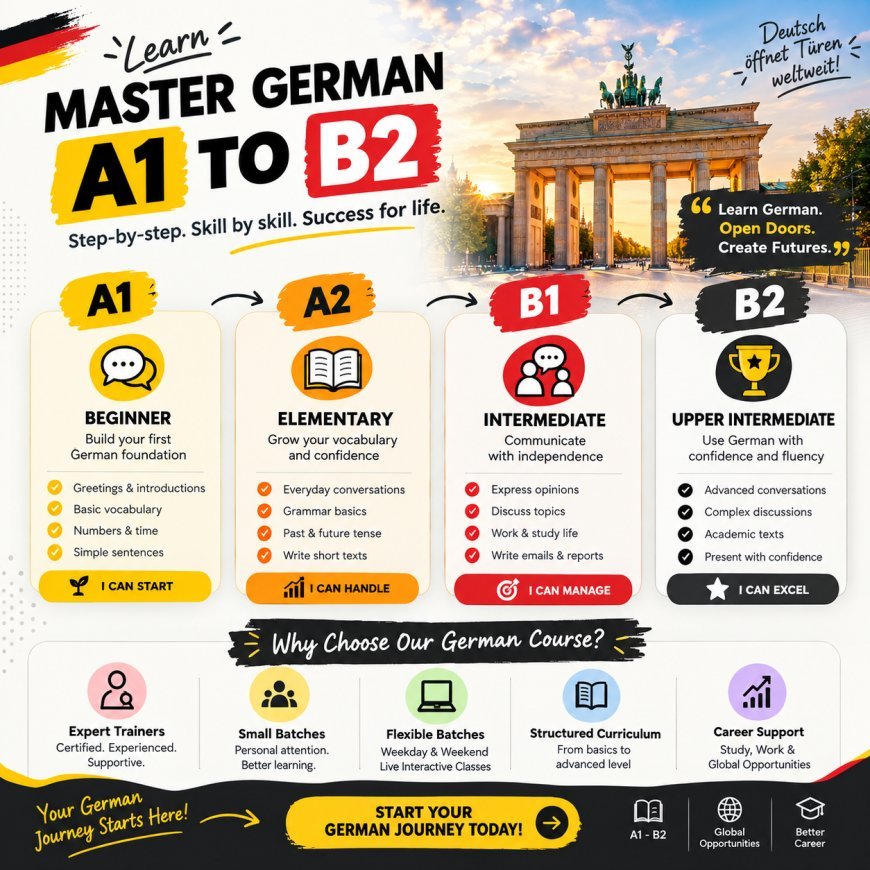
German proficiency is measured using the Common European Framework of Reference for Languages (CEFR). Its four commonly discussed levels, A1, A2, B1, and B2, represent increasing abilities in understanding, speaking, reading, and writing.
A structured German language course in Hyderabad can help learners progress through these levels systematically. The following durations are approximate and may vary according to attendance, practice time, previous language experience, and individual progress.
|
Level |
Duration |
What You Can Typically Do |
What to Focus On |
|
A1 |
About 2 months |
Introduce oneself, ask simple questions, and understand everyday expressions |
Basic vocabulary, pronunciation, sentence structure, and essential grammar |
|
A2 |
About 2 months |
Handle familiar conversations and discuss routine activities |
Conversational skills, grammar, listening, and everyday writing |
|
B1 |
About 3 months |
Communicate independently in many familiar education and workplace situations |
Longer conversations, reading comprehension, writing, and expressing opinions |
|
B2 |
About 3 months |
Communicate more confidently in academic and professional environments |
Complex texts, detailed discussions, structured writing, and advanced listening |
A1: Build a Strong Foundation
A1 introduces the essentials of German communication. Learners practise greetings, introductions, numbers, dates, common questions, and everyday vocabulary while developing an understanding of basic sentence structure.
The main objective is to communicate simple information clearly. Regular pronunciation practice and short speaking exercises help establish a foundation for the next level.
A2: Strengthen Everyday Communication
At A2, learners expand their vocabulary and develop a better understanding of grammar. They practise describing experiences, discussing daily routines, asking for information, and managing familiar situations.
Consistent revision is particularly useful at this stage because learners need to use previously learned structures more naturally in conversations.
B1: Develop Independent Communication
B1 prepares learners to communicate more independently in familiar situations related to education, work, travel, and daily life. They begin expressing opinions, explaining experiences, and understanding longer spoken and written texts.
Learners should devote more time to speaking spontaneously, writing connected paragraphs, and understanding conversations that extend beyond basic questions and answers.
B2: Prepare for Academic and Professional Contexts
B2 develops more advanced communication skills. Learners practise understanding detailed information, participating in discussions, presenting arguments, and writing organised responses on different topics.
For people considering German-taught academic programmes or professional environments where German is important, B2 may be a useful target. However, specific institutions and employers determine their own language requirements.
The complete journey from A1 to B2, including examination preparation, typically takes roughly 10 months under the outlined learning schedule.
Step 3: Choose a Batch That Fits Your Schedule
A consistent study routine is easier to maintain when classes fit around existing responsibilities. Live online lessons delivered through Zoom allow learners to interact with trainers, ask questions, practise conversations, and receive guidance during scheduled sessions.
Most structured programmes offer different batch formats to accommodate students and working professionals.
|
Batch Type |
Session Length |
Best Suited For |
|
Weekday |
About 1 hour per day |
Working professionals and students who prefer shorter, regular sessions |
|
Weekend |
About 90 to 120 minutes per session |
Learners with busy weekday schedules |
|
Fast-Track |
Intensive sessions, depending on the schedule |
Learners who can dedicate more time to frequent classes and revision |
Weekday batches can help learners establish a daily routine, while weekend sessions provide a longer learning period when weekdays are occupied. Fast-track batches require a greater time commitment and may suit learners who can practise consistently outside class.
Before choosing a schedule, learners should consider work hours, college commitments, revision time, and the availability of opportunities for speaking practice between sessions.
Step 4: Choose the Right German Language Institute in Hyderabad
Selecting a suitable German language institute in Hyderabad involves more than comparing schedules. The quality of instruction, opportunities for interaction, and availability of examination preparation can influence how effectively learners develop their skills.
When comparing German classes in Hyderabad, learners should look for a programme that combines structured lessons with active participation. Live online classes should provide opportunities to ask questions, practise speaking, and receive feedback instead of relying entirely on recorded lessons.
Before enrolling, it is useful to check the following:
-
Trainer qualifications: Check whether classes are delivered by Goethe-certified trainers with relevant teaching experience.
-
Live instruction: Confirm that lessons take place interactively through Zoom and include opportunities to ask questions.
-
Speaking practice: Look for regular pair activities, pronunciation exercises, and guided conversations.
-
Exam preparation: Check whether the course includes Goethe-Zertifikat mock tests, exam strategies, and practice for all relevant skills.
-
Study resources: Ask whether study materials, revision exercises, and doubt-clearing sessions are included.
-
Level progression: Confirm that the syllabus covers A1 through B2 with clear learning objectives for each stage.
These checks help learners assess whether a programme supports both practical communication and formal examination preparation. A suitable course should also explain the expected workload and encourage independent practice between sessions.
Step 5: Practice Speaking from the First Week
Speaking should begin at A1 rather than being postponed until learners have completed grammar lessons. Even simple sentences help beginners become comfortable with pronunciation, word order, and responding to questions.
During live classes, learners can practise introducing themselves, describing their daily routines, asking for directions, and discussing familiar subjects. As their proficiency improves, exercises can progress to longer conversations, role-plays, presentations, and workplace scenarios.
Listening practice is equally important. German audio exercises, classroom conversations, and repeated exposure to familiar expressions can help learners recognise common sentence patterns and understand spoken language more effectively.
A useful approach is to speak aloud for a few minutes every day, even when practising alone. Recording short responses and reviewing them can also help identify pronunciation difficulties and gaps in vocabulary.
Step 6: Prepare for the Goethe Exam
The Goethe-Zertifikat examinations assess German language proficiency at different CEFR levels. Learners preparing for certification should become familiar with the examination format relevant to their target level and practise the skills assessed in that examination.
A German course in Hyderabad that includes structured exam preparation can help learners understand the test format and organise their revision. Preparation should cover listening, reading, writing, and speaking wherever these components apply to the selected examination.
Hyderabad has an active Goethe exam centre, giving local learners an examination option without necessarily travelling to another city. However, learners should independently check current examination dates, registration procedures, available levels, and test-centre arrangements before making plans.
An effective preparation routine includes:
-
Reviewing the official format and task types for the target examination.
-
Completing timed practice exercises to improve time management.
-
Taking mock tests to identify areas that need additional work.
-
Practising speaking tasks and receiving feedback on clarity and accuracy.
-
Revising common grammar patterns, vocabulary, and writing structures.
-
Reviewing mistakes after every practice test and adjusting the study plan.
Mock tests are most useful when learners analyse their errors rather than simply checking their scores. Trainers can help identify recurring difficulties and suggest focused revision before the examination.
Daily Habits That Help You Progress
Class attendance provides structure, but independent practice reinforces what learners study during lessons. A manageable daily routine can help learners retain vocabulary, improve comprehension, and become more comfortable using German.
The following habits can support steady progress:
-
Revise vocabulary: Review a small set of words and use them in original sentences.
-
Practise listening: Spend time listening to German suitable for the current proficiency level.
-
Write regularly: Create short paragraphs, messages, or diary entries using recently learned grammar.
-
Speak aloud: Practise introductions, everyday questions, and short answers without reading every sentence.
-
Review mistakes: Maintain a notebook of grammar errors, unfamiliar expressions, and pronunciation difficulties.
-
Complete homework: Finish assigned exercises before the next live session and raise doubts during class.
The amount of time needed for these activities depends on the learner's schedule. Consistency and active participation are generally more useful than occasional long study sessions followed by extended breaks.
Why Online Learning Works Well in Hyderabad
Online learning can be practical for people who want to develop German skills without changing their work or college routines. German language classes Hyderabad learners attend through live online sessions provide a way to study from home while interacting with trainers and classmates.
A well-organised German language course Hyderabad learners choose should combine live teaching with independent practice, revision resources, and opportunities to clarify difficult concepts.
Key benefits of online learning include:
-
Less commuting: Learners can avoid regular travel to a physical classroom.
-
Flexible batch options: Weekday, weekend, and intensive schedules can accommodate different routines.
-
Learning from home: Classes can be attended from a suitable, quiet location with a reliable internet connection.
-
Live interaction: Learners can ask questions, practise speaking, and receive feedback during lessons.
-
Structured resources: Study materials and revision exercises can support learning between sessions.
-
Better routine management: Online classes can make it easier to combine language study with professional or academic responsibilities.
These advantages do not remove the need for discipline. Learners still need to attend regularly, complete exercises, participate actively, and set aside time for revision.
Learners in Other Cities: Bangalore and Mumbai
The same online learning approach can support learners living outside Hyderabad. A German language course in Bangalore can follow the same progression from A1 to B2, with live lessons, speaking practice, revision, and preparation for the relevant Goethe-Zertifikat examination.
Similarly, a German Language Course In Mumbai can provide a structured pathway for students and working professionals who prefer remote learning. Learners in either city can use online classes to study without travelling regularly to a training centre.
A German language course should be selected according to the learner's target level, schedule, teaching requirements, and examination goals rather than location alone. The CEFR framework remains the same across cities, although course schedules and local examination arrangements may differ.
Conclusion
Learning German online is a structured process that begins with basic communication at A1, strengthens everyday conversation at A2, develops independent communication at B1, and builds advanced academic and professional skills at B2. For most learners, the complete journey, including exam preparation, takes roughly 10 months, although individual progress varies.
A suitable German language course in Hyderabad should offer live online instruction, qualified trainers, regular speaking practice, clear level progression, and preparation for the relevant Goethe-Zertifikat examination. Combined with consistent revision and a realistic study schedule, these elements can help learners work towards their language goals.
What's Your Reaction?
 Like
0
 Dislike
0
 Love
0
 Funny
0
 Angry
0
 Sad
0
 Wow
0