


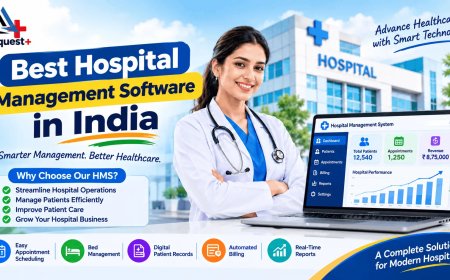























Best Hospital Management Software in India (2026): 10 Options Compared by Size, ABDM Status and Cost
A practical look at how Indian hospitals can compare hospital management software by bed size, ABDM M1–M3 status, NABH certification and real cost, without trusting vendor badges.


Picture a hospital front desk at 10:40 on a Monday. Eleven people are in the queue, the pharmacy phone is ringing, and a billing clerk is retyping a lab result into a discharge summary because two systems don't talk to each other. That is usually the moment someone says, "We need hospital software." It is also the moment many hospitals pick the wrong one.
What is the best hospital management software in India?
There is no single winner. The right system is certified for ABDM milestones M1 to M3, holds NABH Digital Health Standards certification, covers OPD, IPD, pharmacy, lab and billing without re-typing, and costs what you can sustain over five years. For most 20 to 150 bed hospitals, start your shortlist with NABH-listed products. You can see the full comparison in our guide to the best hospital management software in India.
Match the software to your size
- Solo doctor or small clinic: A full hospital system is overkill. Clinic or EMR software is enough.
- 10 to 50 beds: A cloud HIS with OPD, IPD, pharmacy and billing.
- 50 to 150 beds: The same, plus a hard look at lab depth and TPA billing, and a reference hospital of your size.
- 150+ beds or multiple branches: Systems built for scale. Visit a hospital already running the same modules.
Why ABDM status needs a real test
M1 covers ABHA creation and verification. M2 links health records to the facility as care contexts. M3 shares records with patient consent. "ABDM-enabled" and "ABDM-compliant" are not the same thing, so don't accept a badge on faith. In every demo, ask the vendor to:
- Create an ABHA for a test patient at registration.
- Link a completed visit to that ABHA.
- Share the record with consent from a patient-side app.
- Show the production key, not a sandbox screenshot.
If a vendor can't do all four, treat the claim as unproven.
What does it cost?
There is no neutral price survey, so treat every figure as a ballpark. Small clinic SaaS is reported anywhere from ₹10,000 to ₹3,00,000 a year. A 50-bed hospital is reported at ₹5–8 lakh in year one on SaaS versus ₹20–35 lakh on-premise. Custom builds start around ₹8 lakh. The quote is rarely the final bill. Implementation, data migration, training and lab-machine interfaces can add 25 to 40 percent. The cost guide to EMR software in India covers the clinic side in more detail.
A simple way to choose
Score each shortlisted product out of 100: workflow fit (20), India compliance (20), five-year cost with extras (15), usability (15), integrations (10), implementation and support (10), and security and data ownership (10). Then run five timed scenarios on your own data: OPD registration to bill, admission with an advance deposit, a pharmacy issue from a near-expiry batch, a lab order to printed report, and discharge with a TPA pre-authorisation. Let your own staff drive the keyboard. If your billing clerk needs the vendor beside her, you have your answer.
Mistakes to avoid
- Buying on price alone.
- Switching on every department on the same day.
- Skipping staff training.
- Believing an ABDM demo that only works in a sandbox.
If you are not sure whether you need a full HMS or just an EMR, read EMR vs EHR first. An EMR holds the clinical record, and a hospital system wraps registration, billing, pharmacy, lab and beds around it.
Read the full comparison
The complete guide covers ten products, what could and could not be verified for each, a cost table, an FAQ and a buyer's scorecard: Best Hospital Management Software in India (2026): 10 Options Compared by Size, ABDM Status and Cost.
What's Your Reaction?
 Like
0
 Dislike
0
 Love
0
 Funny
0
 Angry
0
 Sad
0
 Wow
0